
The indie publisher Inpatient Press is pursuing provocative, form-defying work. This small press has been releasing compelling novels, collections, zines, and games since 2013. Mitch Anzuoni, Inpatient’s founder, studied computer science and creative writing in college—an apt pairing—and he aims to publish what others tend to overlook.
Anzuoni told MIT Press, which distributes Inpatient’s books, that “the most important, and perhaps defining, characteristic of my publishing is the treatment of the book as a substantial object on its own, not some ready-made crucible for text and image to be poured into.” This deep inquiry has driven cool experiments in form and distribution, such as a series of zines sold through newspaper vending machines. These newsbox editions (available as a set) included items like Armageddon News, a collection of leaflets and zines created by the FBI to target student activists, alongside their internal communications about this muckraking operation. A curiosity about the conditions of publication, and its strange slips and exceptions, threads through everything Inpatient produces.
(This isn’t to say they’re not doing “regular” books too—Inpatient has published work by Samuel R. Delaney and Copi, as well as archival projects like a complete reprint of the legendary SF punk zine Search & Destroy.)
Inpatient has also released games that skew more toward a literary readership than toward traditional gaming enthusiasts. Their inaugural and most straightforward title was “Small Press Tycoon,” marketed as “the original DIY publishing adventure sim.” The game places you in charge of a tiny publishing house chasing metrics like “hipness” and “quality” as you “print chapbooks and zines, host readings, discover new and exciting authors, sign distribution deals, and even win industry awards!” It’s a playful blend of humor, critique, and surrealism wrapped in meta-commentary.
This was followed by Mezzanine, where players assume the role of an HR administrator at the faux Y2K-era multimedia startup Zentropy. The visuals consciously echo late‑1990s graphics: Zentropy’s offices are polished and glossy, edging toward a chrome‑driven uncanny valley. As you roam the quiet, late-night tech offices, hidden secrets begin to surface, but the work’s most intriguing facet lies in its prescient satire of where technology might be headed. Or as Mezzanine’s description notes, “the lost potential of multimedia and how our current societal psychosis may have always been by design.”
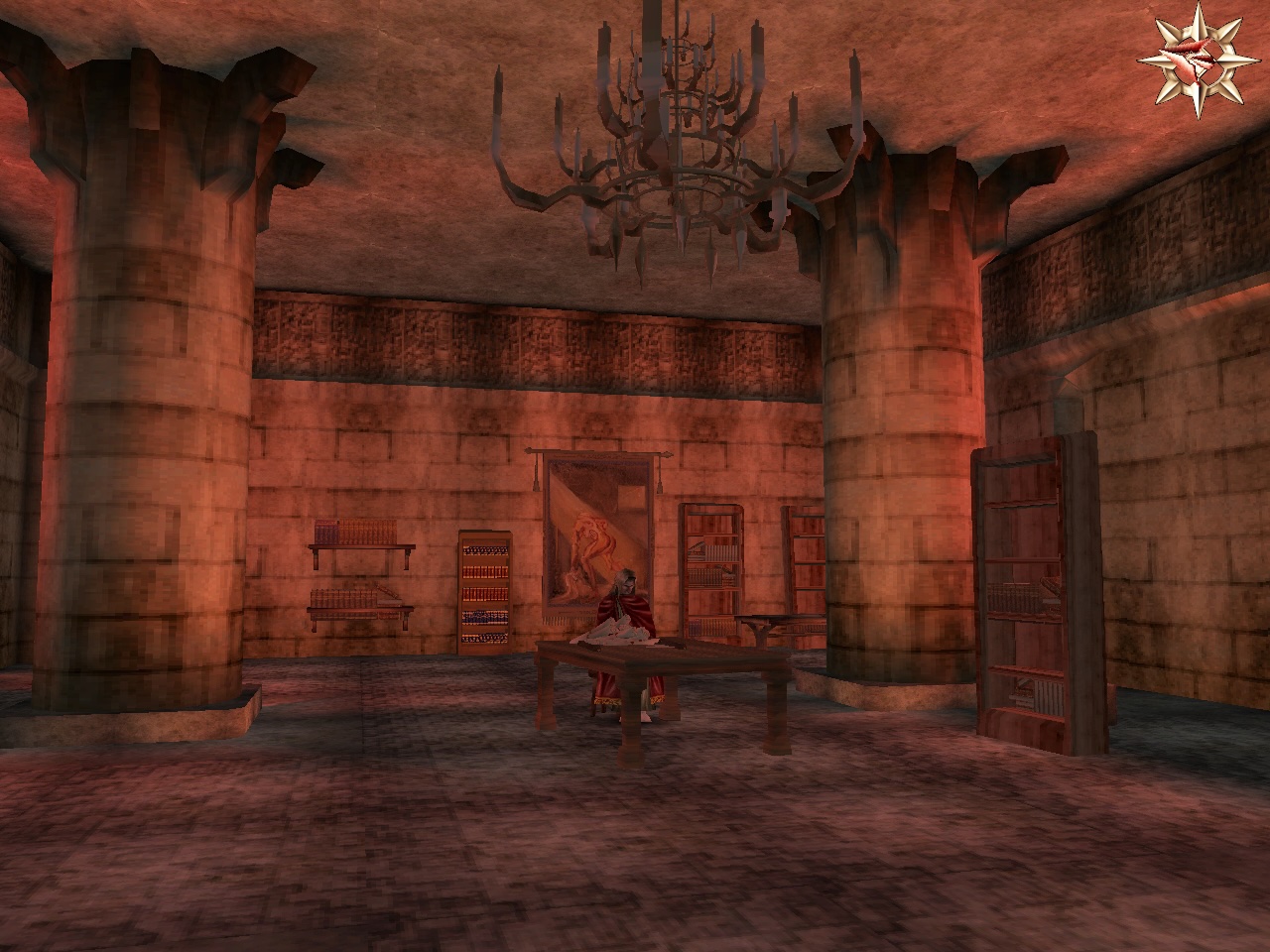
Inpatient’s latest game, Ex Libris, released in April, stands out as perhaps the most literary of the catalog. Ex Libris drops you at the threshold of the Abbey of Theleme, a dark, submerged monastery set in a mythic medieval era. As you wander past the low‑resolution ivy and stone illuminated by the orange glow of firelight, you encounter straggling travelers and locals in the courtyards and chambers: a drunken bookseller, drill‑armed soldiers, a fortune teller, and a companion who refuses to speak. You also meet a profusion of books and scrolls, which you can gradually begin to decipher as you study the languages they’re written in and translations start to appear. The moody score, polygonal, hieroglyphic‑like characters, and text rendered in a blend of English, ancient tongues, and invented languages create a partially foggy, mystical atmosphere.
The act of exploring is itself rewarding, and that payoff begins to feel more literary than game‑like. As you raise your “logos” attribute and start to understand more of the writing and dialogue, the text starts to knit together into a coherent whole. The writing in the game is strong, rightly described as an amalgam drawn from Umberto Eco, François Rabelais, Clark Ashton Smith, Marguerite Porete, and countless other influences to fashion an interconnected hypercathedral. I’m not deeply enough into the work to declare the exact shape of that hypercathedral, but themes around authorship and memory emerge, echoed in the mechanic of uncovering hidden archives and unlocking translations.
I found the experience of exploring and reading to resemble a hypertext novel, akin to The Castle of Crossed Destinies or Pale Fire. As you traverse the Abbey, the initial disorientation eases and the disjointed fragments gradually assemble into a larger tapestry. Think of Ex Libris as if Borges or Cortázar wrote for a retro LucasArts point‑and‑click adventure.
The game’s prose isn’t presented as mere puzzles, nor as texture affixed to unrelated mechanics. The pleasure isn’t a race to finish or to conquer obstacles. Like a book, Ex Libris and Inpatient’s other titles don’t push you to beat them in a linear ascent; instead, you’re invited to read them through the lens of the author’s narrative, aesthetics, and critical decisions embedded in the object itself. Just as one wouldn’t claim to have “won” Helen DeWitt’s latest novel by conquering its trials, there isn’t a singular triumph at the end of an Inpatient game. The works unfold non‑linearly according to the reader’s engagement, and the opportunity to set the pace—figuratively, in the sense of choosing the frame rate of a book—remains one of reading’s distinctive appeals compared with other art forms.
And perhaps the critic known as Eyes of pheasant sold at market captured the spirit most succinctly in their Mezzanine appraisal, noting the unusual depth that comes from a reader who has a broad literary background and a keen sense for lacunae—gaps in what’s known or written.