
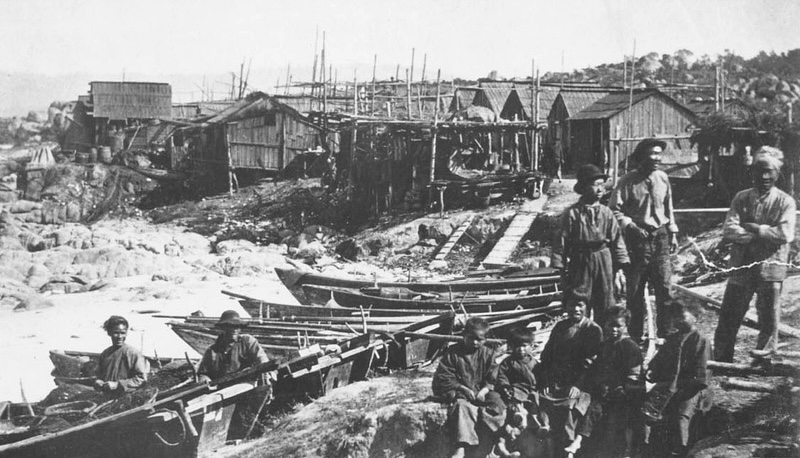
In the annals of Chinese life in America, the border keeps returning to focus, demanding our attention and never letting go. The tale historians tell—about attempts by Chinese migrants to breach that border and America’s efforts to bar them—has been repeated and reshaped countless times. Yet well before the first exclusion laws emerged, and long after, they endured a daily racial regime operating within the United States. This book documents that system of racial control and the individuals whose lives intersected with it.
Arriving along California’s coast in the 1850s, Chinese migrants found themselves entering a nation that lacked the maturity to accept them, even as it clung to an old pattern of white supremacy. White Californians disagreed on how to handle these “exotic” newcomers, but they were united in the belief that the Chinese did not belong. Defined by race, faith, and alleged subservience, the Chinese were imagined as outsiders who could not be folded into the nation as others might be…at least, that is what lawmakers hoped would occur.
In order to enforce this, anti-Chinese statutes spread across western states, territories, and towns. Legislation and informal legal practices governed whether Chinese people could work, run a business, own property, testify in court, pursue education, or start families. For the Chinese, these rules were not merely as written; there was an unspoken violence that could lie behind them, even as many statutes and procedures faltered under Chinese resistance…
Chinese resistance in the courts, and beyond them, guaranteed that racial laws would not dictate reality.
To bring to light the stories that had remained obscure, I traveled to thirty-three archives across California, Oregon, and Washington in search of local legal records…What I uncovered in these repositories was a striking and almost unused trove of Chinese legal documents, including criminal prosecutions, civil complaints, jail ledgers, prison records, and mugshots. Of particular significance is the existence of Chinese legal testimony, some dating to the nineteenth century when such migrant “voices” are especially uncommon. In many locales and periods where scholars have not found Chinese-language accounts, Chinese legal testimony affords a rare window into daily life in the American West. This is especially true for Chinese women and girls, who left behind almost no written records.
The picture painted by legal testimony, however, is not fully transparent. Most interactions with the law by Chinese people left no trace, and when they did, the imprint was often faint. Court transcripts that feature substantial Chinese testimony remain scarce, partly because biased testimony laws kept Chinese people silent in most proceedings for decades. Moreover, the Chinese testimony that survives was often mediated by outsiders, since Chinese witnesses typically testified with the help of English-speaking translators and the legal counsel of white attorneys. And, like all witnesses, the Chinese came to court to tell stories, not all of which were necessarily true…
Nevertheless, a great deal can be learned from these transcripts. Chinese migrants began to approach the courts almost immediately after arriving in the 1850s, negotiating their roles as complainants, plaintiffs, witnesses, and defendants while bringing with them knowledge of the Chinese legal system and gradually adjusting to American norms. Chinese resistance in court, and outside it, helped ensure that racial laws did not govern lived reality. Scholars have demonstrated that law and society shape one another, with legal rights seeping into social relations and vice versa. The terms of conditional inclusion were thus shaped not only by the rights afforded under the law but also by the rights the Chinese managed to assert through daily actions. This dynamic operated in two ways: at times the Chinese gained powers not granted by formal law, and at other times they were deprived of privileges that formal law would have granted. Legal custom could be more lenient than the law, or it could be harsher. Between the gaps of codified law and customary practice lie narratives of arbitrary state force and successful Chinese resistance. Most often, published court opinions and legal statutes gloss over this messy terrain, but trial transcripts reveal more of the bumps and crevices…
Countless stories emerge from these sources. Some are myths—fearful tales about cunning “Chinamen” and the dangers they supposedly posed. These narratives provided powerful motives and justification for racial policing, and I have organized my chapters around these stereotypes. There was the Chinese “coolie,” who allegedly outperformed white labor and sent profits home to China; the Chinese “criminal,” who deceived others and defied the police; the Chinese “alien,” who did not belong yet demanded civil rights; the “Chinawoman,” who represented a return to slavery; the Chinese “invader,” who polluted white neighborhoods; the Chinese “predator,” who preyed on white girls; and the Chinese “immigrant,” who threatened to overwhelm America. Across seven chapters I examine the regulations that sprang from these racial myths and reinforced them.
Each chapter presents these racial myths and the regulations they produced, but each also interweaves the stories of real people—Chinese migrants who faced, adapted to, or rejected the prerequisites for inclusion. Some of these stories may be familiar because they culminated in landmark court cases. Yet most Chinese who appeared in court left only a faint mark on American law, history, or memory. What endures is a glimpse into their experiences.
As I combed through extensive legal archives, the abundance of fragmentary stories tested my attention, my empathy, and my readiness to hold contradictions in my head. You may be tested as well. I have tried to hear every voice above the clamor, but the cacophony can become overwhelming. I think that is perfectly okay. Even when individual voices blur into noise, the collective sound can still move us.
*
Let us begin with Pany Lowe. Perhaps we can see through his eyes. Lowe was not among the “2700 boy babies of San Francisco Chinatown,” yet his experience resembled theirs in many respects. Born in Portland, Oregon, in 1873, Lowe went to China for his education, then returned to the United States, roaming among major western cities—San Francisco, then Denver, then Portland and Seattle. By the time he spoke with a researcher in 1924, he had accumulated a lifetime of insights into the regional racial regime.
He learned, for instance, that he could dine in some places and not in others. Once I went into a restaurant, they refused to serve me. I didn’t want to cause trouble, so I just walked out. Many such incidents happened, though I’ve forgotten most of them. Now, when I want to eat, I go to chop-house places. No trouble there. He recognized that some eateries avoided him, that chop-suey joints felt safer, and he chose to steer clear of potential humiliation.
Most Chinese who went to court left little mark on American law, history, or memory. Instead, all that remains is a glimpse of their experiences.
He also discovered that he could go to some barbershops and not others. Often people insult me. I recall sitting in a barber shop for an hour, not once asked what I wanted. Soon enough the barber asks what you want. I tell him I want a haircut, how much? He says $3.00. That makes me angry, but I have him cut my hair anyway… I will never go to a white bastard again. He understood that price gouging could function as discrimination, but he also realized that money could occasionally buy access.
Over time he learned that legal action could also open doors that seemed closed. My second wife took my little girl born in this country to have her hair cut at Frederick & Nelson. They said they were very sorry, no cut Chinese hair. Oh, my wife got mad. She went to see my lawyer, told him about it, Mr. Sullivan. He wrote a letter to Frederick & Nelson. They wrote back and apologized. Lowe felt the sting of denied service and recognized that discrimination could be illegal, yet he also learned that avoidance often spared him more trouble than confrontation. All the time I tell my wife to stay away from those fancy places; they only bring trouble. He learned to mind the racial boundaries and continue onward.
He learned that where he could reside was likewise regulated by race. When I was in Portland I wanted to live in a residential district, but there was a lot of trouble if you tried to live outside Chinatown. He heard about the trouble from friends. One friend, born in this country, bought a $6,000 house in the Rose City district. White people gave him hell and took him to court. He fought it. Still, they drove him out. He could own the house, but he could not live there.
Lowe understood that the Chinese were supposed to be guaranteed equal protection, but he saw that, in practice, the law protected white neighborhoods from intrusion. I think that is very unjust. Those people are very uncivilized, with no regard for humanity. So when my friend had so much trouble I decided to stay in Chinatown. Nobody cares there. He recognized that some spaces were effectively reserved for white residents and decided not to test the boundaries.
After the exclusion laws were enacted, Lowe also grasped the implications of border control. Our people have been here for a long time. My grandfather came here. When I was in China, he told me about railroad and laundry work. Before, when he left, they used to have a check system. Chinese people had to carry papers showing who they were. Some inspector today makes a Chinaman show a card. It’s the same as a dog license. I say, who are you? He shows me a United States Secret man. I tell him I was born in this country… He says all right, but he seizes other men, locking them up for a day or two. Lowe understood that exclusion made Chinese residents vulnerable and that losing a single document could mean deportation.
Ultimately, Lowe learned that American law had unusual sway over his marriage prospects. He could marry some women but not others. Not allowed to marry a white girl. Not enough American-born Chinese to pair off. The only place to find a wife is in China. Not allowed to bring them back. For a Chinese man, this is profoundly unjust. Not humane. Very uncivilized. He understood that anti-miscegenation and exclusion laws would forever shape his family, and that enduring such humiliations was part of dwelling in the American West.
With all this in view, Pany Lowe recognized that he would never truly belong. When I was a young man, I felt I was American. I wasn’t Chinese. Now I’m older and wiser. I know I’ll never be American, always Chinese. I don’t care as much anymore. He lived on the margins of American society and did not know whether a better future existed. Very hard to tell whether people are treated better now than before. Sometimes I think so, sometimes I don’t. He could not tell if progress had happened.
Still, he clung to the hope that white Americans might come to understand. I hope this survey does a lot of good for Chinese people. It might make Americans realize that Chinese people are human…
I think very few American people really know anything about Chinese.
_______________________________
From John Doe Chinaman: A Forgotten History of Chinese Life Under American Racial Law by Beth Lew-Williams. Copyright © 2026. Available from Harvard University Press. John Doe Chinaman has been shortlisted for the 2026 Cundill History Prize.