
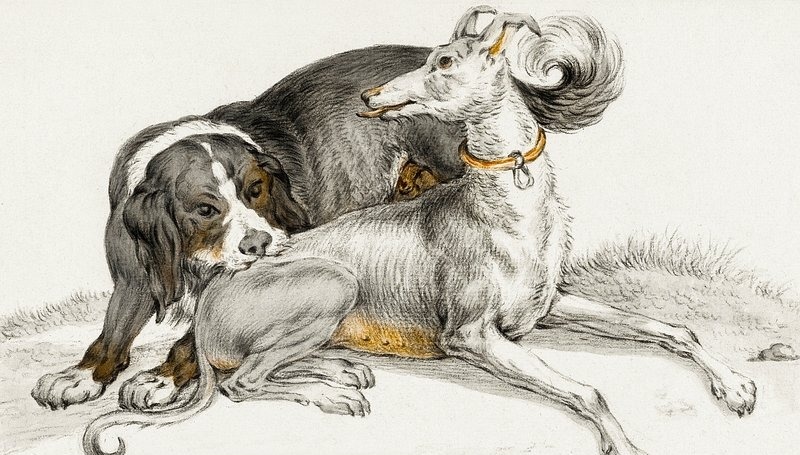
Sunday arrived, marking seven days since Freddie had joined my life. We had just completed a stroll through the park near my building, the second outing of the day for us. In the green space, elderly neighbors gathered at tables to play mahjong, while youngsters flooded the playgrounds. Forty-five minutes later, we returned home, and I sank onto the couch with my shoes still on. Freddie sprang up beside me, planting his two front paws on my shoulder, his tail thumping as he watched me. He yawned, releasing a warm, smoky breath into the room.
We’d spent the entire weekend in close proximity, rarely more than a few feet apart. I couldn’t fathom what he wanted from me. The sense of expectation hung in the air between us. I offered him one of his chewy treats, and he chewed on it for a few minutes. Then he reappeared, his damp nose resting against my cheek. It was only one o’clock in the afternoon, and I had exhausted the list of things I knew how to do with him: walk him, ensure he relieved himself, feed him, and let him engage in the one play activity he’d shown he could handle. How do dogs really fill their days?
Usually, by this moment on a Sunday, I would have opened my computer and allowed myself several hours of a joyless, not particularly useful task—perhaps rifling through emails and marking them as unread again. But Freddie’s presence changed that rhythm; he sniffed near my ear and fixed his gaze on me. I turned toward him, we made eye contact, and his tail began to wag. A growing unease took hold, because I was answerable, not just to myself, and I knew I needed to do something more meaningful.
I suddenly realized that I knew almost nothing about him — why he did the things he did, what sparked or dampened his responses to the world around him.
In Charles Darwin’s On the Origin of Species, published in 1859, there is a chapter devoted to what he called “instinct,” the natural side of animal behavior, treated as part of evolution with its principles of heredity, reproduction, and variability. Before Darwin, most biological observation relied on the Linnaean taxonomy, which arranged species according to a divine blueprint of creation. Behavior itself wasn’t a formal scientific topic, but Darwin’s ideas taught us to view life as a sequence of natural processes capable of change, prompting new questions about what animals do and why they do it.
In Europe at the start of the twentieth century, a field known as ethology emerged from the Darwinian notion of natural behavior. Early ethologists studied animals within their habitats, because that was where behavior evolved. They created ethograms—comprehensive inventories of typical actions, broken into categories like standing, foraging, digging, bathing, and so on. These units enabled measurements of how often and how long certain behaviors occurred. Ethologists rejected laboratory settings, preferring years of patient observation in the animal’s own environment; assembling these catalogs did not always culminate in formal hypotheses and experiments. For the pioneers of ethology, pure description and observation possessed intrinsic value.
When I later read the sometimes idiosyncratic, sometimes dated, and often strikingly forward-thinking writings of early European ethologists such as Konrad Lorenz and Niko Tinbergen, I recognized the inventory-making approach as a tool to demystify the world and to separate it from Creationism—an unlikely source for this kind of clarity: Penelope Fitzgerald’s The Gate of Angels, a novel set in 1912, contemporary with the dawning work of ethology.
The novel reads as a romance on the surface, but it is, at its heart, a meditation on metaphysics, belief, and the limits of both science and religion in explaining the events of life. Early in the book, Fred Fairly, a young Cambridge physicist with a research fellowship, prepares to tell his father, a clergyman, that he no longer adheres to Christianity. After years of scientific training, Fred intends to devote himself to the study of nature and matter. He has rejected the spiritual realm and the comforting presences of God. Going forward, his decision is to rely solely on the tangible world—the state of mind of someone who wants his understanding to be grounded in what can be tested through physical experience.
Religion and God, Fred contends, depend on mystery; what his father would prefer is the honest accounting of things, a kind of double-entry ledger for the world’s traits.
“You see the resemblances between things and the continuity of one idea from another, and gradually, through many lifetimes, everything becomes explained,” Fred argues.
The true meaning of a thing, he maintains, lies only in what we can observe and measure; our task is not to obscure it or assign it to another realm, but to offer a straightforward account. “What is completely described is completely explained.”
To be curious about something, to observe without a predetermined aim, appeared to me as the doorway to a profound form of understanding and a direct kind of love.
Darwin’s ideas, along with the broad set of inquiries that followed, including ethology, had to supplant the notion of an all-controlling God and the idea that things simply exist by fiat. The radical implication was that something like behavior—describable and observable—could be explained. Ethologists set themselves apart from earlier thinkers who treated animals as instruments of divine will, and from many later scholars who saw animal conduct as a bridge to human study. The early ethologists pursued description of animal behavior for its own sake. Accepting natural and physical processes as internal and logically coherent means that, through careful description, we can arrive at an explanation of the thing itself. Watching a creature for hours could yield genuine understanding.
Konrad Lorenz described behavior as a taxonomic character—an index of one’s place in the world. In a typical ethogram, a cat’s stalk and lunge might be labeled “hunting” when prey is present, but “play” when a juvenile performs the same action with a peer—the label reveals purpose and illuminates how the cat lives and relates to others. As a taxonomic character, the relationship between behavior and other life-systems becomes evident. A precise description can illuminate other, interconnected aspects of reality.
When a male three-spined stickleback, a small seawater fish studied by Niko Tinbergen, leads a female to his nest by swimming in a zigzag, courtship-dance fashion, she enters and spawns; the dance is categorized as “reproductive behavior,” giving us a framework to study and comprehend it. The setting, season, water temperature, and nest conditions all feed into the definition of behavior. Through the ethogram, behavior becomes part of a system governed by natural forces, imbuing it with meaning. It is through description that the essence of things is revealed.
That Sunday, Freddie and I sat together in the living room, and he watched me as I watched him in return. He began to emit a low, plaintive sound from his throat. Abruptly, he turned his head toward the window, and he tensed the muscles at the base of his ears to listen. After a few moments, he looked away and resumed the plaintive noise.
I did nothing, waiting—I wasn’t entirely sure what to do next. Yet I felt a new possibility taking shape as I clung to the notebook. Nothing he did was outside my interest, because my task was to discover what he was. To be curious about something, to observe without a goal or plan, struck me as the route to a deep kind of understanding and a direct form of love. If I watched and waited, open to whatever Freddie might reveal, something would begin to become clear.
_______________________________
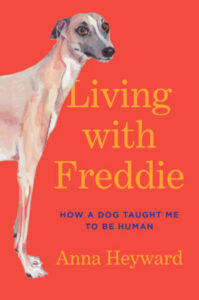
Excerpted from Living with Freddie: How a Dog Taught Me to Be Human by Anna Heyward. Copyright © 2026 by Anna Heyward. Available from Random House, a division of Penguin Random House, LLC. All rights reserved. No part of this excerpt may be reproduced or reprinted without permission in writing from the publisher.