
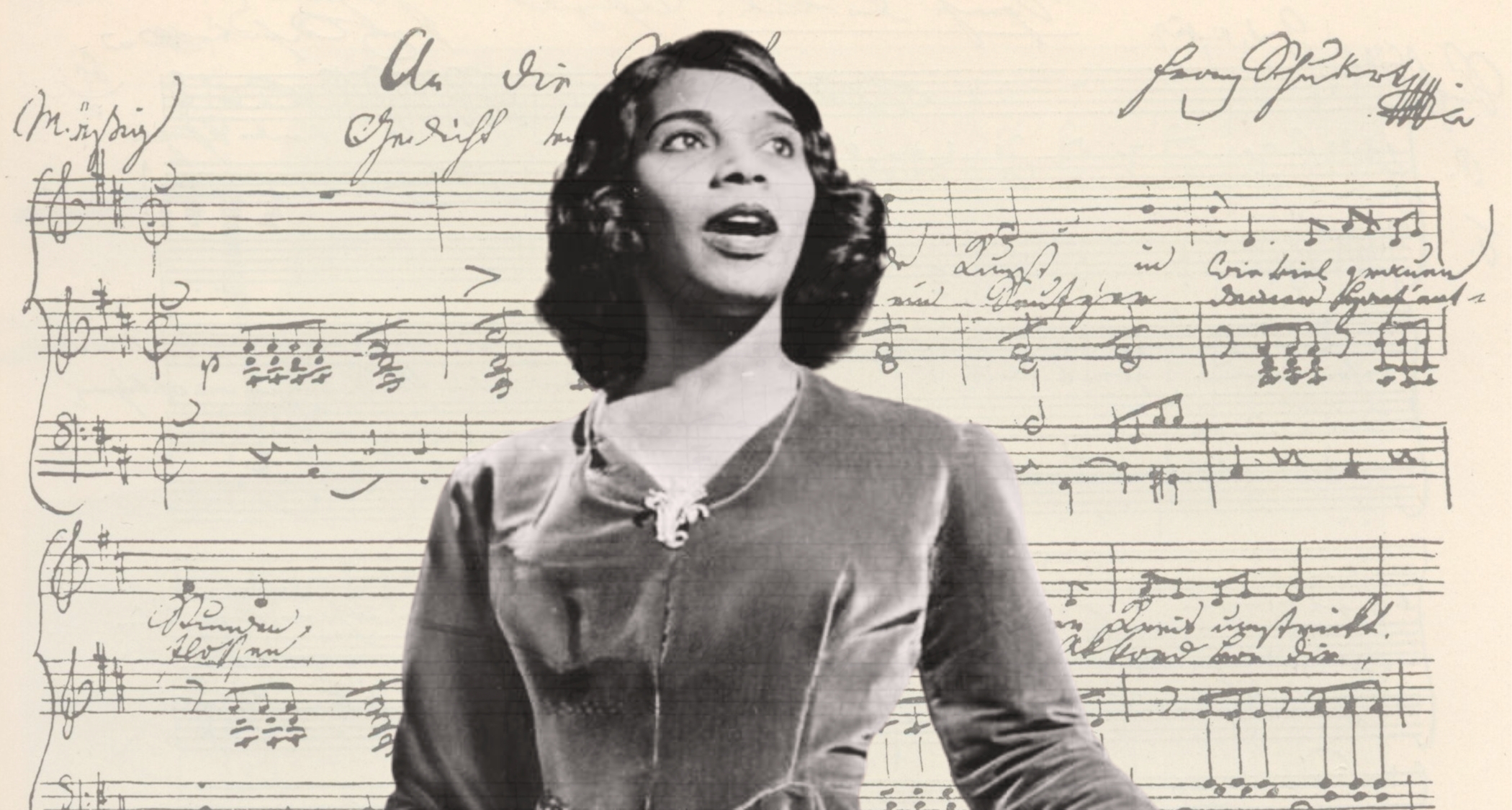
When you’re young, or even later, when a certain music draws you as powerfully as a current pulls you, explaining why it moves you—especially if it’s unfamiliar—can feel impossible, even to yourself. Music often operates beneath consciousness, shaping feelings without a word spoken. That is how Marian Anderson’s lifelong devotion to Schubert’s songs unfolded: a fascination that resisted neat justification, beginning with a flash of realization in adolescence when she heard Roland Hayes perform Schubert in a church recital; she didn’t understand the German texts, yet she was utterly entranced. About fifteen years later, her resolve to study Schubert’s lieder with expert teachers helped push her toward Europe.
During the height of her fame, Anderson was widely recognized as a superb interpreter of Schubert, with flawless German diction, yet she avoided delving into the music’s deeper explanations. When asked how she chose songs for a recital, she recalled turning first to Schubert—“the composer I love most,” she said, who composed “hundreds of songs,” each “more beautiful than the last.” But beyond that, she left the matter largely unexplored. She believed Schubert’s lieder rewarded both pianist and singer, though she didn’t elaborate extensively on why that was so.
Beyond her fascination with Schubert, Marian Anderson has always gravitated toward classical music in a broader sense, a trait that set her apart from family members with more limited exposure. I recognize a similar thread in my own upbringing. Growing up in a comfortable suburb of Long Island, I found classical music by discovering it on my own—first through piano lessons I pursued at eight, not at parental insistence, and then through an initial, almost immediate, sense of belonging I couldn’t quite explain. The pull was instant and potent.
Anderson affirmed a principle she demonstrated throughout her career: no songs by Schubert or Brahms reach the sublimity and profundity of Negro spirituals.
As a child, Anderson sang with her church choir, where the repertoire ranged from well-known hymns and spirituals to the occasional solidly classical choral piece. She recalled singing portions of Handel’s Messiah and even stepping into a solo moment from Rossini’s Stabat Mater, a piece she sometimes performed on stage. Her reaction to that music, like mine in youth, felt immediate and powerful.
There exists a centuries-long tradition that has cast classical music as a peak of refinement, universal and timeless, transcending borders of nationality, race, and creed. Later in life, when Anderson tried to articulate the music she had committed herself to, she could sometimes appear to have subscribed to that mystique—though she seldom spoke of the genre with great clarity or detail.
Her early European tours unveiled a different reality: audiences there seemed more musically educated and approached music with a seriousness that she felt Americans had at times set aside. In a 1945 interview she explained that if one is essentially serious, one would be moved by serious things; lighter songs, she said, could flatter and gently put listeners in a agreeable mood. Yet she observed a notable shift in American musical tastes over the previous two decades, noting how soldiers returning from war and war workers in factories often voted against lighter fare. In those contexts, songs by Brahms and Schubert did not feel out of place.
We should be cautious about reading too much into her use of terms like “lighter” or “higher.” She likely meant that some popular works, though appealing to a broad audience, might seem more accessible and less demanding at first glance. And she cherished Duke Ellington’s music and found companionship with Alberta Hunter during their shared time in London. She never presented herself as a snob about classical music, but she did speak in terms that could be misinterpreted. She suggested that some radio programs could offer higher-quality music and attract more listeners, but many organizers preferred to “lower” the music rather than elevate it.
In fairness, her use of words like “higher” or “up” may have simply reflected her belief that art songs and classical music carry a level of difficulty that might deter some listeners initially. Still, she believed that if programming were oriented toward ascent, the public would grow to love this music as well. She also asserted, with warmth, her deep affection for Negro spirituals: “they are the unburdenings of the sorrows of a whole people who, lacking earthly happiness, look to the future for their joys.” In other words, she again underscored a conviction that no Schubert or Brahms song outranks the spirituals in depth and resonance.
I doubt that Anderson perceived Schubert’s songs or other German lieder as superior in an absolute sense. More likely, the music spoke to her on a subliminal level—its underlying tension and emotional current pulled at her. Beneath a surface of cheerful lyricism in some Schubert songs, there is often a trace of anxiety or sadness that resonates with the contradictions and complexities found in Schubert’s own life and temperament.
Schubert, short and bespectacled, with a tendency toward sociability, lived among a circle of male friends who believed they had unearthed a rare genius. Yet he struggled professionally, wrestled with inner doubts, and died young at thirty-one. A youthful Marian Anderson may have sensed those tensions in the music, and rather than discouraging her, they prompted a hungry curiosity to learn more.
Anderson’s upbringing was steeped in musical ambiguity through Negro spirituals, their verses rich with implicit meanings, subtext, and double entendre. “Deep River, Lord, I want to cross over into campground,” she recorded in her first studio session, signaling a longing for a promised land where “all is peace.” Yet the harsh reality faced by Black people was never spelled out in those lines, nor was it ever meant to be a gospel feast.
“Sometimes I Feel Like a Motherless Child,” a spiritual Anderson performed throughout her career, carries ambiguity in its very structure: the rising two-note motif that begins the melody, with the syllable “some” landing on the downbeat and “times” stretched a touch. In her 1951 recording, she places emphasis on this crucial detail, singing “SOME-times.”
This inflection implies that there are moments when she does not feel like a motherless child. Though Anderson herself became a fatherless figure in life, she had a loving mother who cherished her. And any singer of this spiritual must convey what it feels like to be without a mother, without roots, unprotected, and exposed to vulnerability. The teenage Anderson likely felt such vulnerabilities when an application to a Philadelphia music school was denied, or many years later when the Daughters of the American Revolution refused her a spot on their Washington, D.C. stage—a Black artist who had already performed before presidents and monarchs in international capitals.
Looking back, the sense of ambiguity and pain that these works convey probably mirrored what drew me to Schubert’s songs as a teenager. I recall, perhaps in the summer before my final year of high school, purchasing a two-disc set of Schubert’s song cycle Die schöne Müllerin (The Beautiful Miller’s Apprentice) after my piano teacher urged it. I was a budding pianist aiming to study music in college, already familiar with much of the classical repertoire, yet utterly unacquainted with this pivotal Schubert work. And I hadn’t yet gone deeply into German lieder.
Was hearing Roland Hayes and, later, other artists—Schubert, Brahms, and Schumann performers—like a beckoning brook inviting me to trust my own instincts and pursue a less trodden path?
Indeed, many classical pieces I loved then were themselves rich with ambiguity, from Beethoven’s searching and occasionally playful Fourth Piano Concerto to Stravinsky’s austere, psalm-lit Symphony of Psalms. Yet that summer, listening to this Schubert cycle alone in our home’s finished basement, I was hooked beyond reason and couldn’t explain why. I had only a rudimentary grasp of German, learned in a high school class, but the album provided the German texts—poems by Wilhelm Müller—with English translations, giving me the gist of a story told in the first person by a restless youth, albeit some crucial details remained shrouded.
A journeyman miller wanders the countryside seeking work, hears a babbling brook that seems to guide him toward a mill amid a wooded glade, and secures a position there. He immediately falls for the miller’s daughter, though he fears her to be beyond him, a mere journeyman. He dreams that she might return his feelings, which drives him into ecstatic, then doubtful, states. Soon he realizes she is drawn to a dashing hunter in green—the very ribbon he’d given her. His delight morphs into despair, and in the cycle’s final song he asks the talking brook to grant him rest beneath its waters and to sing him a lullaby as he dies. Whether he actually dies remains deliberately unsettled in the text.
Although I found the miller’s tale wonderfully romantic, it was Schubert’s music—and the way it fused with Müller’s words—that drew me in from the very first note of the opening, “Das Wandern.” In that song, the miller proclaims that wandering is a pleasure, and he equates his own restlessness with the motion of the brook, drawing a parallel between wandering and life’s journey. The vocal line maintains a jaunty, generous character over a steady, pulsing piano accompaniment. The music feels full and robust, even exuberant at times, to the point of overtness. Yet one wonders what the miller is truly wandering from, or toward.
The second song in the cycle, aptly titled “Wohin?” (Where To?), carries the same sense of ambiguity. It is here that Anderson’s exquisite 1945 performance, with Franz Rupp at the piano, captures the delicate balance of movement and doubt. Die schöne Müllerin is written for a male speaker, so Anderson could not perform the entire cycle in that voice, yet two songs became staples of her repertoire, especially this one.
In “Wohin?,” the miller’s reaction to the brook’s call is described with the piano’s rippling right-hand figure that imitates water. The vocal line remains tender, yet resolute and inquisitive. Anderson uses a lighter, more luminous quality of her voice to convey the young man’s curiosity and confusion. Her singing blends warmth and vulnerability, while at moments it becomes mysteriously foreboding, with minor-key shifts and a vocal line that twists in tandem with the bass line. It is in these moments that she summons the deeper, richer contralto, though briefly, when the miller confesses his bewilderment to the brook and wonders if perhaps the waters themselves are whispering to him, or if darker forces are at play beneath the surface. The singer encourages the listener to let the waters sing, and he promises to follow with a lighthearted, cheerful step—though Anderson’s rendering suggests his cheer is hardly settled. The piano trails away as the vocal line lingers with a faint, questioning resonance on the word “nach.”
Even though the recording was made in Anderson’s later, mature period, it’s tempting to imagine that this song spoke directly to the adolescent musician she once was. Was hearing Roland Hayes and, in time, other inspiring performers sing Schubert, Brahms, and Schumann songs like the brook that invites one to follow an uncharted path?
The other Müller song that Anderson embraced from the cycle was “Ungeduld” (Impatience), the seventh in the sequence. Here our narrator experiences a sudden, almost feverish surge of passion, convinced he has found the love of his life and eager to proclaim it everywhere. The vocal line bursts with breathless, staccato phrases and the piano parts respond with a relentless triplet rhythm and lively chords. Each verse ends with a full-voiced declaration, “Dein ist mein Herz” (“Your heart is mine”), punctuated by triumphant high notes on the word “Dein.”
Yet the text itself reveals that the miller has not yet spoken these words to his beloved directly. Instead, he seeks to enlist intermediaries, such as a trained starling he hopes to teach to relay his sentiments to her window. Is his glow of love genuine, or does it teeter on delusion?
_______________________________

From Voice of a Century: The Life and Artistry of Marian Anderson by Anthony Tommasini. Published by Penguin Press, an imprint of Penguin Random House LLC. Copyright © 2026 by Anthony Tommasini.