
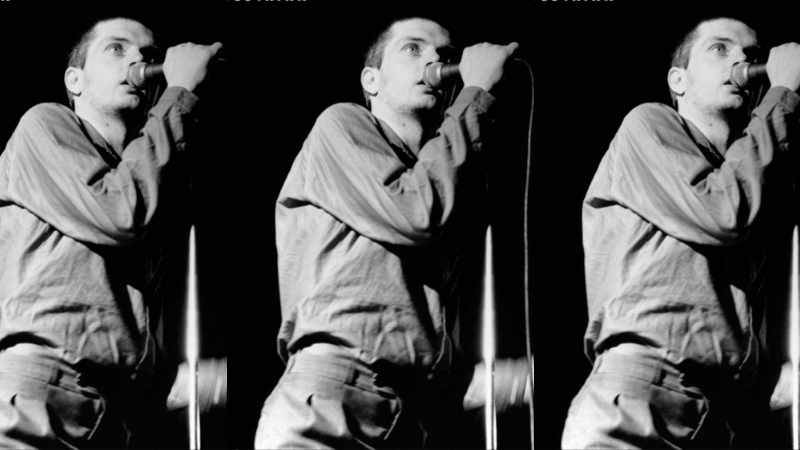
The Ian Curtis whose torch singing floats above the high bass and glistening synths of “Love Will Tear Us Apart” is hardly recognizable as the guy who sang “She’s Lost Control” or “Dead Souls.” It makes sense that the song was a non-album single since it strikes out in such a different direction from the music the band had released on its first album, Unknown Pleasures, or that would characterize their next and last, Closer.
Nearly twenty years after its release, NME crowned it the greatest single of all time—a distinction that feels both absurd and oddly plausible. It also represents some of Joy Division’s final efforts: by the time the single surfaced, Curtis had taken his own life, and the surviving members—who had vowed to dissolve the group if any founder departed—soon regrouped as a new project: New Order.
New Order was a remarkable band—or are (as of this writing in 2025, they’re touring again). Yet Joy Division possessed a singular, transcendent quality. The difference lies with Ian Curtis. And at the moment he was writing “Love Will Tear Us Apart,” his world was closing in with crushing intensity.
And at the time he was writing “Love Will Tear Us Apart,” his life was collapsing in on him.
Punk and post-punk carried with them a near-automatic suspicion of the pop love song. Joy Division’s first charting track, however, did not arise from belligerence but heartbreak. Indeed, the title itself is a sly wink: the squeaky-clean husband-and-wife duo the Captain and Tennille had topped the charts in 1975 with “Love Will Keep Us Together,” and while that song, or at least the optimism it carried, kept its performers together for almost four decades, Curtis seems to have had little time for its saccharine prescription for the seven-year itch.
Not that Curtis was philosophically opposed to the idea of the nuclear family: he married at nineteen, and he and his wife, Deborah, welcomed a child while the band was in the studio putting the finishing touches on Unknown Pleasures. But life on the road wore him down, and he became emotionally involved with the Belgian journalist Annik Honoré. (Honoré always insisted that the relationship was platonic.) And that new love at least contributed to pulling Mr. and Mrs. Curtis apart.
The touring life brought additional strains. One of the band’s best-known songs, “She’s Lost Control,” drew from Curtis’s experience working with an epileptic girl in his civil service role as a caregiver. Around the time he wrote the song he learned that he himself suffered from the condition, and his seizures grew more frequent and severe; his flailing stage movements began to look less symbolic, and grand mal seizures sometimes forced Joy Division performances to end early.
Curtis probably also suffered from bipolar disorder, a condition intensified by the rigors of touring on a shoestring. By the time he wrote “Love Will Tear Us Apart,” these pressures—depression, epilepsy, isolation, and romantic strain—were pressing in with intolerable urgency; Deborah had filed for divorce, though Curtis pleaded with her to reconsider. On May 18, 1980, on the eve of Joy Division’s first US tour, Curtis hanged himself; he was twenty-three.
On May 18, 1980, on the eve of Joy Division’s first US tour, Curtis hanged himself; he was twenty-three.
Like many British bands, Joy Division formed after seeing the Sex Pistols in the summer of 1976. If they initially aimed to be punks, that didn’t endure for long. Peter Hook developed a distinctive bass style—melodic, placed high on the neck so its pitch and timbre resemble a six-string guitarist. In fact, in the opening bars of “Love Will Tear Us Apart,” Hook nods to Pete Townshend’s introduction to “Pinball Wizard” from the Who’s 1969 rock opera Tommy: the bass player as guitar hero.
Another feature that set Joy Division apart from the punk bands that inspired them was the driving force behind their music. Postwar Manchester offered a bleak landscape for young men seeking direction, influencing them differently than London did the Sex Pistols. Tony Wilson, the TV music host who “discovered” the band and later released their LPs on his new label, Factory Records, explains their transition from punk to post-punk this way: “Punk enabled you to say, ‘fuck you.’ But somehow it couldn’t go any further; it was a single, venomous, one-syllable/two-syllable phrase of anger. Which was necessary to reignite rock ’n’ roll. But sooner or later, someone was going to want to say more than ‘fuck you.’ Someone was going to want to say, ‘I’m fucked.’ And it was Joy Division who were the first band to do that, to use the energy and simplicity of punk to express more complex emotions.” “Fuck you” => “I’m fucked” (or “We’re fucked”): it’s the affective arc of punk to post-punk in four words.
“Love Will Tear Us Apart” is a heartbreaking document of the death of a relationship that feels for all the world like the death of the self: a death that’s witnessed and coolly dissected from outside, but from which one can hardly break free.
Curtis’s vocals on the song stand apart from the rest of Joy Division’s catalog in two respects. The first is their drone-like quality; at moments in the track his vocal cords seem to vibrate in sympathy with Hook’s bass and Bernard Sumner’s synth. Because he had to abandon his guitar for the ARP Omni during live performances, Sumner taught Curtis to play only one guitar chord, D major, for the entire piece. That limitation is one reason for the song’s unexpectedly dynamic energy: Curtis’s voice forming a drone against the melodic hooks from Sumner and Hook.
The other vocal approach Curtis adopted on “Love Will Tear Us Apart” was suggested by the session’s engineer, Martin Hannett, who sent Curtis away one day with a Frank Sinatra album and urged him to sing the song in a crooner’s style. We hear that influence most clearly in the extended, hesitating “loooove” that begins each chorus, a delivery that might fit Sid Vicious’s tongue-in-cheek cover of Sinatra’s “My Way.”
“Love Will Tear Us Apart” is a heartbreaking document of the death of a relationship that feels for all the world like the death of the self: a death that’s witnessed and coolly dissected from outside, but from which one can hardly break free. The typical language used to describe such strain—phrases like “drifting apart” or “growing apart”—the song toys with these notions: “we’re changing our ways / Taking different roads.” Yet the mood isn’t indifference, but a mounting desperation that “takes hold”: “Is it something so good / Just can’t function no more?” The stark truth remains: “Love, love will tear us apart.”
Ah: but that’s not the line. That’s the title; Deborah had the phrase “Love Will Tear Us Apart” inscribed on Ian’s tombstone, but a pedant might call that a misquotation. Because the line, repeated eight times in the song, ends with “again.” And that “again” wobbles a bit: Does it signify that we’ll each be alone again, as we were before love brought us together? Or does it suggest an even darker possibility: that love is now and forever tearing people apart? Even at twenty-three years old,
Curtis was capable of more mature insight into the ethical complexities of romantic relationships than the song’s title suggests. “Love Will Tear Us Apart” is the proof.
It’s this that Bernard Sumner has in mind when he calls “Love Will Tear Us Apart” “one of the most beautiful love songs ever written.” “It’s not a love song for the sake of it,” he writes in his memoir, “it’s no vacuous paean to pretend heartbreak or anything like that. It’s genuine, it’s real, and it swings back and forth between full-blown power and reflective introspection.” That’s no mean feat for a song that Hook says was written in three hours. But then the lyrics had surely been writing themselves on Curtis’s heart for far longer.
In a 2014 interview, Hook said that the song “has everything”: “A great bass line, wonderful synths, a great showcase of Steve [Morris]’s drumming, the simple yet effective guitar that became one of our trademarks.” What’s missing from this description? Curtis’s lyrics, of course, and the instrument with which he put them across. “It’s quite strange really,” Hook said, “because the lyrics are very dark but I find the song to be very uplifting—no other Joy Division song works like that. People go nuts for that song when we play it live, but it really is quite dark.” It’s the darkness of a lonely voice crying out, “I’m fucked”—or maybe, even more powerfully, “we’re fucked.”
__________________________________

Excerpt from the book Punk in 50 Pieces by Kevin Dettmar. Copyright © 2026 by Kevin Dettmar. Used with permission of Harper, an imprint of HarperCollins. All rights