
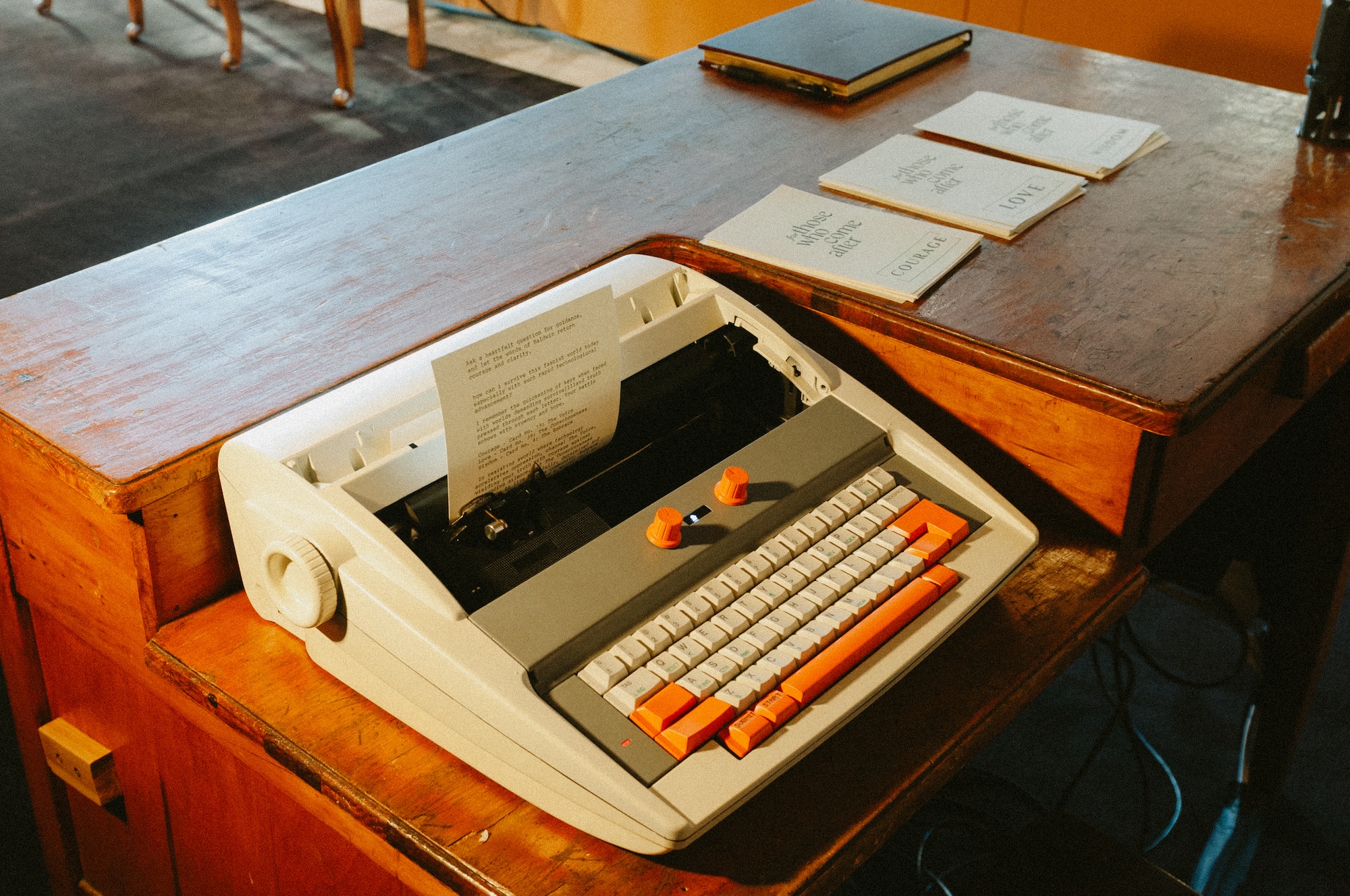
A new interactive exhibition about the writing of James Baldwin features an AI programmed typewriter that directs users to writing drawn from Baldwin’s books, essays, and letters. If you, like me, are aghast that “AI” and “James Baldwin” are in the same sentence, take a closer look. The issue here is not with this project, which is building something artistic and beautiful, but with a broader, pro-AI tech culture that has discredited AI and its public image.
An innovative, hands-on exhibit exploring James Baldwin’s craft introduces a typewriter powered by artificial intelligence that guides visitors toward passages inspired by Baldwin’s own books, essays, and letters. If, as I did, you recoil at the idea of pairing “AI” with “James Baldwin,” pause to examine more closely. The concern isn’t with the project itself—an artistic and aesthetically striking creation—but with a wider pro-AI tech culture that has undermined AI and tarnished its public image.
The experiential exhibition is titled “For Those Who Come After” and is part of “KIN: A Festival of Memory and Imagination” in New York, as covered in Fast Company. The installation and its software is designed by Kinfolk Tech, “a nonprofit using immersive technology, public art, and community-led design to help displaced and excluded communities tell their own stories—and shape their own legacies.” They’ve created augmented reality monuments of Black, Brown, Indigenous, and queer figures, run fellowships on community memory, and created archival projects around story telling.
Named ‘For Those Who Come After,’ the immersive showcase belongs to New York’s ‘KIN: A Festival of Memory and Imagination,’ reported by Fast Company. Kinfolk Tech crafted the installation and the accompanying software—a nonprofit that employs immersive technology, public art, and community-driven design to empower displaced and marginalized communities to voice their histories and carve out their legacies. Their portfolio includes AR monuments honoring Black, Brown, Indigenous, and queer individuals, memory-focused fellowships, and archival storytelling initiatives.
The Baldwin installation is centered on a physical station: “a desk, a typewriter, and three card stacks labeled Wisdom, Courage, Love.” The visitor sits in front of the typewriter and asks the question. Using what seems to be a bespoke AI model, the typewriter points you to three cards from the stacks that are relevant to your question, and then types out “a poetic reflection, generated from the spirit of Baldwin’s archive.”
The Baldwin piece orbits a tangible station: a desk, a typewriter, and three decks titled Wisdom, Courage, and Love. A guest poses a question to the machine, which—likely via a custom AI model—selects three pertinent cards and then types a short, poetic reflection drawn from Baldwin’s archive.
My knee-jerk is to recoil from anything that brings AI close to Baldwin’s work. But the closer I looked, the more it seems clear that the emphasis is firmly to bring people closer to Baldwin’s writing—elsewhere in the room, you’ll find a radio, TV, and record player that all reproduce Baldwin’s words.
Initially, the impulse is to recoil at anything that furls AI into Baldwin’s corpus. Yet as I studied more closely, it became evident that the intention is to bring real people into Baldwin’s prose—elsewhere in the space, a radio, a television, and a record player all echo his words.
Kinfolk’s founder Idris Brewster told Fast Company that the project is designed as “a ‘poetic intervention’ to slow people down long enough to reflect on the partnership between humans and machines.”
Idris Brewster, founder of Kinfolk, described the project to Fast Company as a ‘poetic intervention’ intended to slow visitors briefly so they can ponder the relationship between humans and machines.
Kinfolk is clearly doing interesting, careful, and artistic work, so I have to question my AI anger, which feels more appropriately directed at the tech bosses, boosters, and acclerationists who have so thoroughly poisoned the well about this technology.
Kinfolk is evidently pursuing thoughtful, precise, and artistic work, prompting me to check my hostility toward AI, which seems more rightly aimed at the tech executives, promoters, and accelerationists who have so corrupted the public image of this technology.
This also happens to be, as Vox put it, “the week the AI freakout went mainstream.” It’s been a deeply infuriating experience to hear higher-ups at these tech companies tell us they believe themselves to be engineering our doom. It’s the sort of thing tech has gotten very good at: inventing a problem and then throwing the consequences to the public to tidy up. And what are we to make of it? Are they lying to us to boost their stocks and their egos? Or are they really going to work every day at the Armageddon factory and expecting sympathy?
Moreover, as Vox described it, this is ‘the week AI panic went mainstream.’ It’s been profoundly frustrating to hear executives claim they are steering us toward doom. This is exactly the pattern tech has grown adept at: conjuring a problem and shifting the fallout onto the public to fix. What should we conclude? Are these leaders deceiving us to lift their stock prices and pride, or do they genuinely labor daily in some Armageddon factory, hoping for sympathy?
Fittingly, this is a very American intersection of wealth and power, the exact kind of problem about which James Baldwin was always so eloquent and incisive.
That convergence—a distinctly American crossroads of wealth and power—embodies precisely the type of issue Baldwin spoke about with clarity and sharp moral insight.
My armchair psychology is that this is a phenomenon similar to how certain men in Hollywood are bizarre about method acting, which has “become wrapped up in a brand of identity politics that tries to make the art form resemble more traditional forms of male labor,” according to Angelica Jade Bastién in The Atlantic. I sense an similarly insecure defensiveness behind these men crying “we’re too smart!” and “we’re building a bomb!” when in practice, they’re just on the computer.
From a speculative psychology, this resembles the Hollywood habit of taking method acting to a strange extreme, a tendency Bastién notes in The Atlantic as merging with identity politics to retrofit art as conventional male labor. I perceive a parallel defensiveness among the same critics who scream ‘we’re too clever!’ and ‘we’re building a bomb!’ while, in reality, they’re simply working at a computer.
Quieter, more humanistic uses of machine learning or LLM technology must now contend with a public whose idea of AI has been shaped by the loudest, maximalist voices. Many of us see AI and can only think of everything we know about the tech’s unethical creation and deployment, and cheered on by hogmen who brag about killing jobs, killing the planet, and killing people. It makes me sad that our path to a gentler relationship with this software, full of things like a typewriter that quotes James Baldwin, is impeded by the influence and wealth of some of the worst people in the world.
Subtler, more humane uses of machine learning and large language models must now contend with a public molded by the loudest, most extreme voices. Many of us associate AI with the troubling narratives surrounding its unethical origins and deployments, amplified by swaggering figures who boast about destroying jobs, the environment, and people. It saddens me that our route toward a gentler relationship with this technology—embodied by Baldwin-quoting typewriters and similar gestures—is obstructed by the power and wealth of some of the planet’s most reprehensible individuals.
Image from Kinfolk Tech