
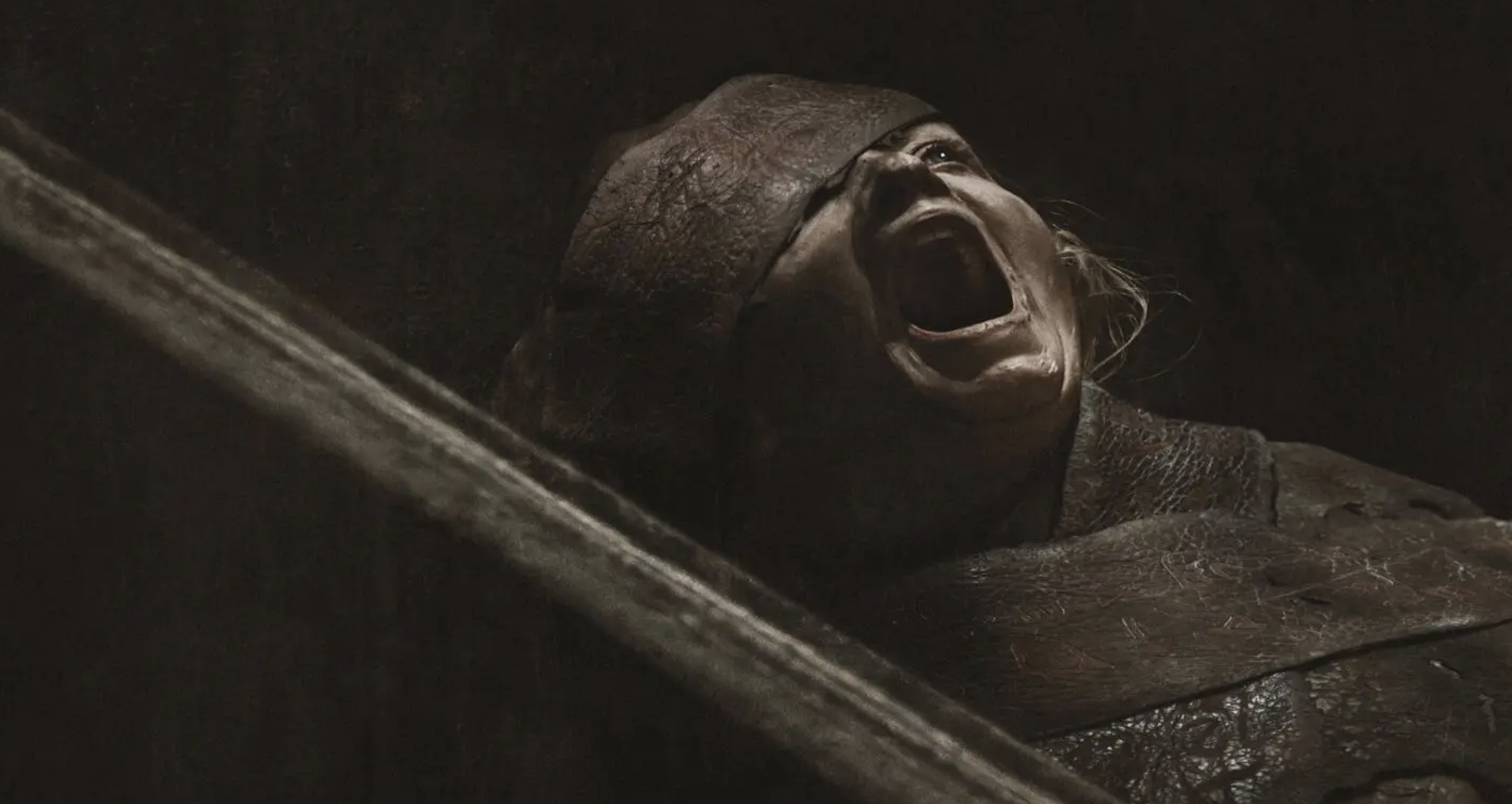
Let me just say I don’t like Lee Cronin. Not that I know the Irishman, best known for regurgitating horror’s tired tropes with a view to winning the most nauseating gore competition—but I watched his latest film. And no matter how I look at things now, I cannot bring myself to like him.
To be frank, I don’t have much fondness for Lee Cronin. Not because I actually know the Irish director, renowned for recycling horror’s worn-out tropes in a bid to clinch the most nauseating gore-off—but I watched his newest movie. And whatever way I assess it now, I can’t bring myself to warm to him.
As Layla El-Faouly in the Disney+ miniseries Moon Knight, the Egyptian-Palestinian actor May Calamawy gave a convincing, emotionally potent performance in English. I have no idea how good her Egyptian Arabic is, but, using my mother tongue in Lee Cronin’s The Mummy, Calamawy’s Detective Dalia Zaki comes across like an English speaker mindlessly parroting sounds she does not understand. In this way Lee Cronin achieves the seemingly impossible task of employing, not a white American but a “real native” to portray what nonetheless amounts to a Hollywood parody of one.
As Layla El-Faouly in the Disney+ miniseries Moon Knight, the Egyptian-Palestinian actor May Calamawy delivered a convincing and emotionally charged English performance. I can’t gauge how proficient her Egyptian Arabic is, but watching Cronin’s The Mummy with my own mother-tongue, Calamawy’s Detective Dalia Zaki reads as if she were an English speaker repeating phrases she does not truly grasp. In this sense Cronin attains what seems to be the nearly impossible feat of casting, not a white American, but a genuine native, to enact what nonetheless becomes a Hollywood caricature of one.
This is just as true of Zaki’s nemesis, identified simply as the Magician (the Iraqi-British Hayat Kamille), along with every “Egyptian” character here. Not only their accents but the intonation, the stress, the pauses, everything about their Arabic is a kind of coded moviespeak that, were it not unintelligible, would be indistinguishable from the rest of the film’s canned dialogue. The words are technically Arabic, but they might as well be Chakobsa: the language David and Jessie Peterson invented for the pseudo-Arab inhabitants of the desert planet Arakis in Denis Villeneuve’s Dune films. The only—passing—exception is the man who plays Calamawy’s young colleague at one point; and his lines seem to be dubbed with the help of AI.
In Lee Cronin’s The Mummy, evil is a native sickness that contaminates an otherwise perfect, unsullied child of empire. That is the only reason Egypt is there at all.
Not only do they look Egyptian, but the body language and mannerisms the film leans on cause them to move and speak with an American cadence. From the detective munching on a sandwich while standing as she talks to the aforementioned man, to the way the possessed woman crawls, every character feels like a skin worn by a stock blockbuster type, Calamawy’s fearless cop and Kamille’s wicked sorceress the most clearly pedigreed.
But, aside from the fact that it consists of “a bunch of cheesy jolts and a vulgar array of physical assaults, most of them aimed at young girls and old women”, critics seem to agree that this is more of an exorcism than a mummy film. There are wrappings inscribed with incantations that seem to replace the skin of the victim, but no preserved cadaver reanimated. No mummy. That’s why the film has been been called “A Laughably Bad Attempt at The Exorcist” and an “Evil Dead follow up in all but name”. But if you happen to be even minimally culturally aware, there is this, arguably graver problem.
And beyond its clichés, the work appears to present a form of problem that runs deeper than gore. Critics argue Cronin’s The Mummy foregrounds a version of evil as a native affliction that mars an otherwise pristine, unblemished offspring of empire. That is the sole reason for Egypt’s presence in the narrative: to function as, as I have described Arab Muslims in Postmuslim: A Testimony, “the foil of civilization.” This is precisely the Orientalism the essays in that book challenge. It reduces millions of Arab Muslim lives and thousands of years of Arab Muslim history to mere packaging—a kind of themed carrier bag to carry the very “desires, regressions, investments, and projections” Edward Said spoke of in his seminal work—and to what end?
Cronin’s country is a ludicrous Arabian Nights phantasmagoria of random “Eastern” visual cues, black magic, desert fantasies, and strangely sanitized government offices that resemble a spoof of Cairo’s notoriously gritty bureaucratic spaces. Meanwhile the country’s actual sights and sounds, including its everyday mores—all ignored. We have no women police officers in criminal investigations, for one thing; but even if we did, no woman who wears hijab while in uniform would remove it while not; and no one would ever dream of answering the phone by stating their surname.
None of which is to broach the story of the film, which opens with the worst imaginable disconnect for an Egyptian viewer.
Back in pre-internet times, when you could perhaps excuse people for being appallingly ignorant of things they weren’t familiar with, a fellow undergraduate in Hull, England found out I was Egyptian. “Wow, Egypt!” he said. “Do some of you get around on camelback, then?” He was probably naïve rather than disingenuous, but in 2026 the same cannot be said for a forty-four-year-old director or the big production companies he works for. And truly, now, does the idea of a modern Egyptian family having an underground pyramid in the backyard of their Aswan home strike you as any less pathetically misguided?
Likewise ancient Egypt: really, the only Egyptian thing a film like this might credibly draw on. It is reduced not to an exoticized object the imperialist gaze can freak itself out about—as Mummy films have traditionally done with it—but to a lame excuse for a bilious bonanza bereft of “scares, satire, wit, or humour,” or any convincing storytelling.
Consciously or not…he references a predatory culture so completely narcissistic it cannot conceive of another except as inert raw material into which only it can breathe life.
In the small black pyramid is a sarcophagus, in the sarcophagus an ancient mummy possessed by an immortal demon, the “Destroyer of Families”, Nasmaranian (why it has what sounds like an Armenian name, I don’t know). The magician—and apparently her family, down through the generations—is responsible for keeping this creature at bay by binding it to a living body that remains immobile. Nasmaranian’s host needs to be replaced every so often in eternity. Now that the demon has awakened, killing the Magician’s husband Gamal (Omar El-Saeidi) while it does so, a new body must be found.
And, seeking something young and healthy, who should the Magician target but the unsuspecting daughter of a Cairo-based American journalist? A dedicated family man, wholesome, sensible, and ambitious, in this set-up Charlie Cannon (Jack Reynor) is the unequivocal agent of civilization.
To perform civilization’s duty of truth-telling, Charlie has been living in Cairo with his pregnant wife, Larissa (Laia Costa), though he is soon moving onto greater things. And behind their backs, while playing in the garden of a house that doesn’t look like anything Egyptian, their daughter Katie (Natalie Grace; Emily Mitchell as a child) is tricked into a friendship with the Magician’s daughter Layla (May Elghety; Aisha Laouini as a child). Until the magician herself arrives with a scarab in an apple that incapacitates the child and a sandstorm into which she can disappear with her. Trailed uselessly by Charlie, who is next seen ordering the police chief about.
Why on earth the Magician would choose an American girl remains unclear. But it is no less inexplicable than the plane crash that, eight years after Katie disappears, exposes the sarcophagus being transported with her inside. Or the fact that the Magician has recorded the group ritual through which the demon was transported into the little girl’s body on videotape. Or Dalia’s spontaneous ability to perform the same ritual effectively without the usual cohort of Nasmaranian trustees in the video by reciting a few lines of laughable formal Arabic. Twice.
When the possessed Katie eventually joins the family in Albuquerque, New Mexico, there is much Catholic prayer on the part of Larissa’s mother Carmen (Verónica Falcón). Predictably, it has no effect on Nasmaranian. But the remarkable thing is—apart from erroneously making the hijab a part of Egyptian police uniform, and despite religion’s close association with sorcery and possession, in 132 protracted minutes Cronin makes no reference to Islam (or Coptic Christianity). Not one.
Until the mystery is resolved and Nasmaranian is transported through Charlie, who bravely carries him back to Egypt, into the Magician, now in custody—the happy ending of just punishments!—Cronin references, instead, every last American horror trope both on-screen and off. The horror of imperialism, especially.
Consciously or not—and this is why I don’t like Lee Cronin—he references a predatory culture so completely narcissistic it cannot conceive of another except as inert raw material into which only it can breathe life. So that, zombie- or indeed mummy-like, the barbarians can mimic imperial subjects enough to look human. The better to act out empire’s idea of what disgusting demonic sickness looks like.
____________________________
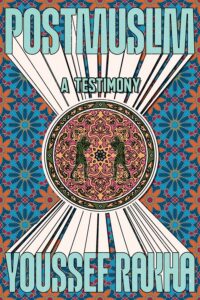
Postmuslim: A Testimony by Youssef Rakha is published by Graywolf Press.