
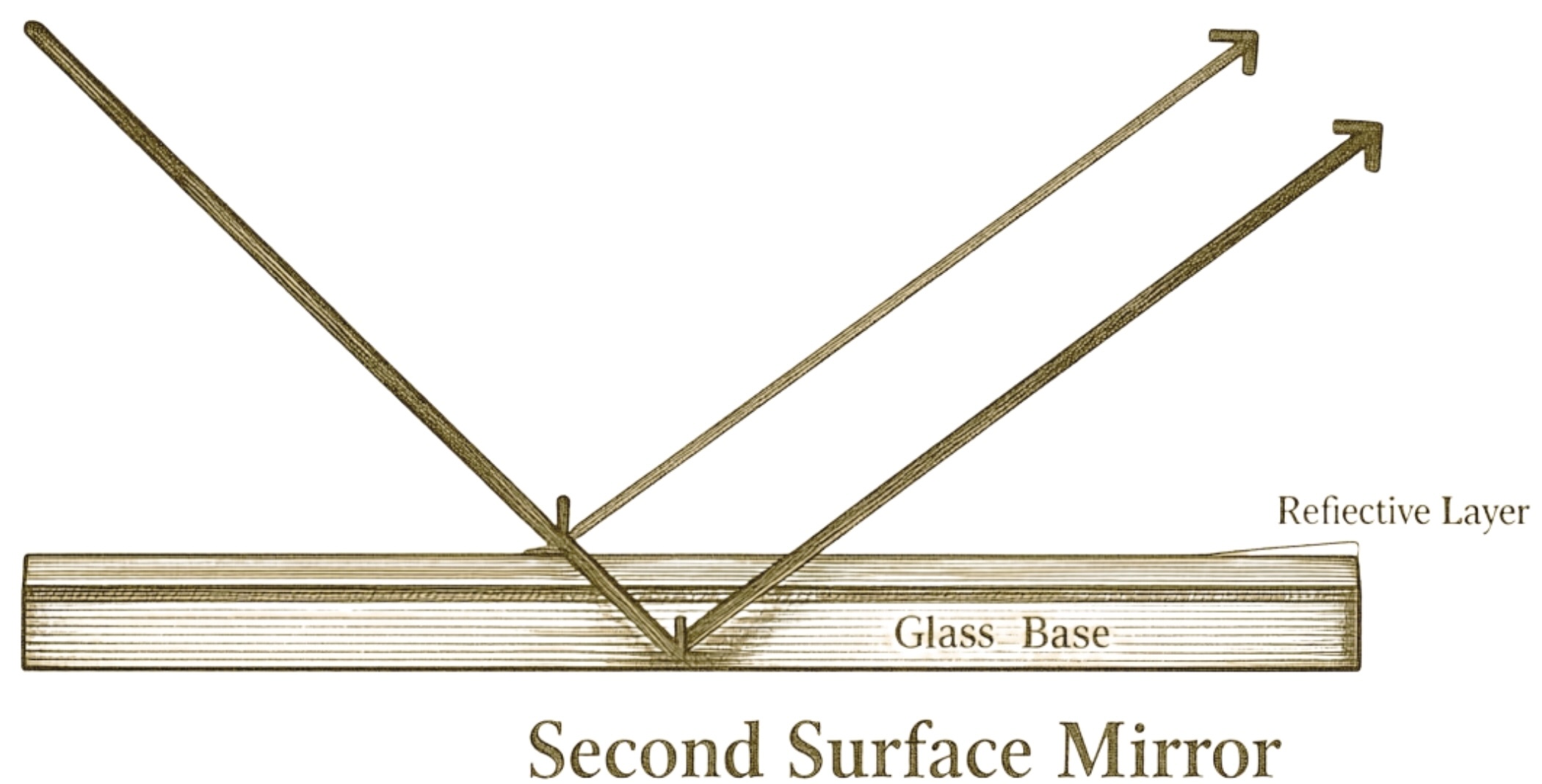
“A second surface mirror, also known as a standard or regular mirror, creates a ghosting effect (double image).”
______________________________________________________________
“Displaced people also lived in two time zones, the here and the there, the present and the past, being as we were reluctant time travelers.”
–Viet Thanh Nguyen, The Sympathizer, as quoted in his essay “Horrific Surrealism: Writing on Migration,” Paris Review blog, March 6, 2025
*
I possess only one photograph of myself while I was in South Korea. It was snapped by a staff member at the Holt International adoption agency. A small card leans against the front of my sweater, and on it are scratched in English: my name, Shin, Sun Yung, my orphan case number K-6596, and my birth date. The reverse side of the image, much like the back of a mirror, remains blank.
My name, my case number, and my birth date were all assigned by the agency.
One might say that the case number represents a fact, while my birth name and birth date function as fictions—constructed rather than fixed truths.
Given a birth story of this kind, is it any wonder I became a writer? Of the 26 letters of the Latin alphabet, or any other script, an identity can be designated, stabilized—and established as, if not truly real, then at least socially legible and legally recognized by the state.
*
Confronting ourselves.
Humans have long used polished obsidian as a reflective surface for millennia. Mirrors crafted in China, tracing back to the era of the Han Dynasty (206 BCE–24 CE), eventually circulated through Korea and Japan. One of my favorite tales from The Story Bag, a modest collection of Korean folktales that I cherished in childhood, is entitled “The Bridegroom’s Shopping.”
I suspect every adopted person or anyone raised in a family or situation in which she is not genetically related to anyone else has a special relationship to mirrors.
This folktale begins with a venerable farming clan whose only daughter has just married. In Korea, prior to Joseon rule and its Confucian influences, husbands typically resided with their wives’ families. The story’s spark occurs when the bridegroom must travel to the town; the bride asks him for a specific shopping request:
A few days after the marriage, the bridegroom has to run a town errand. As he gets ready to depart, his wife pleads, “Could you fetch a comb for me while you’re there?”
“Naturally,” he replies, eager to satisfy his young bride.
Yet his wife understands that her husband tends to forget things. Hadn’t her in-laws mentioned this trait? As she ponders how to jog his memory, she glances upward at the sky. A new moon—an increasingly slim crescent of pale light—hangs there, pale and gentle. It is three days old and resembles a moon-shaped comb she desires.
The young wife instructs her husband to watch the crescent in the sky and to remember to complete the shopping if he forgets.
In the town, the bridegroom attends to business for several days, and his wife worries that he will forget the comb. When he looks around the room to ensure he has everything, he steps outside and sees in the heavens a large, round moon. Ten days have passed since he left home. The moon has transformed from a slender crescent to a full, gleaming globe of silver.
He recalls the request and asks a shopkeeper to provide him with something resembling the moon for his wife. The shopkeeper is delighted and suggests a mirror, saying, “A young bride would want it as she beautifies herself. Surely that is the thing she desires.”
The groom had never encountered a mirror before, finding mirrors exceedingly rare, and he trusts the shopkeeper’s judgment. He buys it and returns home. When his wife asks if he completed the shopping, he presents the “strange round object.” She peers into the smooth surface and sees a reflection of a pretty young woman.
She complains to her mother that she requested a comb, yet the item brought home is a “strange young woman.” Naturally, when the mother looks, she sees an old wrinkled woman and declares the stranger to be a distant relative from a neighboring village. The two argue angrily. A small boy enters, munching a rice cake, peers into the mirror, and sees a stranger who has taken his snack. He raises his hand to strike the intruder, and the other boy mirrors the gesture, and both begin to cry in fear.
The grandfather enters, spies in the mirror a fierce old man, and prepares to strike the aggressor for interrupting the children’s quarrel. He drops the mirror, it shatters with a loud crash, and then the grandfather, the boy, the two women, and the bridegroom all fall silent, staring at hundreds of shards scattered beneath their feet—an ending to the tale.
What I appreciated in this story was the grownups’ blindness to a phenomenon I already knew in childhood—mirrors. In the tale’s setting, I later realized I internalized this and many other narratives about men stepping out into the world. A secondary moral is that women rely on a forgetful partner to obtain what they want.
Almost all folktales are lessons about family, about roles and belonging. Who is known, and who is a stranger.
This mirrored the home in which I was raised: my father left for an office every day while my mother stayed home—driving around town to tend to my older brother and me, the house and garden, our dog, and our father. I watched my mother prepare three meals daily, scrub and dry dishes by hand, wash and iron my father’s shirts and handkerchiefs, clip coupons, shop for groceries, vacuum, mop, dust, wash windows, balance the checkbook, and ensure we got to school, our lessons, activities, doctor and dentist appointments, friends’ homes, and so on—day after day, year after year.
“The Bridegroom’s Shopping” also presents a portrait of being versus doing (the woman exists while the man acts) and resonates with Simone de Beauvoir’s ideas in The Second Sex on the male as subject and the female as object. The household spirals into chaos because the husband prioritizes business and forgets his wife’s one request. It is also a meditation on modernity; the bride hails from a well-off family yet remains a rural person, not yet cosmopolitan, unacquainted with the latest technologies or the purpose of a mirror.
The union of the woman’s vanity and the husband’s forgetfulness disrupts the home, a pattern that appears in many American sitcoms where a wife seeks beauty or improved utility to uplift the household, while a well-meaning but bumbling husband introduces humor into the situation.
“The Bridegroom’s Shopping” may have served as a message to my younger self that if a woman wants something done properly, she should do it herself—but perhaps that was not an option in Korea at the time. Folktales are, more often than not, commentaries about family, about roles, about belonging. Who belongs, and who is an outsider.
The Story Bag: A Collection of Korean Folktales by Kim So-un, translated by Setsu Higashi, appeared from Tuttle in Tokyo, Japan in 1955. This release came a decade after Japan’s defeat in World War II and its retreat from imperial holdings, including Korea, which it had annexed in 1910, and two years after 1953, the unofficial end of the Korean Civil War.
Kim So-un, fluent in both Japanese and Korean, grew up in colonial Korea. In his foreword he explains, “…stories do not like to be hoarded, but want to be told and told again, passing always from lip to lip. These stories were first heard in my childhood in Korean, then written down by me in Japanese, and finally translated into English by Mrs. [Setsu] Higashi.”
Our household lacked mirrors except above the bathroom sinks and on the dressers in our parents’ and brother’s rooms. I did not have a mirror in my own room until adolescence. My mother always presented herself neatly and comfortably, but vanity was never the driving force; she avoided makeup except on holidays and special occasions, and then it was only a modest dab of drugstore lipstick in a soft hue.
In some ways my life as an immigrant, since the age of about one-and-a-half years old, feels like a second surface.
In many ways, every adopted person, or anyone raised in a household where kinship is not direct, bears a special relationship with mirrors. The people you call family cannot provide you with your genetic likeness in your eyes or your smile; you cannot infer your skin tone or hair texture from them if you are of another race; you do not share the same hands as a sibling; you cannot reveal your true origin. You may not know where your personality originates. For many intercountry adoptees, the precise origin of the whole “you” remains unknown, beyond perhaps the country or region of birth.
If you are adopted, every mirror in your home becomes a reminder, as in a family portrait, that your belonging was a stitched-together matter, that you inhabit one place while another, older place lingers in your reflection, one that is both present and distant. You are not simply suspended between two states; you exist in a single place, yet a constant echo of that other place—the you that existed before this current self—resonates within.
The mirror becomes an uncanny threshold, fixing your sense of self in the here and not the there. This family is familiar, while the other, unknown kin remains forever present. It mirrors, as in “The Bridegroom’s Shopping,” a figure who appears as a stranger in the reflection.
*
There are numerous varieties of mirrors—concave, convex, flexible, planar, front-silvered, back-silvered, and more.
Most everyday mirrors function as back-silvered, also known as second-surface mirrors, meaning they consist of a glass base with the reflective coating on the rear side.
For someone like me, an immigrant and an adoptee, certain aspects of this layered, multi-material instrument become a metaphorical framework.
The poetics of the mirror.
The poetics of self-perception, memory, time, surface, depth, flatness, dimension, and boundaries.
In many respects, my life as an immigrant, beginning when I was only a year and a half old, feels akin to a second surface. There exists a liminal space between the outer glass and the reflective coating. Light enters, a reflection forms, yet one’s consciousness remains malleable, able to shrink or expand to fit within the space behind the thin metallic layer. The self can approach the first layer beyond the coating without ever merging with it.
Being raised apart from my biological family and culture—and having failed to locate any trace of those people despite searching—means I possess no firsthand stories about my Korean kin or ancestors. For now, I am the narrative and the evidence alike.
To be severed from one’s birth family is to experience closeness without proximity. Form without knowledge.
*
I contemplate DNA and the interconnected shapes we carry. I wonder how my own children might look at their biological, genetic, or gestational parents—parents who are, in every meaningful sense, the same people who raised them—and understand why one of them gravitates toward art while another loves mechanical things.
Being the product of creation without knowing the source is, to me, like the back of a second-surface mirror—the layer that provides the reflective film, covered by glass. A constant refraction persists.
*
Looking into the mirror of my past is a blend of historical inquiry, private investigation, community revival, and personal conjecture. When information runs dry, which is often, it resembles peering at the back of a mirror—a surface that bears nothing written on it, no reflection, a doorway without a door, a wooden pane that resembles a window but is in fact solid. Yet this is the material I have, and what many adoptees possess. Before I had my two children, my own method of reverse engineering was even poorer in information. I have transmitted that structure of absence to my children, and they will bear it for the rest of their lives. How heavy is nothing when it is filled with longing, curiosity, confusion, discomfort, and sorrow?
Being an adoptee is a lifelong lesson in impermanence.
There is a palpable sense of paranoia in not knowing—an intuition that something lurks behind you, a breeze upon the skin that you cannot see, nor sense its form, speed, or distance; and when you turn, it vanishes. In many cultures, spirit doubles, or doppelgängers, are considered bad luck.
What is the physics—the velocity, frequency, mass, and volume—of absence? Not a single absence, but a multitude. Questions that remain unanswered yet continue to surface, like air bubbles rising only to break at the surface.
That burning hunger to know one’s origins proves that we are not fully individuals, but rather segments of a continuous chain. As a test case for individuality, the rewritten adoptee in me reveals that individuality can be, in some respects, a myth.
The sensation of being outside the usual patterns of kinship is acute. It can feel like a wind-blown sense of novelty and self-creation that masquerades as freedom but more often conveys emptiness. An existential state. I exist, but for what purpose? From where?
Being part of a second, adoptive family means recognizing that families can be deconstructed, assembled, and deconstructed again. Bearing a second or third name allows you to be detached from language at any moment, and perhaps it is wise to hold onto names with light hands. A lifelong lesson of adoption is impermanence. Yet if one relinquishes too much, too soon, one risks relinquishing everything. Psychiatry might call this depersonalization; when taken to an extreme, the mind can drift away from life itself, a fate some have described as suicide.
Without knowledge of who my birth family was or is, I am constrained in how deeply I can understand myself. My body is the consequence of their reproduction, but there is no decoder to reveal precisely why my skin hue, my finger shape, my temperament, or my character appear as they do. It can feel like staring into a mirror and seeing nothing beyond the glass.
*
To be cut off from one’s people and heritage—one’s inheritance—while still craving understanding, and to possess a mind that, even as an adult, continually ponders what combination of people, places, and circumstances birthed my existence, amounts to a persistent hunger. Most days, other practical concerns demand attention, yet when I pause to articulate this condition, my mind reaches for metaphors, for multi-layered objects resembling a second-surface mirror. Unlike a polished metal surface, which returns a uniform reflection from every angle, a second-surface mirror is constructed in layers, with a transparent layer, a reflective layer, and an opaque layer.
*
As an immigrant, I seek to grasp what it means to move, to be displaced, to cross an ocean, to be placed, to be cared for, to be transformed from resident to citizen. It feels like a form of temporal travel, a continuous folding of time—prisms, refractions.
I doubt any immigrant could completely escape imagining a parallel life in which they never left. In science fiction, there is often a shimmer, a ripple, or a portal, nothing unlike a mirror. One can dream, speculate, or envisage Borgesian branching paths. The key is to avoid getting lost in the gaze, to resist lingering forever in the reflection like Narcissus.
*
A company named “FSM,” short for First Surface Mirror, presents a straightforward diagram on its site with the caption, “A second surface mirror, also known as a standard or regular mirror, creates a ghosting effect (double image).”
Another firm, Abrisa Technologies, explains occasions when a first-surface mirror might be preferred over a second-surface one:
Most people are familiar with standard mirrors used daily—bathroom mirrors, handheld mirrors, or a car’s rear-view mirror. These employ glass as the protective surface and have the reflective layer on the back side, a “second surface.” The exposed glass helps shield the reflective coating from scratches and environmental exposure.
In high-precision contexts, second-surface mirrors bring certain drawbacks. Light passing through the glass to reach the back-coated surface results in a refracted, altered image and some loss of energy, effectively dimming and warping the reflection. A faint secondary reflection also arises from light striking the front of the glass. This secondary image is known as a “ghost image” or “ghosting effect.”
This, too, serves as a useful metaphor—the ghosting effect. Even when I am not writing as a direct autobiography, I am writing to explore the phantoms and distortions produced by second-surface mirrors or by the space between my first life and my second life. It remains difficult, if not impossible, to discern what is real, what is fantasy, or what mixture of both exists. Are my feelings, grief, sorrow born of pre-verbal, primal wounds, or of an innate temperament? Or do they arise from narratives? DNA? Hormones? Bacteria? Microplastics? The questions exhaust me, and the more intricacies I examine, the less certain the conclusions become. Light can only bounce around so long before it vanishes, leaving one again in darkness and solitude.
Ghosts constitute an ancient human technology, and I do not believe our species has exhausted them, or that they have exhausted us. In this context, Betty Jean Lifton, a psychologist and white domestic adoptee, and author of Journey of the Adopted Self: A Quest for Wholeness, published in 1995, addresses the topic in the chapter “Ghost Kingdom.” In her discussion she cites Carl Jung’s claim that among all the ghosts that haunt us, the spirits of the parents hold the greatest significance. For those born into closed adoption systems, birth parents can become something akin to the ghosts I mentioned in a previous chapter (these were labeled as “hereditary ghosts” by the Finnish psychiatrist Max Frisk). Lifton designates the mental space where these spirits reside as the Ghost Kingdom. It is a remarkable realm, existing only within the adoptee’s inner experience. The Forbidden Self, and at times even the Artificial Self, slips into the Ghost Kingdom to rendezvous with the lost mother and the lost baby who never had the chance to become the child they should have been. One man described it as “a forbidden world, like a hole—wonderful, terrifying, ghostly—that you could fall into completely.” Once there, it is not necessarily a serene realm; the adoptee is free to express not only affection but also anger at being, as one woman remarked, “cast out into the world with strangers.”
_________________________________

Sun Yung Shin’s Heart Eater is available now from Black Lawrence Press. Sun Yung Shin will be launching the memoir at Minneapolis’s Moon Palace Books, September 15 at 7pm.