
Our quintet of quality reviews this week includes Joseph O’Neill on Jared Weisberg’s Profiles in Cowardice, Hua Hsu on Brian Dillon’s Ambivalence, Felipe De La Hoz on Mahmoud Khalil’s No Land to Stand On, Edna Bonhomme on Imani Thompson’s Honey, and Jeremy Gordon on Jon Ronson’s The Castle.
Brought to you by Book Marks, Lit Hub’s home for book reviews.
*
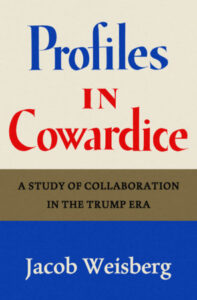
“Say what you like about President Trump, he has ushered in a golden age of cravenness. A nation long perceived, not least by its own nationals, as resilient and courageous—a people of gallant pioneers, fearless entrepreneurs, irresistible war heroes, nerveless astronauts, brave civil rights activists— is now forced to contemplate an entirely new set of data. It seems that, when placed under mild authoritarian pressure, an extraordinary number of powerful Americans, ostensibly honorable and right-thinking, quickly revealed themselves to be cowardly and unprincipled and made of the wrong stuff.
The journalist Jacob Weisberg is one of the first to attempt to chronicle this new landscape. In a dismal inversion of the John F. Kennedy classic Profiles in Courage, Weisberg’s Profiles in Cowardice offers case studies of eight representative men and women ‘who recognized the danger Trump posed to American values, who had the ability to say no to him and who at earlier moments showed flickers of integrity—but who, when a more serious test came, failed to act courageously, in ways that reveal both their moral weakness and the fragility of the institutions they represented.’
…
“Weisberg’s intention isn’t simply to lambaste these individuals, even as he hopes that shaming them will serve a useful purpose. Because cowardice ‘wears disguises: pragmatism, realism, caution, institutional loyalty,’ he investigates the specific situational and psychological forces at play in the moral downfall of each of his subjects, taking care, it must be said, to acknowledge that it isn’t straightforward to resist lawless state power.
Standing your ground can be frightening; it can negatively affect one’s career and net worth; it can leave one socially isolated; and, when you’re trying to discharge institutional responsibilities, it can feel ethically complicated. But in the final analysis, Weisberg suggests, the rights and wrongs were pretty clear. His subjects are voluntary members of the American elite who were at no risk of imprisonment or impoverishment.
…
“It must be pointed out, as Weisberg does in this valuable and dauntless book, that for every poltroon in high places, thousands of ordinary citizens have raised their heads above the parapet, none more bravely and persistently than the people of Minnesota as they protected their neighbors from rampaging federal officers. Their example upholds what’s left of this country’s reputation for courage.”
–Joseph O’Neill on Jared Weisberg’s Profiles in Cowardice: A Study of Collaboration in the Trump Era (The New York Times Book Review)

“The overheated circuits of teen-age life are well-worn ground for a coming-of-age story, yet Dillon’s approach is anything but. The writer and editor has become known for a kind of memoir-inflected approach to criticism, publishing a series of entrancing books that are as much about questions of form and technique as they are about art’s power to move and transform . . . Dillon wanders through his shelves, scrutinizing works by Walter Benjamin, Joan Didion, or James Baldwin and seeing, at a granular level, how writing achieves such profound effects. Ambivalence isn’t a how-I-did-it prehistory of his career, as it ends well before he published anything of note. Rather, he writes about this formative span of his late teens and early twenties in the third person, investigating the passions and neuroses of young ‘B’ from a distance. Few people intervene on B’s trajectory, if you can call it that; he spends most of his days dreaming and turning newly discovered ideas over in his mind until they feel like his own. Trauma and tragedies—such as the death of his parents, or periods of estrangement from his siblings—receive less scrutiny than the emotions unlocked by Virginia Woolf or Roland Barthes. The result is a strange, bewitching experiment in autobiography, in which there are no friendships or love affairs, just exquisite digressions on life-changing texts.
…
“I still believe that the songs or books we love contain blueprints for how we hope to live, and Dillon’s memoir embodies how these personal canons inflect the way we understand and express ourselves. B fears being outed as a poseur, meekly copying the outline of some micro clique, rather than a true aesthete ‘driven only by curiosity and love.’ Fifty pages in, the author observes that he has ‘not yet, in any meaningful sense of the verbs, begun to read—or write.’
You’ll drift in and out of Ambivalence, and muse on your own formative inputs. As I turned the pages, wondering whether any of B’s quandaries would be resolved, the book reminded me of how much of youth is spent pondering time, waiting, ready for the world beyond and yet slightly terrified of what’s actually out there. It’s an ode to a kind of boredom that feels desperate, endless, and, in retrospect, luxurious.
I’m about a decade younger than Dillon, and I recognized his desire to hoard and paw at any morsel connecting his small world to an alternative culture somewhere out there. As a child of the nineties, I at least had the benefit of cable television and the early days of dial-up internet. But I’m closer in age to Dillon than to those currently in their teens and early twenties; I wonder if Dillon’s dream of accumulation (of books, songs, ideas, anything), redolent of the eighties and nineties, still holds in an age of far too much. Do people still have the spare hours to linger and obsess over the meaning of taste, when the internet delivers us an endless stream of ready-made new poses? Ambivalence is a story of solitude, patience, and faith—qualities that contemporary culture seems to militate against. One of my favorite moments comes when an excited classmate emerges from the library holding a new book of feminist literary theory. ‘I have no fucking clue what it’s about,’ B’s friend says, ‘but it’s brilliant.’ There’s still time to figure out what it all means.”
–Hua Hsu on Brian Dillon’s Ambivalence (The New Yorker)
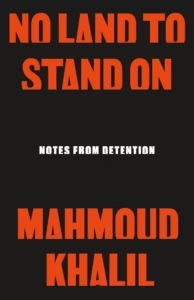
“For these tribulations, he became an emblem. Of what, depends on who you ask: of Palestinian resistance, of ‘woke’ campus politics, of the retrenchment of free speech, of supposed antisemitism. In his plainspoken memoir, No Land to Stand On, Khalil seeks to reestablish sovereignty over his own life story, at least, and re-center the underlying reason he ended up in this position: Since his grandfather and countless others were expelled from Palestine as a result of the Nakba in 1948, he and his community have been standing on borrowed land, at best tolerated by the authorities wherever they’ve managed to set down.
…
“Each chapter heading is a location—Jena, Louisiana, or Beirut, Lebanon, for example—and Khalil spends the book jumping around, mixing the chronology of his detention with memories of his upbringing and young adulthood. This never feels disorienting because the narrative is cemented around the core idea that, regardless of place and circumstance, he is defined by being Palestinian, both to himself and to the systems around him, a sense felt perhaps most acutely when it becomes evident that he will miss his son’s birth. For his entire time in the GEO facility, he has pushed away the possibility that he’d remain locked up for this moment; then his wife, Noor, goes into labor and the government denies his furlough request. ‘This was the fate of Palestinian men, I thought. Was I any different from the Palestinian prisoners who not only missed the birth of their children but also their lives?’ Khalil writes.
…
“This is not a story of stoic heroism but of constant estimation (and sometimes underestimation) of risk and the decision to accept it as the price of doing the right thing in a world of despots and cowards. It’s marked by fear, second-guessing, and frustration, all with no guarantee that things will actually get better. Khalil does not want to be shot at, or sought by the secret police, or detained in some for-profit gulag. He wants to live a normal life in his home with his wife and son, something that the world around him has decided is impossible, and so he struggles on.”
–Felipe De La Hoz on Mahmoud Khalil’s No Land to Stand On: Notes from Detention (The New Republic)
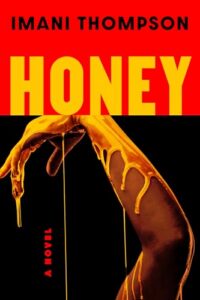
“Honey is a feverishly twisted and sharply sardonic tale. Yrsa, a killer who projects herself as a virtuous Black feminist, openly condemns racism and sexism. Owing to her claimed moral superiority, she feels justified in terminating men she deems culpable—scholarly philanderers, finance bros, American jocks. Not only does she indict these men for society’s ills, but she believes she possesses the right to erase the manosphere, one murder at a time, all under the banner of critical race studies. Her vengeance isn’t merely visceral—it’s academically grounded.
…
“Honey isn’t solely a serial-killer saga; it doubles as a satire of a culture obsessed with moral polish. The suspense of the revenge plot hinges on the buildup rather than the act itself. We watch closely as Hamlet weighs how best to avenge his father’s murder. The stakes lie in the ambiguous possibility that vengeance might be essential, yet it may never come to fruition. When Medea feels spurned after Jason’s death, her reprisal becomes our triumph, because we live through her bereavement vicariously.”
Honey uses this sense of ambiguity to propel the narrative forward. Yet, at moments, Yrsa’s inner core gets eclipsed by momentum. Revenge-as-propulsion for toppling male figures is not particularly novel, especially given its resonance with contemporary TV portrayals of Black women seeking retribution, such as Michaela Coel’s I May Destroy You or Donald Glover’s Swarm. We sense the book sets out as satire, but Thompson’s constant self-justification prevents readers from fully inside Yrsa—or any other character for that matter. ‘She does what comes easily,’ Thompson writes. ‘People think she’s ambitious because often she’s the best, but it’s not drive.’ And yet we rarely encounter Yrsa at her best, either.”
…
“Honey is the portrait of an erudite antihero who speaks in the language of redress yet has little investment in it; it traces a character’s estrangement from the society she claims she champions. The material inequalities tied to anti-Blackness, housing discrimination, or financial precarity remain largely unaddressed; Yrsa is a figure absorbed by her own grievances and disappointments. Her murder spree doesn’t feel ethically intricate; her acts are simply nefarious. Honey stands as a literary case study in which conflict isn’t about abuse. At times, we’re left wondering: Was Yrsa truly hurt, or does she merely imagine herself to be?”
–Edna Bonhomme on Imani Thompson’s Honey (The Nation)
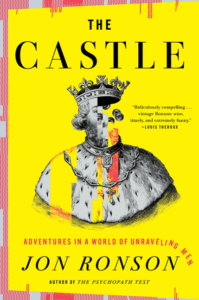
“I thought about Ye while I was reading The Castle, a new nonfiction work by the journalist Jon Ronson that attempts to unpack the motivations of wayward men who no longer fit into traditional society. Ronson is probably best-known for his 2015 book, So You’ve Been Publicly Shamed, a journalistic account of the emotional incentives and historical context behind the social-media-fueled frenzy that became known as ‘cancel culture.’ Like the people in that book, many of the subjects of The Castle have been shoved to the margins. But the forces at play in this new book are more disparate, and perhaps more stubborn, than an angry online mob. Ronson explores how men become alienated because they can’t achieve success in their chosen field, because they can’t pay their bills, because they have too much money, because the town around them went to hell. The book shows how their free will, coupled with a lot of free time on the internet, leads them to pursue their self-interest as best they can—which, eventually, begets more alienation.
…
“He’s especially interested in men ages 25 to 54 who are both unemployed and no longer looking for work—people he claims have ‘opted out of society,’ choosing instead a ‘life of male nothingness.’ In a moment of general anxiety about men—whom they vote for, what they’re reading, whether they share their feelings—his interest isn’t political. It’s empathic. He offers no prescriptive solutions, wags no fingers. Instead, he wants the reader to conceive of the scale of social anomie, and to envision the millions of other men chasing meaning in the wreckage of their former aspirations.
…
“Ronson doesn’t build toward any prescriptive conclusions; he gives these men a platform to explain how they feel, and allows the reader to weigh the validity of those feelings. I remember the Chism pile-on well, and was slightly horrified to hear the story from his perspective—how confusing it must have felt to toggle so rapidly and randomly between being seen as heroic and villainous. Ronson’s empathy is not boundless; he draws hard lines around some of Mark’s behavior. But he seems to understand that his personal judgment is more or less meaningless. The factors shaping these men are external, but how they react comes from the inside—and many of them remain trapped in their own metaphorical castles, far from the light.”
–Jeremy Gordon on Jon Ronson’s The Castle: Adventures in a World of Unraveling Men (The Atlantic)