

We frequently perceive breakups as private funerals. When a romantic bond ends, we sacrifice a shared vision of what life could be. We grieve the beloved, the common history, and the anticipated future, yet we often overlook the erasure of a particular version of the self. It is this precise fracture that can fuel rebirth. The termination of a relationship becomes the doorway to the rest of our days. At times, an awakening serves as the catalyst for the breakup—the self who entered the union no longer resembles itself. Other moments, the breakup ignites an unforeseen awakening. Hidden facets come into view. Our identity veers, and we encounter a mysterious self who learns to love again, as Galway Kinnell writes in his poem “Wait”: “The need for the new love is faithfulness to the old.”
My new collection The Going Is Forever traces the dissolution of a marriage and the many endings that blur separation from closeness. The poems resist the binary of leaving versus being left and welcome a continuing love in the wake of loss. Friends and family often press questions like “what happened,” hoping for a cause or a single narrative. In trying to respond, I have frequently felt inauthentic, defensive, guilty, and, above all, solitary. Poetry allowed me to confront the borders between privacy and disclosure, to acknowledge a commitment more to paradox than to any one person. In a poem, one can endure moments of not knowing, hold onto versions of a life that must be released, and break open toward the life that lies ahead.
Several of my cherished poetry volumes illuminate the delicate process of breaking up, with its intense states of yearning, anger, and sorrow—while also widening the capacity for joy, pleasure, and compassion. The books below refuse to treat breakups as a singular ending or to separate the breakup from the inevitable awakening that follows. When a relationship ends, language itself becomes a casualty alongside love. Virginia Woolf spoke of “the little language such as lovers use.” We lose the person we confide in in secret, and from this devastating silence, poetry redraws language. In non-linear lyric forms, these collections braid love’s harsh endings with its tenderest beginnings.
*
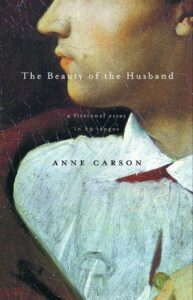
Anne Carson, Beauty of the Husband
In Carson’s “Essay in 29 Tangoes,” each fragment opens with an epigraph from John Keats as the speaker weaves together a meditation on Keats’s notion of beauty as truth with her husband’s allure and infidelity. By reframing the question of whether she will stay or depart, the work emphasizes how love often involves obsession and denial: “I can think of no reason not to be with you, / except the obvious one.” By pushing the limits of form, Carson demonstrates that there is no single narrative to a marriage, and that language, too, can be a beautiful falsehood.
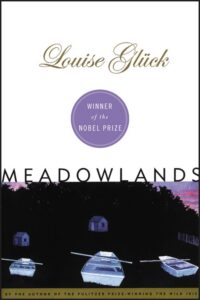
Louise Gluck, Meadowlands
If Anne Carson expands marriage into a dialogue about aesthetics with Keats, Glück places the dissolution of a marriage within an epic conversation with The Odyssey. Merging the private shattering of a home with the epic narrative of return, Glück adopts a measured, often ironic stance on life’s most painful moments. She intertwines her own story with the familiar tale, while also unraveling the stories she has told herself—not out of loyalty to her partner (as Penelope might) but as an inward awakening. The Odyssey closes with a homecoming, driven by Nostos (the hope of return). In Glück’s poem “Nostos,” a breakup becomes a homecoming to a ground of reality that can be sustained: “We look at the world once, in childhood. / The rest is memory.”
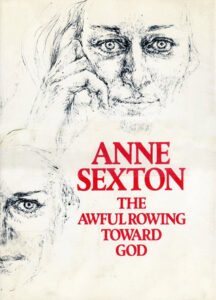
Anne Sexton, The Awful Rowing Toward God
Sexton composed the entire collection in a span of 20 days—the same stretch during which she chose to leave a marriage that had lasted a quarter of a century. The opening lines declare, “A story, a story! / (Let it go. Let it come.)” She presents the act of exiting the marriage as rowing toward a new self: “This story ends with me still rowing.” Breakups can function as a continuation of life. For Sexton, divorce is both a doorway and a cleansing of “the rat inside of me.” Departing from a cherished partner may involve discarding the worst parts of oneself.

Tiana Clark, Scorched Earth
Although this volume does not shy away from the sorrow that follows divorce, its heart lies in a celebration of Blackness, motherhood, and Queer desire, flowering into a more complete sense of the speaker’s identity. Indeed, loss expands the power to love. The afterlife of a romance involves a radical revival of self-love—there is ever more love to give: “O tiana I want to love you there.” In a title poem, an homage to “Black breasts,” Clark turns vulnerability into self-adoration. In the midst of feeling estranged from oneself, self-pleasure becomes a reminder of being alive: “Do you want to see me / touch me? Sometimes, I touch myself / because I don’t know if I exist.”
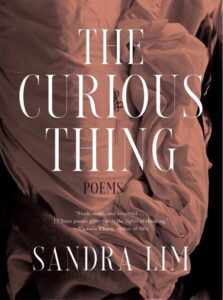
Sandra Lim, The Curious Thing
Although a thread of a breakup runs through the collection, the driving force is a reorientation of the self within the world. How has the speaker been altered by the places she has inhabited? In what ways does the past shape the present? Rendered in seemingly plain diction, the obstacle of a single love affair provokes an examination of desire and belonging. Yearning is not a lack but an invitation to imagine:
When there is anything
you want very much,
you are making up a story
all the time,
of how you will get it
and how it will be . . .
The lucidity of Lim’s questioning reminds us that poetry, like longing, offers both intimacy and containment amid crisis and estrangement.
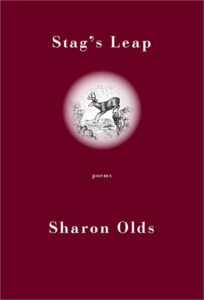
Sharon Olds, Stag’s Leap
I was in high school when I first encountered Stag’s Leap, Sharon Olds’sPulitzer Prize–winning volume. I barely knew what poetry was, much less sex, or marriage—or divorce! Yet I was stunned by the simultaneous flood of contradictory emotions: betrayal, rage, despair, exhilaration, tenderness, and nostalgia. Without the depth of love and intimacy the couple shared as they raised a family, I could not grasp the devastation of the husband’s infidelity and hypocrisy. If these are divorce poems, they are also poems of love. I think of Catullus’s “Odi et Amo.” Within a relationship or in its wake, love and hatred often inhabit the same space.
In the poem “Last Night,” the speaker relives the final time she and her husband made love (my poem “If I Have to Look Back” depicts a comparable moment in a marriage). Olds describes her physical motions as shifting from a chrysalis, an image of pain and rebirth. The familiar act of closeness becomes a shared ritual of dissolution, after which the speaker is awakened:
That was love, and we woke in the morning
clasped, fragrant, buoyant, that was
the morning after love.
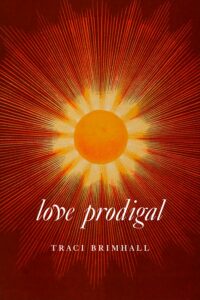
Traci Brimhall, Love Prodigal
Brimhall interweaves the end of a marriage with the beginnings of new love, and the arrival of a difficult medical diagnosis with the awakening of physical pleasure. Motherhood and Eros feed one another in radical ways. The natural world invites intimate connections that were previously unrecognized. This collection does not sentimentalize ordinary mess but reveals how love can celebrate imperfection. Through these poems, we witness how love, like illness, can be beyond our control: “It is sudden as conversion, / worthy of radiant trespass.”
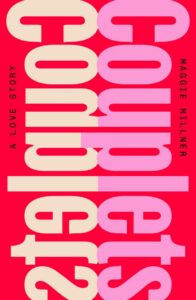
Maggie Millner, Couplets
In this bold, verse-novel crafted from rhyming couplets (in the first person) and prose-poems (in the third person), Millner presents a queer love story that begins with discovering oneself in a mirror. The opening lines declare, “I became myself” and culminate in:
But I was wrong. My eye loved
everything it fell upon.
And then one day it fell upon
a mirror. And he was nowhere
in the mirror. And she was everywhere.
The rupture extends beyond a man and into the idea of a heteronormative life. Falling for a woman, even though the romance ends, marks the start of a journey toward self-discovery. Just as Carson experiments with the form of “tangoes” to tell a nonlinear tale, Millner adopts the rhyming couplet to narrate a story of fracture, reflection, becoming, and undoing.

Katie Ford, If You Have to Go
Ending a relationship often begins in a manner akin to how a poem starts—by presenting a seeming contradiction: the certainty that is really doubt. When a beloved is lost, desire shifts its focus, but that does not mean desire disappears. One must continue, even as the meaning of that continuity remains uncertain. Although the object of desire (the husband) is gone, the desire itself reorients the speaker. This longing to believe in love again, while doubting its possibility, resembles a spiritual awakening. In a sonnet sequence about divorce, Ford writes:
I don’t know what I mean,
but I mean it. I don’t know what to want,
but I want it. And when I say God
it’s because no one can know it—not ever,
not at all—. It’s a wall.
And it drops to the floor as I fall.
The motions precede understanding, as lines loop, pause, and cascade toward discovery—more wound than solution. After the greatest love ends, we may discover that love is a higher power. The life we built fragments, yet the wall of what cannot be known also collapses as we are torn open. Breakups can undermine self-trust, but they can also convert us into believers.
Writing The Going Is Forever compelled me to reassess my identity as wife, mother, and daughter. Yet amid heartbreak, I heard what Sylvia Plath described as “the old brag of my heart: I am I am I am.” The more poems I composed, the louder that voice grew.
__________________________________
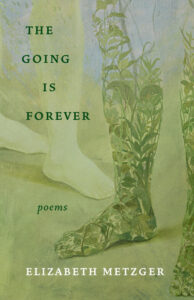
The Going is Forever: Poems by Elizabeth Metzger is available from Milkweed Editions.