
This first appeared in Lit Hub’s Craft of Writing newsletter—sign up here.
It began on January 8, 1981, when I started drafting a letter to my grandfather, who was dying in Chile. My initial aim was to tell him I remembered every tale he had shared with me, so they would not fade away when he was gone. The letter kept growing longer, and I soon realized it wasn’t a letter at all, but something else. It would become my first book, The House of the Spirits.
If I had set out to write a novel right away, I likely wouldn’t have gotten past the first few sentences. But since it began as a letter, like many I had written to my mother and others, I wrote without any expectations. By the second page it became clear that it wasn’t a normal letter; it carried the tone of a soap opera. My grandfather wouldn’t live to read it, but that didn’t discourage me—in fact, it gave me wings. I could write anything I wanted without fearing to offend him. I could weave his stories and alter them. Never again have I felt such an incredible sense of freedom to write.
At that time I endured twelve-hour shifts at the school. Free time was scarce, but my enthusiasm was boundless. Each night I came home and sat in my kitchen, typing away. As I recalled episodes from the past, the story took shape and the characters surfaced one by one, almost all inspired by my extravagant relatives and people I had known. I wasn’t daunted by the magnitude of the undertaking. Page after page, the narrative unfolded.
I kept writing for several hours every night and on weekends. The saga of the Trueba–del Valle family evolved organically, reflecting the larger story of the country. Although Chile is never named in the novel, it functions as the main character. In those years many Latin American nations endured repressive governments, military coups, dictatorships, and undeclared wars against the poor and Indigenous populations, often supported by the CIA in the Cold War context. The brutality seen in Chile resembled that in Argentina, Uruguay, Brazil, and Central America, where leftist movements and guerrillas were crushed with extreme violence. My novel could have taken place anywhere on our troubled continent.
I carried out my duties at the school as if in a waking dream, my mind completely absorbed by the story. When I finally could return to writing in the evenings, the words flowed as if dictated by a voice from deep memory. By year’s end, I had more than five hundred pages stacked on the kitchen counter.
That pile of paper was almost indescribable. It looked like a manuscript. There was only one copy, and making more in those days wasn’t easy. Throughout that year I wore those pages in a canvas bag slung over my shoulder, never letting them go, just as I had guarded my newborns with jealousy. I recall one time leaving the bag at the hair salon and panicking; by the time I returned to fetch it, they had tossed it in the trash, so I had to reach into a large street container to recover it. There it lay, intact, mockingly.
Since that first kitchen moment in Caracas, much has happened in my life, and I’ve written many books. Writing and reading are intimate experiences. In silence and privacy I converse with my reader; we communicate, we share, we greet one another across time and space. I offer something, and each reader interprets it differently. A novel is reborn every time someone reads it. I believe my books don’t belong to me; they are living beings that venture into the world to fulfill their destinies. With any luck, they may spark the imagination of some readers or touch their hearts.
_________________________________________
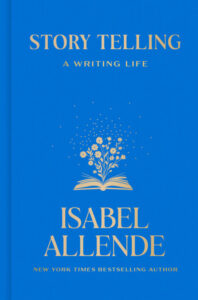 Excerpts drawn from Story Telling: A Writing Life by Isabel Allende. US edition published by Ballantine Books, an imprint of Penguin Random House LLC.