The American Academy of Pediatrics couldn’t explain why Martin, seven, rolled around on the living room rug, flinging his limbs and making crowing noises, while Teddy, not yet four, waited calmly on the front walk. Teddy pushed the empty wagon back and forth and sucked his thumb. Teddy was Emma’s precious, vulnerable baby who still nursed, who adored her exhausted body the way no man ever had. Martin, her firstborn, woke each morning with new schemes to turn Emma into someone she despised. He refused to climb into the wagon until he tracked down his troll doll with the neon pink hair and a hot-pink shirt that said TOTALLY RAD, and after ten minutes of flapping and cawing and not even looking for the troll, Emma wanted nothing more than to strike him. Instead, she leaned in until her nose nearly touched his and yelled into his face, If you don’t stop that I swear to God I will throw all your toys in the trash and I mean every single one do you hear me.
For reasons she couldn’t name, that shout didn’t make Martin stop. He only crowed louder in reply, eye to eye, as if she were the enemy and he a brave, defiant little freedom fighter. He wasn’t a baby. He was a big kid, which she yelled at him. She gathered every toy she could find and dumped them into the bin beneath her mother’s kitchen sink, where, of all places, she uncovered the TOTALLY RAD troll doll, so Martin was all right again, which meant she could be all right again, and both boys climbed into the wagon. Martin with his troll, Teddy with his plastic dragon, and Emma had managed to get through the morning without striking anyone. She carried a clogged milk duct in her right breast, swollen into a hard, veiny lump, yet she persisted in pulling her children toward the park.
“When you were fighting with Martin, two birds stopped singing,” Teddy observed, guiding his dragon over her head. The ache in Emma’s breast made her feel lightheaded. She wanted to go home. She hadn’t wanted to come to the park in the first place. She was here out of guilt. She was probably getting divorced. She was living temporarily in her mother’s house. She was here because the central organizing committee of Nation Awake, whose website claimed its mission was to build identity, support community, and win local power, had chosen Avalon, Ohio, for its first White Family Picnic.
At dinner the night before, Emma’s mother had read the coverage aloud from her phone. Nation Awake, as it turned out, had a local campus chapter right here in Avalon. It had grown from ten to thirty members in the past year alone, according to a student spokesperson who, pressed by endemic cultural Marxism at the university, wished to remain anonymous. In fact, membership in white nationalist groups had risen by at least fifty percent nationwide, and was still climbing. Nation Awake had invited organizations from Kentucky and West Virginia, from Pennsylvania and Maryland and Michigan. They were expecting hundreds of attendees.
“Why Avalon?” Emma asked. “I’d think we’re too small to be noticed.”
Eloise held up her hand and kept reading. Appalachia is an obvious choice, the spokesperson said. The region is overwhelmingly European. Avalon, for instance, has a population of twenty-four thousand. Twenty-two thousand of those residents are white. We’ve been sneered at, made to feel bad about ourselves in the name of diversity. But our pure Scots-Irish ancestry is a source of pride, not shame. Like the Avalon of legend, we will rise to defend the land and the people from darkness.
Eloise put the phone down. Can you imagine, she asked, in this year of our Lord 2017. Shameless. After what happened in Charlottesville this summer. And the media, my God. So voyeuristic and breathless.
In Emma’s view, Eloise sounded almost breathless herself. Emma rubbed her breast irritably.
“What happened in Charlottesville?” Martin asked. “Nothing,” Emma answered.
“What’s the Avalon of legend?” asked Martin.
“It’s not exactly that,” Teddy said, “it’s more like Legend of the Star Dragon,” one of his audiobooks.
“No, that’s not it,” Emma insisted.
“The counterprotest is at one,” Eloise said. “We’re trying to get numbers, but the mayor urged businesses to shut down and people to stay home.”
“Then let’s stay home,” Emma suggested.
“Absurd,” Eloise shot back. “White families need to say no.” That’s how Emma knew she was being told to bring the kids.
At the park, Emma skirted the police barrier reserved for opponents of the White Family Picnic. On the other side there were no baskets, blankets, hot dogs, ants, or white families—only a handful of League of the South men in drafty breeches and suspenders. On Emma’s side, turnout was also sparse. She found her mother and her aunt Dev at the fountain, handing out placards that read NO WHITE SUPREMACISTS ALLOWED. Emma parked the wagon beside them and sank onto the steps. Her breast felt like a throbbing alien egg ready to crack. “Teddy, I need you to nurse,” she pleaded.
“Teddy doesn’t want to nurse from your disgusting monster boob,” Martin said, stuffing his troll doll into his mouth.
“As soon as we get home you’ll be spanked,” Emma warned him.
“You spank him too much,” Eloise interjected.
How much is too much? Once this week. Twice the week before. The American Academy of Pediatrics was unequivocal on the matter. Not only was corporal punishment wrong, it also didn’t work. Emma had scrolled through the whole useless statement. Of course it was wrong. Of course it didn’t work. Yet, again and again, it was what she did. Emma loved Martin with a tenderness that could break her, and just as certainly she desired to strike him. The Academy had little to say about what Emma typed into the search bar on sleepless nights. Violence. Instinct. Desire.
“You spanked me,” Emma said hesitantly.
“I never did,” Eloise replied.
“You hit me with a hairbrush,” Emma retorted.
“That was a different time,” Eloise said. “Besides, reflexive violence is nothing compared to systemic violence.” She handed a placard to a Happy Hills attendant whose hair was teased into a cotton-candy bouffant.
“I still don’t understand what you mean when you say that,” Emma admitted.
“I would never have told you later that I intended to spank you,” Eloise said. “That’s cruel. It creates a system of pain, fear, and punishment. I simply expressed my natural feelings in the moment. No premeditation. No plan. When it was over, it was over. It was honest. Emotional.”
“You could try the Discipline Café,” Dev suggested.
“The Discipline Café?” Emma asked.
“It’s at Mother Ginger’s,” Dev explained. “The new childcare cooperative. You know, where the uncooperative hardware store used to be.”
“Right,” Emma said, and didn’t explain, even to herself, why she hadn’t been there yet. If Dev wasn’t Emma’s real aunt, there was no better word for her. A restless wanderer. A cool customer. Eloise’s best friend for nearly forty years. She wore her signature bleach-stained black T‑shirt with a pocket for gum. She wore her signature mint-green Keds. She tossed Dum-Dums to Martin and Teddy, who nearly toppled the wagon as they clawed for them.
Eloise held up a placard. “Did you take a look at these yet?” she asked. “Woody printed them on the Multigraph I gave him. Pretty impressive, right?”
“Woody didn’t show up, did he?” asked Emma.
“He’s contributing in his own distinctive way.”
“He’s using,” Emma said.
“Your brother needs your support, not your judgment,” Eloise said. She handed Emma a placard. “Bring one of these to Mother Ginger’s when you go.”
“I never said I’d go.”
“We want them up in all the local businesses.”
“Oh, Mom, I don’t know,” Emma said. She slid her hands into her pockets so she wouldn’t have to take it.
Her mother regarded Emma the way she had since she was a baby, as though she might change. “Listen,” she said. “That thing with the hairbrush—hitting or whatever you called it—I would never do that now. People change. At the molecular level I’m a completely different person. That’s scientific.” She slipped the placard into Emma’s tote. Emma’s breast jolted with a sharp ache. She tugged at the collar and saw a white scab forming on her nipple. The American Academy of Pediatrics had little to say about breastfeeding beyond age two, but Teddy wasn’t ready to stop and Emma didn’t know how to stop him.
“I’m hungry,” Martin announced in his pterodactyl voice, perfectly tuned to make Emma want to flee her own body. “And Teddy’s hungry too. We’re both hungry.” He started flapping his arms. “Hungry hungry hungry hungry hungry hungry hungry hungry.” The Academy had little to say about maternal instinct. Emma had once thought it was a myth. Now she knew it was real. Before Martin, she had never felt that ache in her arm, that overpowering urge to unleash a big, decisive blow. Now she could not ignore it.
__________________________________
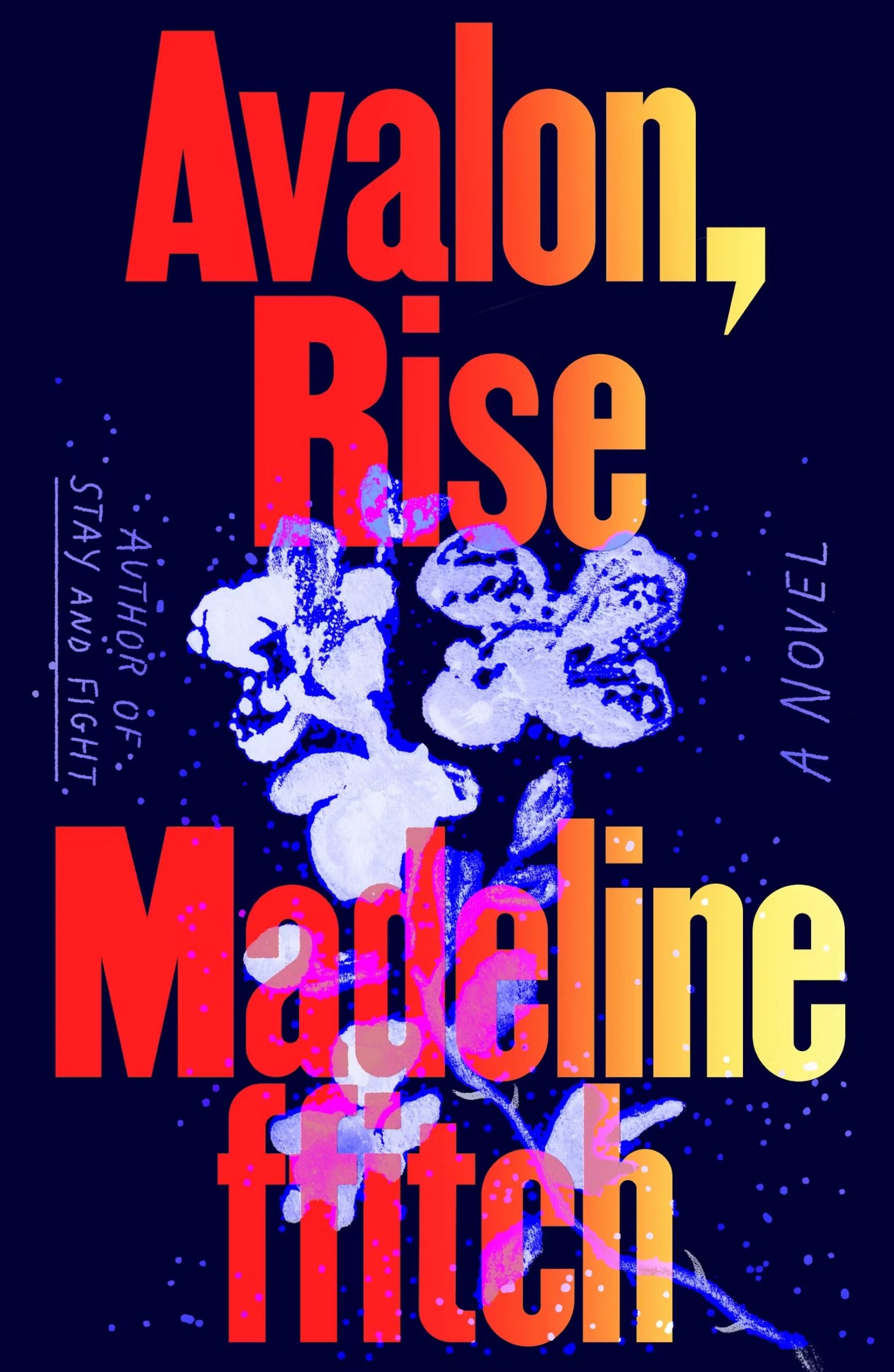
From Avalon, Rise: A Novel. Published by Farrar, Straus and Giroux. Copyright © 2026 by Madeline ffitch. All rights reserved.