“We warn our opponents not to drive us to the uttermost,” he bellowed. “Hunger is preferable to disgrace, and deprivation is to be preferred to dishonor.”
And, as it turned out, the punitive terms of the treaty fostered intense resentment, which ultimately morphed into political—and military—action.
A proportional elective system, where a party gains seats in parliament in proportion to the share of votes it receives rather than via a winner-takes-all rule, ensures that a broad spectrum of beliefs can gain voice. To form a government, coalition agreements are necessary because no single faction secures an outright majority. In such a fragmented landscape, even a small party with a handful of votes can swing the balance and wield outsized influence. The system also invites a proliferation of parties with divergent ideologies, each competing for support.
Although this arrangement might seem like the purest form of representative democracy in principle, in reality it frequently produced governments that were unstable or prone to continual reshuffling as alliances shifted. In the Weimar Republic, for instance, a dozen or more parties regularly won seats in the Reichstag at different times. Participants included Ebert’s liberal Social Democratic Party (SDP), the moderate Centre Party, the Communist Party (KPD), and the far-right German Workers’ Party, which evolved into the Nazi movement formally known as the National Socialist German Workers’ Party.
The Nazi Party.
Formed in 1919 by a handful of men, among them a locksmith and a journalist, the party emerged to speak to middle-class workers disenchanted by the terms of the Treaty of Versailles and frustrated by the Weimar government’s inability to stabilize the economy. From its inception, it rejected democratic reforms and embraced anti-government, anti-Communist, and anti-Semitic stances. Its weekly gatherings took place in the back of a beer hall in Munich.
The German Army, alarmed by some of the small parties’ Communist leanings, instructed soldiers to attend their meetings and report back. In September 1919, war veteran Corporal Adolf Hitler was tasked with monitoring the right-wing Workers’ Party. Hitler, born in Austria-Hungary, had struggled to gain admission to an art school in Vienna and eked out a living painting small watercolors. He avoided compulsory military service by relocating to Munich, but when war resumed, he enlisted and fought on the Western Front, where he sustained injuries. While assigned to report on the beer-hall meetings, he found his niche. He embraced the party’s radical, anti-Semitic platform, which aligned with his own racist, ultranationalist beliefs. He became the fifty-fifth member of the party.
Hitler’s exceptional oratory propelled him to the top of the party leadership, and after leaving the army he devoted himself to the party full-time. In his early speeches he began to describe Germans as Aryans, a so‑called “master race” responsible for humanity’s major achievements. In his political autobiography and manifesto, Mein Kampf, he asserted that “Everything we cherish on this earth today—science and art, technology and inventions—is the creative product of a few peoples and originally perhaps one race.”
When Germany endured the Great Depression of 1929, Hitler found himself positioned to appeal to the people’s needs and fears, and to channel their deepest anxieties into political momentum.
Aryans.
With the Weimar government shown to be ineffective in solving the country’s countless problems, a growing segment of Germans began seeking radical remedies. By 1923 the Nazi movement had attracted more than fifty thousand members, including respected World War I commander Erich Ludendorff. Hitler and Ludendorff believed the party had reached a threshold that could spur a coup d’état.
Their attempt began with an uprising in the Munich Beer Hall. The Nazis claimed to have seized control of the Bavarian state government and expected a nationwide wave of support that would topple the Weimar regime. “The government of criminals sitting in Berlin is deprived of office,” Hitler boasted. “Tomorrow will see the establishment of a nationalist government in Germany, or it will see us dead. There is no middle ground.” General Ludendorff was proclaimed dictator. In Berlin, President Ebert denounced Hitler, Ludendorff, and their followers as traitors. The army, however, remained loyal to the republic. The next day, Munich police confronted roughly two thousand Nazis marching through the city center; in the ensuing shootout, sixteen Nazis, four police officers, and a bystander were killed. Hitler was arrested and charged with treason. The month-long trial would amplify his visibility and give him a platform to disseminate Nazi propaganda. As “steel-helmet soldiers reinforced by Munich police” blocked pro‑Nazi demonstrations, Hitler was found guilty of treason and sentenced to five years in prison, though he served only about eight months. The trial, far from crippling him, became a propaganda victory for the party.
General Ludendorff was acquitted, perhaps because of the wartime respect he enjoyed.
Rather than serving five years, Hitler left Landsberg Castle Prison after a little over eight months. While incarcerated, he composed Mein Kampf, in which he left no room for ambiguity about his aims, declaring, “The weapon of ruthless, brute force is of greatest value in war between two divergent worldviews…The 1914 frontiers mean nothing for Germany’s future. They were not a safeguard in the past, nor will they guarantee power in the future.”
Many European and American politicians tended to dismiss the threat, believing, as the Brooklyn Eagle put it, that his release signaled that the Bavarian government had grown tired of Hitler’s ambitions. Their confidence would be shaken in 1925 when seventy-eight-year-old Field Marshal Paul von Hindenburg, who had commanded the German forces in the war, became the first directly elected president of the Reich. He won by a wide margin over his opponent. The conservative, authoritarian Hindenburg was the right-wing candidate, and many supporters hoped he would use his authority to undermine the republic from within. Yet in his inaugural address he urged that “no war nor internal uprising will set the nation free without patient, orderly labor… The President must safeguard the sacred principle of justice.”
Despite the obstacles, Hindenburg managed to bring a measure of stability and prosperity to Germany. Currency reform and increased foreign investment helped steady the economy, though this came with sizable borrowing from the United States to satisfy reparations and to sustain industry. In 1925 Germany concluded several agreements with former wartime adversaries acknowledging current borders, which opened the door to joining the League of Nations, restoring some national pride, and enabling Germany’s re-entry into international politics. German culture regained prominence—Bauhaus, the famous school of art, architecture, and design founded in 1919, profoundly influenced global creative practice. The constitutional liberties fostered a lively culture that transformed Berlin into a cosmopolitan hub of intellect.
Yet beneath the surface glamour and economic revival, the Nazi movement continued to expand, waiting for a moment to seize more power. When the world was hit by the Great Depression in 1929, Hitler found himself well positioned to respond to the public’s hopes, fears, and above all, anxieties.
*
The Nazi propaganda apparatus, masterminded by Hitler alongside Joseph Goebbels and architect Albert Speer, blended political strategy with psychological techniques to create a pervasive culture that reinforced the myth of the infallible leader. Der Führer, the term he would later employ for himself, was presented as a man who truly understood the struggles facing ordinary people. The party began staging carefully choreographed gatherings in Nuremberg, designed to trigger emotions and make attendees feel part of a movement larger than themselves—that they truly mattered. By 1929 the Chicago Tribune reported that around “120,000 uniformed Hitlerites marched before their leader,” though other sources estimated lower figures.
Nevertheless, before the Depression the extremist Nazi faction remained marginal in electoral affairs. In the 1928 vote they captured only 12 of 491 Reichstag seats. The stock market crash of the following year hit Germany particularly hard. American banks demanded repayment of loans, deepening the economic crisis. By mid-1931, virtually all banks were shuttered as businesses failed and unemployment surged, with hyperinflation erasing the savings of many citizens.
The Reichstag’s response was limited, and President Hindenburg assumed emergency powers, with Chancellor Heinrich Brüning issuing decrees aimed at stabilizing the economy. Yet none of these efforts succeeded. Democratic hopes collapsed as six million workers were unemployed by 1932, industrial output had fallen roughly 42 percent, and the public grew desperate. Radical options gained traction on both sides of the spectrum, with the Nazis rising as a dominant force on the right and the Communists on the left. Hitler’s movement rose to become the second-largest faction in the Reichstag, making it impossible to overlook its influence.
In times of crisis, communities often search for scapegoats, and the Nazis became adept at blaming Jews, Communists, liberals, and other non‑Aryan groups for Germany’s ills. As misery spread, anti-Semitic hostility intensified.
The presidential race of 1932 pitted 84-year-old Hindenburg, backing the anti-Nazi centrists; Hitler, age 42, running on a nationalist platform; Communist Ernst Thälmann; and Theodor Duesterberg, leader of a major veterans’ association. Hitler traveled extensively by plane, attending multiple rallies daily, while the other candidates pressed their own, more traditional campaigns. A Toronto Star report described the spectacle of Hitler’s arena events, where thousands rose in unison to salute him, and where his oratory converted crowds into fervent believers. The piece captured the sense that Hitler’s mass appeal bordered on religious fervor—an evangelist who could found a new dogma, an actor who could command packed theaters, a politician who could trigger a revolution.
Hindenburg ran as the stabilizing force who could unify moderate factions and maintain a democratic government, while Thälmann promised to overhaul the capitalist system in favor of a socialist order modeled on the Soviet example, reining in private ownership to benefit the broader populace.
The electoral system required two rounds of voting; if no candidate secured a majority in the first, a runoff would decide the presidency weeks later. American papers anticipated a tight race, with Hindenburg possibly halting the Fascist surge by a narrow margin, though not decisively. In the first round, Hindenburg captured 49.6 percent, just short of a majority and forcing a runoff. Hitler trailed by about seven million votes, with roughly 30 percent of the total. Some observers warned that a Nazi victory remained a danger to the nation and Europe. In a Des Moines Register piece, the warning was stark: a Hitler triumph in April could unsettle the continent’s future.
In April 1932, Hindenburg narrowly won the runoff with 53 percent of the vote, while Hitler’s support grew by more than two million. After the result, Hitler proclaimed a “great victory,” claiming that the people, in facing persecution, had proven themselves worthy to advance the banner of national liberty, and that the next phase of struggle would begin.
To curb the rising right, Hindenburg brought in conservative diplomat Franz von Papen as chancellor. Papen, a monarchist at heart, believed that an authoritarian framework could rescue Germany from the Depression’s worst effects.
Even as Hitler had suffered a setback in the election, his overall popularity continued to rise. In late July, Hindenburg, seeking to restore confidence, called another set of elections. This move backfired: the Nazis surged to command 230 of 608 seats, winning 37 percent of the vote and becoming the largest single faction in the Reichstag. The Social Democrats trailed with about 21 percent, and the Communists with roughly 14 percent.
*
As the leader of the largest party, Hitler pressed to be named chancellor. The president disliked him, reportedly remarking that Hitler could be made “a postmaster with my head on the stamps”—an image that underscored how far he was from being welcomed. Yet Papen’s authority had waned, and his successor, General Kurt von Schleicher, failed to fracture the Nazi bloc. The attempt to split the Nazi movement by backing Hitler’s rival ended disastrously.
The tally in the votes did not determine the outcome. Hitler had harnessed democratic tools to undermine democracy itself. The election was neither free nor fair.
German politics had become tangled, volatile, and perilously combustible. Hitler did not hold a formal elected office, but his command over a vast mass following gave him power equivalent to any official. While the army remained loyal to the Weimar government, his options to seize control were still constrained. To dismantle the existing regime, he first needed to insert himself into the government structure.
Hindenburg finally concluded that he had to address the threat Hitler posed directly. He agreed, after persuasion by Papen, to bring Hitler into the cabinet so he could be checked from within.
It was a calculated gamble: by granting Hitler a share of power, Hindenburg hoped to curb his influence.
On January 30, 1933, Hitler was appointed chancellor after days of negotiations. United Press noted that the old Field Marshal insisted Hitler would hold only a minority of cabinet seats and would not be allowed to install a dictatorship, should that be prevented.
“The question is, can it be prevented?”
The dispatch reflected a common belief that this small, unassuming man with the distinctive mustache might still be restrained, at least for a while. Yet the Chicago Tribune later explained why millions of Germans gravitated toward him: Hitler had given his followers renewed self-belief, faith in their country, and hope for a future. For that, millions of Germans idolized him.
And once Hindenburg invited him into the government, Hitler moved swiftly to transform Germany into a dictatorship. His immediate move was to secure permission for a fresh round of parliamentary elections in the following March. The campaign quickly turned violent, with Nazi squads intimidating opponents, breaking up meetings, and vandalizing newspapers and printers with near‑total impunity.
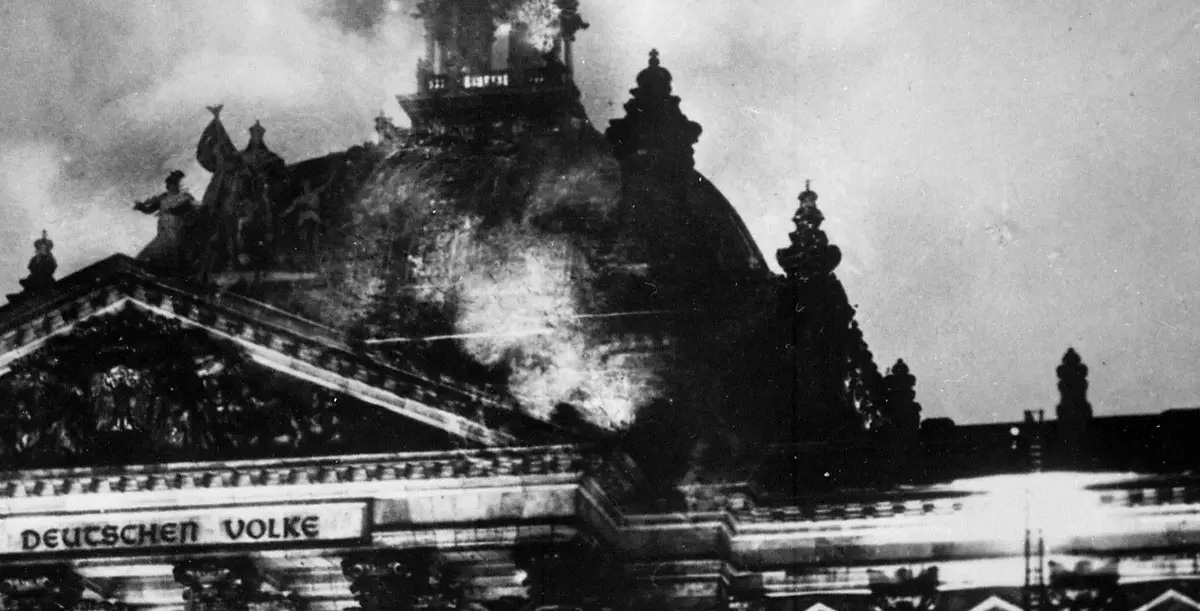
The legal takeover began five days before those elections when a massive fire enveloped the Reichstag. A 24-year-old Dutch Communist, Marinus van der Lubbe, was caught at the scene, allegedly carrying plans to ignite further targets and spark a “bloody Bolshevik revolution and civil war.”
Questions immediately arose about this claim; the incident appeared suspicious for an arsonist to have passports and planning documents in his possession, and how he could have smuggled so much gasoline into the building remained unclear. Some historians have argued that the Nazis themselves may have started the blaze. While van der Lubbe was convicted of treason and arson and executed, no conclusive evidence has ever settled the matter.
Regardless of who started the fire, it furnished the Nazis with a pretext to seize more power. While firefighters battled the flames, the cabinet produced an emergency decree “for the protection of the German people against the Communist danger,” which effectively legalised a state of emergency. Civil liberties were suspended and political opponents were jailed. The Communist Party was outlawed; around a hundred Communist Reichstag members were arrested, opposition demonstrations were banned, and left-leaning newspapers were forbidden to publish. Four thousand Nazi storm troopers were armed and given police powers, and in the next days thousands more were imprisoned.
Even as the other members of Hindenburg’s cabinet failed to curb the Nazis, Europe watched with fear. The Times of London warned that the Continent faced a calamity comparable to the world wars that had preceded it.
With the elections already decided in the Nazis’ favor yet the parliament still to vote, the outcome was effectively a foregone conclusion. The Associated Press would declare that the German democracy, living only a brief 15 years, had collapsed, and that Hitler, by suppressing opposition, occupying Communist centers, breaking up assemblies, and mobilizing his Brown Shirts to terrify voters, had negated whatever the Reichstag might have produced in a future electoral result.
As chancellor, Hitler demanded—and the new Parliament granted—an Enabling Act that granted the cabinet, under his dominance, dictatorial authority. It stipulated that laws could be enacted by the cabinet without Reichstag approval and could deviate from the constitution.
From a balcony, amid a roaring crowd shouting “Heil Hitler,” he proclaimed, “The first chapter of our movement is closed. Now we begin the second.”
Throughout the remainder of 1933, Hitler extended his grip. He dissolved all other political parties and trade unions, imprisoned opponents in the first concentration camp at Dachau which would become a training ground for guards and a model for later camps, and initiated a systematic persecution of Jews, including a nationwide boycott of Jewish-owned businesses and barring them from government employment, higher education, and the practice of law. He installed governors to exert authority over state legislatures and set in motion the steps toward rebuilding Germany’s military capacity by withdrawing from the League of Nations, which had limited its strength.
The one person who could have stopped him, President Hindenburg, did not act decisively for a complex mix of reasons. When Hindenburg died in August 1934, his estate announced that Hitler had been designated as his direct successor as head of the German state just before his death.
Hitler then declared himself both president and chancellor, taking the title Der Führer, the supreme leader, and he legitimized his rule with a referendum showing overwhelming support. Yet, as many observers noted, the turnout and vote total did not reflect a free or fair process; even American papers observed that the tally did not eclipse the momentum he had already built in the months prior.
The numbers themselves mattered less than the reality: Hitler had exploited the democratic mechanisms to erode democracy itself. The campaign and referendum were not conducted on an even field.
In addition to the manipulation and coercion, throughout history, powerful figures have used fear to shape outcomes. The Nazi regime demonstrated that dissent could be punished severely, with opposition imprisoned or killed. The 1933 Law Against the Founding of New Parties effectively ended organized political resistance. Meanwhile, the Nazis restored a sense of national pride that many people believed had been sacrificed after the Versailles settlement. While some voted to back Hitler’s referendum as a display of national revival, many others were swayed by the perception that Germany deserved and would regain its rightful place on the world stage.
The result, though illegitimate, drew global attention.
In the years ahead, Hitler rebuilt the military and enacted further racial and anti-Semitic laws. He introduced a personal oath of loyalty to the Führer, binding citizens to him rather than to the state. By late 1934, hundreds of thousands attended the yearly Nazi rally in Nuremberg, which became a monumental propaganda triumph when Leni Riefenstahl’s film Triumph of the Will introduced the rebuilt, militarized Germany to an international audience. The 1936 Berlin Olympics offered a global showcase of a Germany reborn and determined to demand recognition of its ambitions on the world stage.
Europe did not know how to respond. During the Olympic opening ceremonies, for instance, the Atlanta Constitution described how spectators from various nations greeted the events with mixed enthusiasm; the French team saluted the Nazis and Hitler returned the gesture, while France simultaneously fortified its Rhineland defenses, wary of Germany’s reassertion of power and the potential unraveling of the Versailles and Locarno accords.
Hitler’s ambition for a vast empire—a Third Reich lasting a millennium—took shape with the 1938 annexation of Austria. World War II began with the invasion of Poland on September 1, 1939, provoking Britain and France to declare war. By the time the führer died by his own hand in a bunker in Berlin on April 30, 1945 and Germany surrendered a week later, more than seventy nations had become involved. The conflict claimed the lives of roughly fifty million civilians and twenty-five million soldiers, including 5.3 million German troops. In countless camps across Germany, Poland, Austria, and territories under occupation, six million Jews—over a third of the global Jewish population—were murdered. The war left vast segments of Europe in ruins, redrew borders, displaced millions, and created a disturbance that reverberated for decades. The postwar era saw new alignments, the emergence of a Cold War, and enduring regional and global tensions that reshaped international life for years to come.
From a dim back room of a beer hall to the center of a totalitarian regime, Hitler’s ascent embodies a stark warning: democracies can be subverted from within, and institutions designed to protect liberty can be repurposed to extinguish it.
____________________________
Excerpted from The Elections That Changed the World: Fifteen Pivotal Moments That Shaped How We Live by Dana Bash, with David Fisher. Copyright © 2026 by Dana Bash and David Fisher. Published by arrangement of Hanover Square Press/HarperCollins Publishers.