
The azaleas growing by the new hospital’s gates are in full bloom, a bright pink that makes my eyes sore.
The azaleas outside the gates of the new hospital are in full bloom, a vivid pink that can feel almost overwhelming to the eyes.
May is my wife’s favorite month. She’s always said that May evening skies are the most beautiful, with their layers of orange, yellow and blue. Back when we were engaged, we treated ourselves to an evening out at a fancy hotel. The May sky looks just like the cocktail she sipped that night, at the bar on the top floor: a gradually deepening ultramarine, with a scattering of twinkling stars. She could have spent hours looking at it.
May has always held a special place for my wife. She used to insist that the evenings in May reveal the most stunning palettes of orange, gold, and blue. When we were newly engaged, we indulged in a night at an upscale hotel. The May dusk resembled the drink she enjoyed that evening, up in the bar on the top floor: a slowly intensifying navy hue, dotted with twinkling stars. She could have stood there for hours.
Last month, she was transferred to her third hospital. It’s not as small as the first one she stayed in, nor as big as the second, but somewhere in the middle.
A month ago she moved again, to a third hospital. It isn’t as compact as the first place, nor as expansive as the second, but sits somewhere between.
The automatic doors open, and I step inside. This hospital interior looks like a hotel, its curtains and walls in matching pink.
The automatic doors glide open as I enter. The hospital interior resembles a hotel, with pink curtains and walls painted in a coordinated shade.
I’m almost always able to keep my promise of visiting on Mondays, Thursdays, Fridays, Saturdays, and Sundays. I’ll pop in on other days too when I can, even if just for a half hour. It’s caused a few difficulties at work – I’ll bow to my superiors, peers, and subordinates and excuse myself early, or sometimes I’ll ask them to take on some of my workload. Some of my professional relationships are starting to feel strained, and work has begun to pile up.
I manage to visit most Mondays, Thursdays, Fridays, Saturdays, and Sundays, and I squeeze in additional days when possible, even if only for a brief half-hour. This has created some friction at my job—I bow out early or delegate portions of my duties to others. Several of my professional connections are beginning to feel strained, and the workload is mounting.
Most people are kind. They’re sympathetic and ask me to pass on their best wishes when I go to see her. So far no one’s seemed to mind my adding to their workload. So when I say these relationships are ‘starting to feel strained,’ I might be overthinking it.
The majority of people are kindhearted. They express sympathy and ask me to convey their bets wishes when I visit. So far, no one seems to object to my side tasks; when I mention that these ties are “beginning to feel taxed,” perhaps I’m reading too much into it.
Whenever I tell people about my wife, they want to know what she’s been diagnosed with, what stage her illness has reached, how long she has left.
Whenever I mention my wife, people press for details—her diagnosis, the stage of her illness, and how much time remains.
I’ve had these questions thrown at me from more people than I can count. Everyone is curious about death. They want to know how long a stranger has left. But we’re all moving toward death. It starts seeping into babies’ cells right from the moment they are born. No one – ill or otherwise – knows how long they have. It’s like that story about the god of death, who gives us each a candle. The candles are all different lengths, gradually burning out, and there’s no way of knowing how long each one is. None of us has an eternity – only our allotted time.
I’ve heard these questions from more people than I can tally. Death fascinates many; they want the remaining hours of a stranger. Yet we’re all heading toward death. It begins infiltrating a newborn’s cells the moment of birth. No one—sick or well—knows their own duration. It’s akin to the tale of the death god handing out candles. Each flame lasts a different length and fades away unpredictably. None of us possesses immortality—only the time we’re allotted.
Most people here don’t see it this way, though. We’re all born equal, they think, so we all start out with the right to live to the average age. But certain people lose that right, they imagine, because of choices they make.
But many locals don’t view it like that. They believe everyone starts with equal standing, entitled to live to the average lifespan. Yet they imagine that some lose that entitlement due to the choices they make.
Lived irresponsibly.
Skipped their health checks.
Careless with their diet.
Heavy smoker.
Lived irresponsibly.
Missed health screenings.
Careless with their diet.
Heavy smoker.
They try to make sense of other people’s timelines and seem to think that only those who have been given a life expectancy by a doctor are moving toward death. Everyone else is moving toward life.
They attempt to rationalize others’ timelines, convincing themselves that only those granted a life expectancy by a doctor are heading toward death, while everyone else advances toward life.
If I avoid telling the story of how long my wife has left, saying vaguely that I’m ‘looking after my wife, who is ill,’ I’m asked whether there are other people who could look after her, and if I might not be better leaving it to the professionals. Taking leave is not seen as an employee’s ‘right’ in Japan, and few think that someone’s quality of work could improve if they’re able to live fully, without regrets. I’m sure I’m in the minority in managing to reduce my hours for a while. I probably wouldn’t have been able to do even this much if I were working elsewhere. Still, I struggle to feel any straight-forward kind of gratitude.
If I avoid detailing how long she has left and say I’m merely “caring for my sick wife,” people ask whether there are others who could care for her and if perhaps professionals should handle it. In Japan, taking leave isn’t widely regarded as a guaranteed employee right, and few believe that one’s work quality improves when one is free to live more fully, without regrets. I suspect I’m in the minority by reducing my hours for a period. I might not have managed even this in another job. Still, I find it hard to feel a straightforward sense of gratitude.
We have ‘condolence leave,’ but what’s the point of having time off once someone is dead? Maybe I’m asking too much, but I can’t help wishing that my colleagues would understand why I’m taking time off without needing me to tell them how long she has left.
We do have condolence leave, but what good is time off after death? Perhaps I’m asking too much, yet I’d prefer my coworkers to grasp why I’m stepping away without me having to spell out her remaining time.
My wife is still facing forward, toward life. She’s trying to move in the direction of light, and not to let herself be swept away by this singular current.
My wife continues to look ahead, toward life. She strives to move toward light, resisting being carried away by this single, overwhelming current.
I wonder how to get people to understand, without succumbing to the countdown narrative. Without showing them that I’m losing hope.
I wonder how to make others understand without falling into a countdown narrative or revealing that I’m losing hope.
Recently I’ve started just plainly stating what’s been happening:
Recently I’ve begun speaking plainly about what’s transpiring:
‘The hospital called us in urgently three times last month, saying “She’s in critical condition, please get here as soon as you can.” They told us things like “She’s losing consciousness,” or “The oxygen in her blood is falling.” I jumped into a taxi in the middle of the night. Her condition improved, but it seems like these kinds of things could happen at any time now’
‘Three urgent calls from the hospital last month said, “She’s in critical condition—please get here as soon as you can.” They warned that she was slipping in and out of consciousness or that her blood’s oxygen level was dropping. I rushed to a taxi in the middle of the night. She improved for a while, but episodes like that could occur at any moment now.’
Still, it feels like this has less impact than something as simple as a life expectancy.
Nevertheless, it feels less tangible than a single life expectancy figure.
*
The doctor who told us about my wife’s condition, that time in the conference room, was a man I guessed to be in his early fifties. His thick-rimmed black glasses and short hair peppered with grays made him one of the more memorable doctors. He had a calm air about him and was well-attuned to how we were feeling. I understand that this word is a hard one to hear. He was careful to leave a pause before it. After our initial silence, he listened patiently both to the questions we asked and to all our various grumblings, muddled up as they were with shock and confusion, and concerns about money and work (which of course had nothing to do with him). He looked at my wife when he spoke to her, respecting her intelligence and without trying to hide the details from her. He showed her all the scans, used the proper medical terms, and explained the stages of her illness. The one thing he never discussed was her life expectancy, but even at that point it was obvious to us that there wasn’t really a future to speak of. I wonder what made it so. Maybe it was the scans showing that the cancer had spread to her peritoneum. But no, I don’t think it was just that. It was clear in the little things he said, and his expression when he said them.
The physician who delivered the news about my wife’s condition, in that conference room, struck me as a man probably in his early fifties. His thick black-rimmed glasses and hair tinged with gray gave him a durable impression. He carried a composed aura and was perceptive to our mood. I understand that this word is a hard one to hear. He paused before saying it. After our initial hush, he listened with patience to both our questions and the many complaints born from shock, confusion, money worries, and work concerns (which, naturally, had nothing to do with him). He spoke to her directly, meeting her gaze, respecting her intellect and not concealing the details from her. He showed her every scan, spoke in precise medical terms, and outlined the stages of the illness. He never spoke of a life expectancy, yet it was clear to us that a future did not look promising. I wonder what exactly signaled that to him. Perhaps the scans showing peritoneal spread, though I don’t think it was only that. It showed itself in the small things he said and in the look on his face.
I didn’t want to know what her life expectancy was. What good would it do?
I wanted to hear the name of her illness, and for her to hear it as well. For us to hear it together, as husband and wife. I couldn’t see how we’d be able to put our trust in each other, and in the hospital or the doctors, if we didn’t know the name of the thing.
I didn’t want to know what her life expectancy was. What good would it do?
Hearing its name didn’t rob my wife of her individuality. The label might be the same as the one given to others with this condition, but that didn’t mean she’d become interchangeable with them. Maybe it helped that the doctor didn’t talk in statistical terms. So often, when people talk about the different types of cancer, they also talk about the prognosis: ‘This is what happens to X number of people after Y number of years.’ People are always making these kinds of statements. Percentages are important for researchers and practitioners, no doubt, but I wonder if they’re necessary for patients just living their own lives? It’s foolish to spend the everyday thinking in terms of percentages, as if you’re in some kind of lottery. Some doctor hands you a life expectancy, and you shape your life around that? Nonsense. Where’s the sense in being that passive? Where’s the sense, also, in being brainwashed by clichés? By platitudes like a peaceful and dignified death and silly words like natural. Who cares if it’s peaceful or natural? Someone’s life – a happy life – is coming to an end. That’s what I think, anyway. I’m not sure if my wife feels the same as I do, but she didn’t ask the doctor for a life expectancy that day or about what caused her cancer.
Hearing its name didn’t rob my wife of her individuality. The label might be the same as the one given to others with this condition, but that didn’t mean she’d become interchangeable with them. Maybe it helped that the doctor didn’t talk in statistical terms. So often, when people talk about the different types of cancer, they also talk about the prognosis: ‘This is what happens to X number of people after Y number of years.’ People are always making these kinds of statements. Percentages are important for researchers and practitioners, no doubt, but I wonder if they’re necessary for patients just living their own lives? It’s foolish to spend the everyday thinking in terms of percentages, as if you’re in some kind of lottery. Some doctor hands you a life expectancy, and you shape your life around that? Nonsense. Where’s the sense in being that passive? Where’s the sense, also, in being brainwashed by clichés? By platitudes like a peaceful and dignified death and silly words like natural. Who cares if it’s peaceful or natural? Someone’s life – a happy life – is coming to an end. That’s what I think, anyway. I’m not sure if my wife feels the same as I do, but she didn’t ask the doctor for a life expectancy that day or about what caused her cancer.
I feel like her mood is darkening, though, as she faces death. There must be a way to live happily without looking to the future. I haven’t found it yet, but I will.
I feel like her mood is darkening as she confronts death. There must be a way to live contentedly without peering into what lies ahead. I haven’t found it yet, but I intend to.
__________________________________
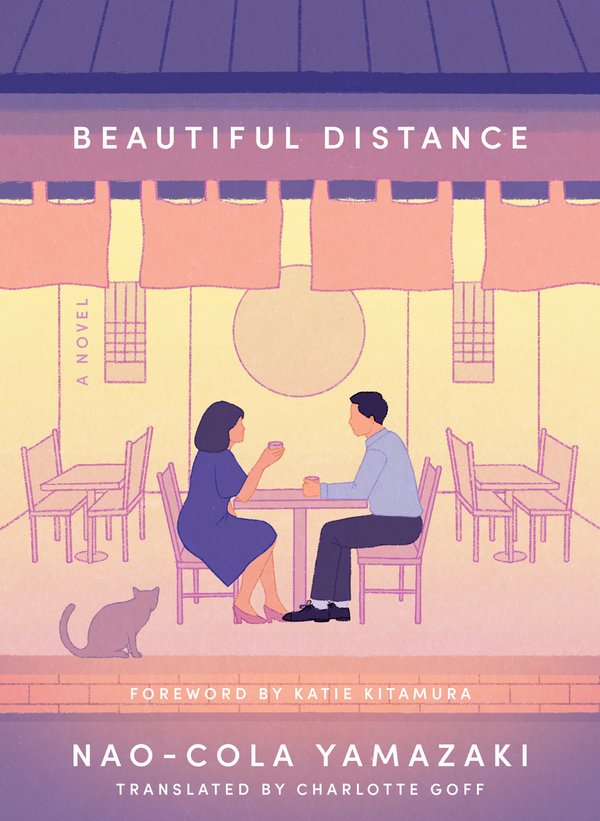
From Beautiful Distance by Nao-Cola Yamazaki. Used with permission of the publisher, SJP Lit. Copyright © 2026.