At the BFI, Ruby’s film is barely through its screening when the crowd turns to critique: what parts were true? The interviewer pushes for origins, for autobiography, the small badge of hardship audiences sometimes demand before they trust invention. Ruby imagines Hitchcock concealing a light inside Cary Grant’s milk glass so it glows. “Film’s an illusion,” she declares. She adds, “I invent things.” A perfectly reasonable reply. Doomed.
The ritual feels ordinary enough to seem harmless. In readings, Q&As, profiles, and festival conversations, the question recurs: where did the story originate, which figure secretly authored it, what was lived, what was borrowed, what endured. Often this passes for intimacy. Sometimes it is intimacy. Yet the question has other manners as well. It asks the artist to unpack the suitcase. Show us the wound. Name the source. Tell us what you paid for this. A created thing is admired, then searched for a biography.
Imogen Crimp’s Give Me Everything You’ve Got takes that modest public examination and builds a house around it. Ruby, a young filmmaker, is invited to the country estate of Ellen, the renowned feminist director she worships. Ellen offers what every rising artist longs for before knowing whether it is safe to want it: attention, closeness, a desk, a view, a room in which to become serious. The invitation is generous. That is the problem. The danger begins before mentorship separates itself from mere assistance.
Ruby’s longing for Ellen feels embarrassing because it reads so plainly. Ellen isn’t just successful; she is formative. Ruby discovered Ellen’s films when she was young and learning to be angry. Ellen’s work taught Ruby how to look, which is to say how to be. To be noticed by someone so influential is not only a professional blessing; it is the recognition of the self that art helped assemble, acknowledged by one of its original creators. Ruby blushes when she spots Ellen in the audience. Inwardly she imagines Ellen saying she’s proud.
Crimp, in mercy, does not mock that longing. She understands that wanting to be chosen by power isn’t simply vanity wearing a better haircut. For a young artist, being chosen can change the realities of life: fellowships, introductions, recommendations, money, the confidence to persist. It can mean the room. Ambition here never cleanly separates from need.
Ellen’s invitation carries a near-maternal completeness. She arranges the train ride, hails a cab, waits outside the house. The house itself has the aura of an institution posing as a home: red brick, roses, sash windows, grounds, stairs, rooms whose functions aren’t immediately legible. Ruby, who tutors wealthy children for money, reads the grammar well. Excess becomes invisible to the heirs of it. A room nobody needs isn’t emptiness; it’s class rendered spatially.
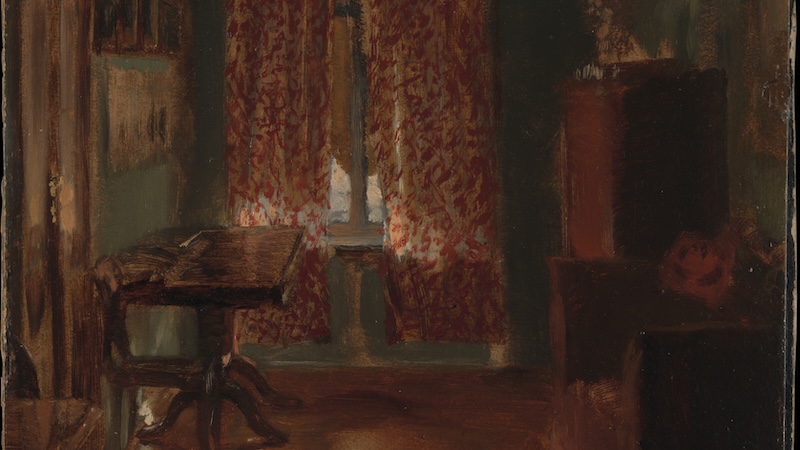
Then comes Ruby’s bedroom, the focal object of the spell. Wooden floors, a woven rug, terra-cotta walls, a fireplace lined with candles, a desk facing an open window. Towels folded at the foot of the bed. Blue blossoms on the mantel. Ruby thinks, “this room is mine,” and the line is beautiful, naive, and entirely understandable. The room is hers as a loan can be yours: intimately, temporarily, with consequences that arrive later in fine print.
Virginia Woolf is not optional here, even if she needn’t be permitted the best chair. A Room of One’s Own: the Woolfian compact of money, privacy, and time, the material dignity without which genius becomes another cruel joke played on the poor. Crimp doesn’t sneer at that inheritance. Her novel is too earnest about art, and too alert to precarity’s humiliations, to pretend rooms don’t matter. Ruby needs quiet. She needs money. She needs protection from rent, interruptions, freelance panic, and the exhausting comic labor of appearing fine. The twist isn’t that the room is false; it’s that this room comes from someone else’s house, someone else’s taste, someone else’s desire to supervise what Ruby might become.
For a young artist, being chosen can alter the material facts. It can mean the fellowship, the introduction, the recommendation, the money, the confidence to keep going. It can mean the room. Ambition here is never cleanly separate from need.
The country house feels timelessly safe because it has learned to cloak power as ambiance. Books, rugs, art, wine, garden, pool, trees, cows beyond the fence: the place grants Ruby the calm of having already arrived somewhere officially sanctioned. Even her hostess gift, a few carefully chosen chutneys from a market near her old place, becomes a tiny class injury. Is it too modest? Too eager? Too clearly the gift of someone trying to appear casually cultured? The humor is precise. Ruby steps into a world where every object is also an exam.
The gothic mode earns its keep here. Not thunder, not spider webs, not a door slamming for union reasons. The trap sits in refined taste. A woman carries your bag upstairs. A mentor asks thoughtful questions. Wine appears. The garden keeps blooming despite the heat. Exploitation, in Crimp’s novel, wears excellent taste.
At first, Lara seems to intrude on Ruby’s fantasy of private selection. Ellen’s daughter, she is already inside the arrangement Ruby has just entered. Ruby recalls seeing her before as a child in one of Ellen’s films. In the bathroom Ruby uses, a still from that film glowers back at her: Lara, young and wary, already captured by her mother’s camera, already offered up under the protection of art. Ruby expected a child, sweet and easily managed. Instead there is a young woman with a cool smile, bearing the authority of someone who cannot be evicted from the house’s historical orbit.
With Lara present, mentorship stops looking like a ladder where wisdom descends. It becomes erotic, maternal, competitive, performative. Ellen displays intimacy with Lara in Ruby’s presence; Lara withholds and then grants attention; Ruby watches with envy, longing, and the alertness of a guest who cannot tell whether she’s being welcomed or assessed. She desires Ellen’s approval, Ellen’s attention, perhaps Ellen’s body. More perilously, she wants to know what it would feel like to be the person Ellen routinely takes in.
Being taken in, Crimp keeps reminding us, does not equal being saved. It may merely signify entering a circulation.
The same logic has already shown up in Ellen’s workshop for women in film, where authority gathers under the banner of confession. Ellen invites participants to describe the moment they realized they were female. The prompt makes the room tense, eager, mutually supportive and quietly competitive. Each woman seeks to honor the others, yet each also wants to articulate the thing that will matter most to Ellen. Tell the truth, but make it useful. Make it painful, but not messy. Make it personal, but shaped correctly.
Ruby’s own film resists that mold. She is crafting a narrative in which pregnancy and abortion do not become the moral peak, the hidden wound, the revelation that explains everything. She aims for the experience to feel ordinary, consequential without being turned into monument. Ellen pushes back. Producers, too, want what they recognize as a “female story.” Ruby understands the trap with painful clarity: once abortion enters the frame, everything can be made to orbit it. A woman’s story, in that economy, becomes legible when it carries a wound large enough to light the scene.
This is the moment when the novel refuses an easy virtue. It would be convenient to claim: confession is bad, invention good; the self must be protected from the world’s crude little questions. Crimp rejects that comfort. Power dynamics matter. Trauma shapes art. Bodies and histories do not politely wait outside the studio until the artist allows them in. Confession has also been a vehicle for artists to seize authority from systems that preferred them silent, decorative, or easily explained. What Crimp worries about is the difference between confession as freedom and confession as toll. Who decides what an experience means? Who decides when it is available? How much must be handed over before the work is considered serious?
Ruby’s insistence on invention is not a denial of life. It is a bid to keep control over transformation. She wants the right to use experience without being consumed by its explanation.
Inside Ellen’s house, that argument becomes domestic. Ruby isn’t just invited to write. She is gradually drawn into the household’s emotional weather. Ellen casts Lara as lonely, difficult, in need of companionship. Ruby’s residency starts to resemble a task assignment. Later, the chores become almost comically plain: Lara’s personal statement, mowing the lawn, the regular maintenance of other people’s lives. This is one of Crimp’s most merciless strokes. The gothic apparatus doesn’t erase chores. It exposes them.
What Crimp worries over is the difference between confession as freedom and confession as toll. Who decides what an experience means? Who decides when it is available? How much must be handed over before the work is considered serious?
One of the novel’s sharpest moments arrives when Ellen phone-calls and Ruby, sensing urgency in her voice, sprints through the house to seek better reception. She despises the eagerness within herself even before Ellen asks. Might Ruby help get Lara working? Could she mow the lawn? The lawn looks fine. That isn’t the point. The point is the adjustment, tiny and decisive. The young artist who arrived seeking solitude and serious work has become the caretaker of someone else’s daughter, someone else’s property, someone else’s peace of mind. The room hasn’t been revoked. Its terms have simply become visible.
Elsewhere, Ruby finds herself wearing Ellen’s gloves and gripping Ellen’s scissors by the rosebush. The image is almost too neat, which is part of its delight: the protégé dressed in the mentor’s instruments, gently placed inside another woman’s labor, standing among flowers that have already been trained where to grow. This is how the invitation redefines itself. Not through a contract. Through something placed in your hands.
Ellen would be easier to dismiss if she were merely monstrous. Instead, she is perceptive, charismatic, often funny. She sees power where others might sentimentalize talent. She knows how artistic seriousness is distributed, how women are asked to defend their authority, how mediocrity protects itself. She can help Ruby because she understands the system. She can harm Ruby for the same reason. The benevolent mentor and the dangerous mentor aren’t opposites here; they share a wall.
Crimp gives that wall a doorway. In Ruby’s bedroom, what appears to be a cupboard door swings open onto a hidden spiral staircase for servants, descending into darkness: an old route of labor, service, and access built into the privacy’s architecture. Soon after, Ruby opens her bedroom door and finds Ellen standing there, listening to see if she’s asleep. The room has a desk, flowers, a window, a bed. It also has the routes through which other people’s needs can arrive. Privacy, here, has a service entrance.
The house knows more than its guest. It knows how people move unseen. It distinguishes between the formal staircase and the servants’ one. It knows what beauty can cover. It knows how easily gratitude can be mistaken for consent. Ruby has been given a room, yes, but the room is linked to long-standing systems of labor. This isn’t a subtle symbol, perhaps, but houses rarely are. They are blunt tools made livable by draperies.
Throughout it all, Crimp preserves the allure of the fantasy. The reader isn’t asked to sneer at Ruby for craving Ellen’s attention. Only someone very secure, or very dishonest, would pretend the fantasy holds no appeal. To be summoned by the artist who formed you; to hear that your mind matters; to be pulled out of ordinary life and installed in a beautiful room; to have your own seriousness reflected back by someone with the power to make that reflection endure—that is not nothing. It’s one of art’s oldest narcotics. Recognition can feel like shelter before it feels like surveillance.
Nor does Crimp urge us to sequester art away from life. The issue isn’t transformation. The issue is compulsory availability: the economy the novel sketches, one that rewards particular transformations most when they resemble confession; the mentorship that translates encouragement into extraction; the hospitality that offers a desk while tucking a bill under the blotter. Art can engage with life without demanding the artist remain perpetually accessible to every admirer of the finished work.
The title’s cadence begins to sound less like adulation and more like a demand. “Give me everything you’ve got”: the mentor’s challenge, the audience’s plea, the appetite the novel locates in artistic seriousness itself, the house’s hidden invoice. The old dream of the artist’s room survives the book, but it arrives altered. Crimp asks what the fantasy can forget: who owns the room, who opens the door, who’s been there before, who is allowed to leave, and what kind of self must be laid on the desk before work can begin. The room Ruby desires is real. So are the flowers, the towels, the view, the thrill of being chosen. The error lies in treating the key as if it were the same as ownership.