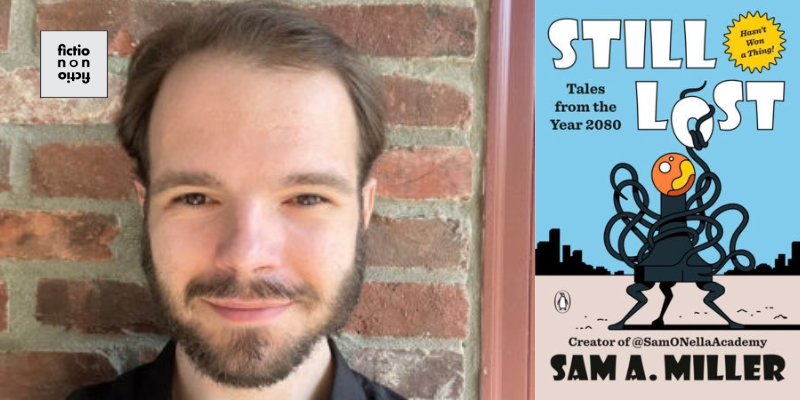
Fiction writer and popular YouTuber Sam A. Miller joins co-hosts Christian Barter and V.V. Ganeshananthan to talk about his debut story collection, Still Lost: Tales from the Year 2080, as well as his educational and comedic videos. Miller reflects on how he got started on YouTube a decade ago, when he was an adolescent, and amassed 4.8 million followers by developing Sam O’Nella Academy, a channel with a scrappy, homemade feel and distinct illustrations. Miller discusses the genesis of the unusual aliens who set the stage for most of Still Lost’s human-centered stories by solving potentially world-ending problems like climate change right off the bat. He explains why he decided to self-publish the science fiction collection and how it found its way to a traditional publisher. He also shares his science fiction influences and talks about how his personal history with addiction shapes the book’s final story. He reads from Still Lost.
To hear the full episode, subscribe through iTunes, Google Play, Stitcher, Spotify, or your favorite podcast app (include the forward slashes when searching). You can also listen by streaming from the player below. Check out video versions of our interviews on the Fiction/Non/Fiction Instagram account, the Fiction/Non/Fiction YouTube Channel, and our show website: https://www.fnfpodcast.net/ This podcast is produced by Christian Barter, V.V. Ganeshananthan, AJ Abernathy, Grace Workman, and Sienna Hoopingarner.
Sam Miller
Still Lost: Tales from the Year 2080 by Sam A. Miller • Sam O’Nella Academy – YouTube
Others
Stories of Your Life and Others by Ted Chiang • Project Hail Mary by Andy Weir • Blindsight by Peter Watts • Wheelers by Ian Stewart & Jack Cohen
EXCERPT FROM A CONVERSATION WITH SAM A. MILLER
Christian Barter: Your YouTube channel covers a broad spectrum as well. So what drew you to write science fiction? You come across as someone who could have written in many other genres.
Sam A. Miller: I appreciate that. I’m not sure I’d be particularly well-suited for historical fiction, to be honest. I think of myself as something of a generalist, which is another way of saying I don’t know much about any single thing. A broad base, but no real depth in one area, you know. And so, I feel science fiction fits me best because the appeal of the genre often lies in mixing disparate elements—technology, philosophy, and more—until they form something greater than their parts.
V.V. Ganeshananthan: Absolutely. I also want to point listeners to the back matter. You did this neat thing with story notes, which isn’t the same as citations. It reminds me of those little pieces at the end of some Best American Short Stories where the author explains how a piece came together; I love having these windows into things like “Being A Nothingness” or the alien Xenos. How did you decide to include them? It isn’t the norm.
SAM: I was inspired by Ted Chiang’s Stories of Your Life and Others, which contained something similar, and I found it fascinating to glimpse what was in his head. I also wanted to ensure that some human experiences feel authentic, especially in the final story, where I touch on addiction. I aimed to be transparent about my own history in order to avoid misrepresenting anyone else’s experiences. I also wanted these notes to make it clear that the characters sometimes serve as targets for my self-critique; if readers recognize themselves in these figures, I’m not aiming at them but at my past self. Every character who grows in these pages reflects something I’ve lived through… a conversation with my former self.
VVG: Indeed, and that self–deprecation is a fundamental principle of humor, which also informs many of your stories. I appreciated the glimpse into early drafts—like the initial version of “Agency,” which features a version of football players who are terrifyingly formidable, and how notes on references helped me follow all the layers of meaning in the story.
I also know that the book in this form isn’t the original publication—because you released it first on your own. It’s intriguing that we now share a publisher; I, too, am with Penguin Random House. How did you decide to self-publish and push Still Lost forward, and how did it reach a major house?
SAM: Self-publishing felt like a straightforward path for me. I’ve always had a hands-on, do-it-yourself instinct, which is obvious in my channel, and I’m stubborn about preserving my independent voice. At the same time, my ability to reach readers directly was limited. In the self-published edition I even used a faux copyright page—purely playful. Among the playful lines, there was a note inviting literary agents to email me, and one did, ultimately introducing me to Penguin. That connection opened doors for broader success, and I couldn’t turn that down.
VVG: So, when I checked the author’s page on Amazon, someone who bought the original edition received a copy with a different cover and some extra content; it felt almost like a collector’s item, and perhaps people didn’t realize they were different. It was a moment that made me think about whether Reddit had discussed it. In any case, the two editions diverge, though they share core elements and you added a couple of stories. Can you describe the shifts between the versions?
SAM: Certainly. The revised edition includes two fresh stories, one of which is “Agency.” The premise follows enhanced athletes in the UNFL, the Unrestricted National Football League, who are permitted to use any drugs, hormones, surgical enhancements, or gene therapies to improve their performance. On the surface, that premise is ripe for humor and social commentary.
When I began writing it, the narrative leaned toward a bleak and grim arc—one man destroys himself while a friend watches. It echoed the emotional arc of the earlier piece “Beat” but lacked the kind of personal honesty that would justify that darkness. It wasn’t particularly funny either. To make the piece work, I reframed the setting as a future where, what if the kind of neurodegenerative damage analogous to CTE could be reversed? That lowered the stakes, lightened the mood a bit, and allowed some levity to creep in as we watch this character’s decline become survivable, which in turn makes the humor more accessible because healing is possible in the near future.
Transcribed by Otter.ai. Condensed and edited by AJ Abernathy, Grace Workman, and Sienna Hoopingarner.