
Within the Royal Geographical Society’s vast archives—exceeding two million items—there exist more than 150 glass and early celluloid negatives created by Frank Hurley, the official photographer for Ernest Shackleton’s Imperial Trans-Antarctic Expedition of 1914-1917. These extraordinary photographs matter to me beyond their beauty and their ability to evoke the past because they were the conduit through which I learned the tale of my grandfather’s voyage aboard the Endurance.
I cannot recall my father Eddie, Shackleton’s youngest child, ever sitting me down to recount his father’s life. In truth, he hardly knew him, having been only ten years old when Ernest died of a heart attack on January 5, 1922, amid the Shackleton-Rowett Quest expedition.
I unearthed the story by asking questions about the Hurley photographs that adorned the walls. To a child, the images could be puzzling: “Why does it look dark when it isn’t night?” and “Why do all the men bear beards?” One photograph, showing Endurance frozen in the ice with the dogs gathered nearby, fascinated me; I would ask, “Whatever happened to the dogs?” The grownups often dodged a direct answer, and only years later did I learn the truth—that, as was common on expeditions of that era, the dogs were killed for food when supplies ran short.
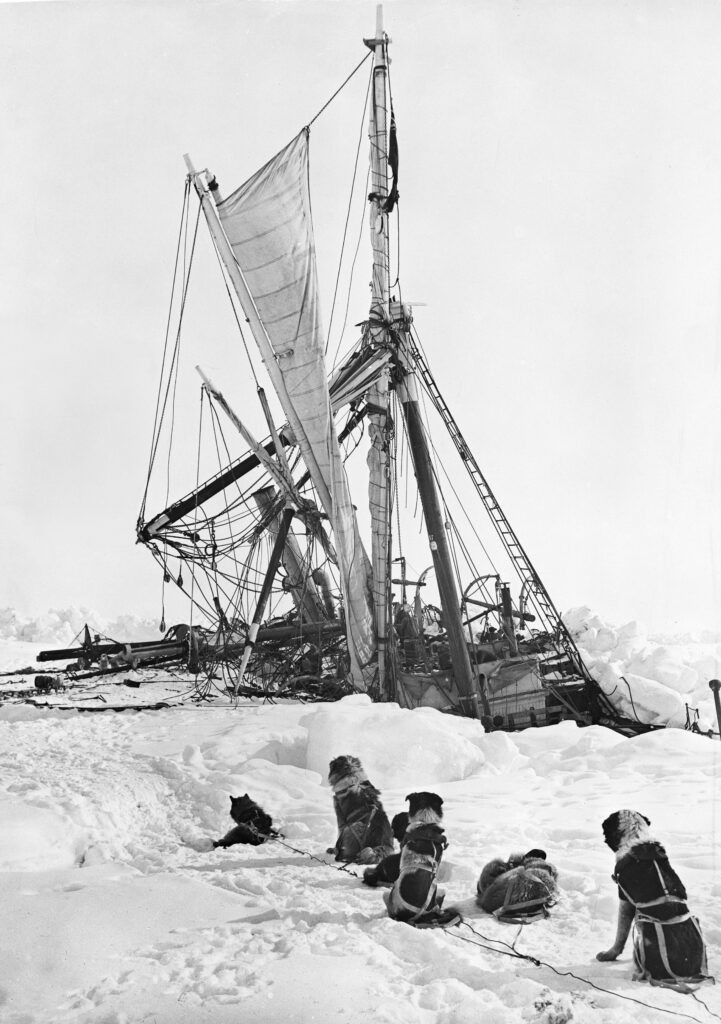 Over the following days, Hurley and his fellow crew members returned to the wreck of the Endurance to salvage supplies. Diving into the frigid water, Hurley recovered a substantial portion of his photographic equipment, including glass plate negatives and cinematograph film. ©Royal Geographical Society.
It wasn’t only children who could be puzzled by Hurley’s images. I recall one visitor standing for a long while before a picture of jagged rock faces and a glacier tumbling into a deep fjord, its surface packed with floating ice. At last the visitor declared, “I know where that is! It must be Lulworth Cove!” Henceforth, the family referred to that scene as Lulworth Cove. In reality, the scene depicted South Georgia.
Hurley’s cine film South, released in 1919 as In the Grip of the Polar Pack-Ice, also held great significance for me, because it was the first time I saw my grandfather on screen, moving and smiling. The film contains remarkable footage of the Endurance’s demise, with Hurley placing cameras around the vessel to capture her masts collapsing.
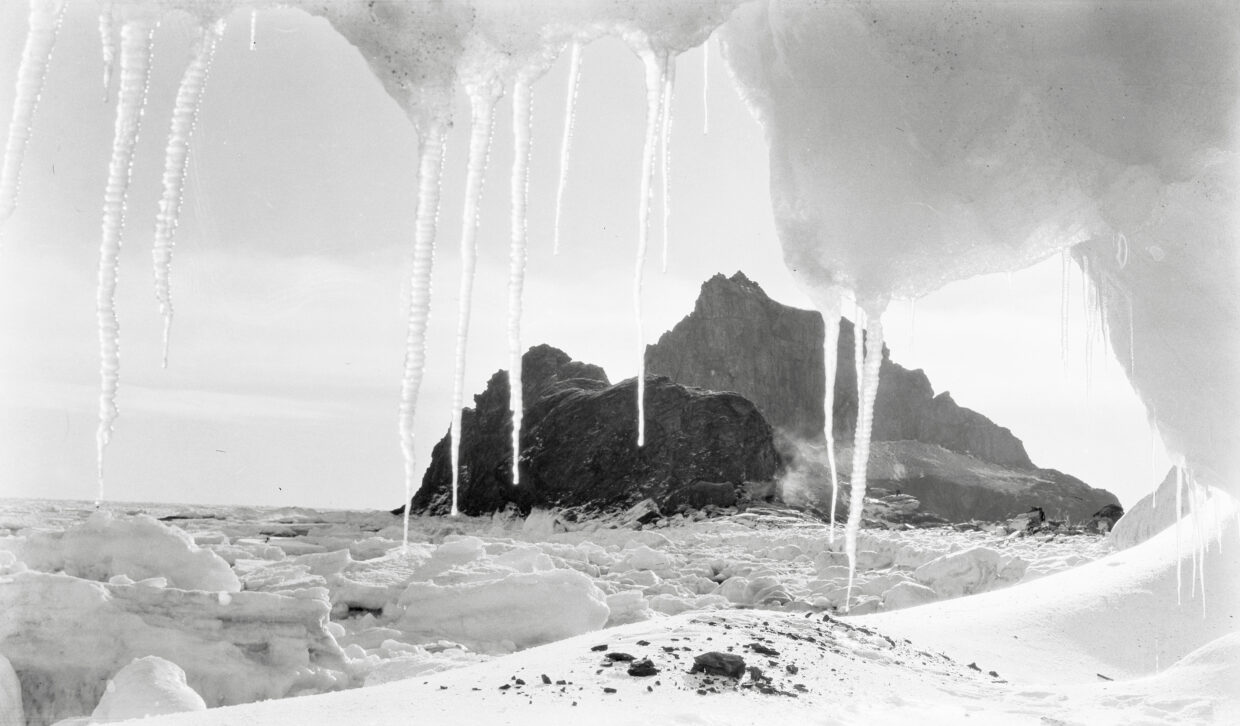 “…During the morning we walk with Wild. We visit a neighboring cavern inside the glacier, whose walls gleam with icicles. Fine shawl-like stalactites cling to the walls, while the roof is studded with peculiar and footlike stalactites.” –Frank Hurley ©Royal Geographical Society
How did my grandfather come to pick Frank Hurley to document the Endurance expedition? Hurley had served as the official photographer on Douglas Mawson’s Australasian Antarctic Expedition of 1911–1913. Shackleton saw Hurley’s 1913 documentary Life in the Antarctic and decided to recruit him. The departure date loomed, but Hurley—unaware of it—was deep in the Australian bush. In all likelihood, he became the sole polar photographer recovered by an Aboriginal tracker.
Hurley was a remarkable photographer, not only for his artistic sense but for his unwavering dedication. He would lie in front of the moving vessel and climb high into the mast, lugging heavy cameras and equipment. The results spoke for themselves. He viewed himself as an artist first and foremost, not merely someone who recorded events. On occasion he did not shy away from embellishing his subject matter or altering details.
After the expedition’s return, Hurley journeyed back to South Georgia to film penguins and seals. They were a novelty to audiences at the time, and Hurley felt his footage did not fully capture their allure. The film’s success helped settle the expedition’s debts. From December 1919 to May 1920, Shackleton presented public lectures about the film, and twice daily he endured the painful sight of his ship being lost to history.
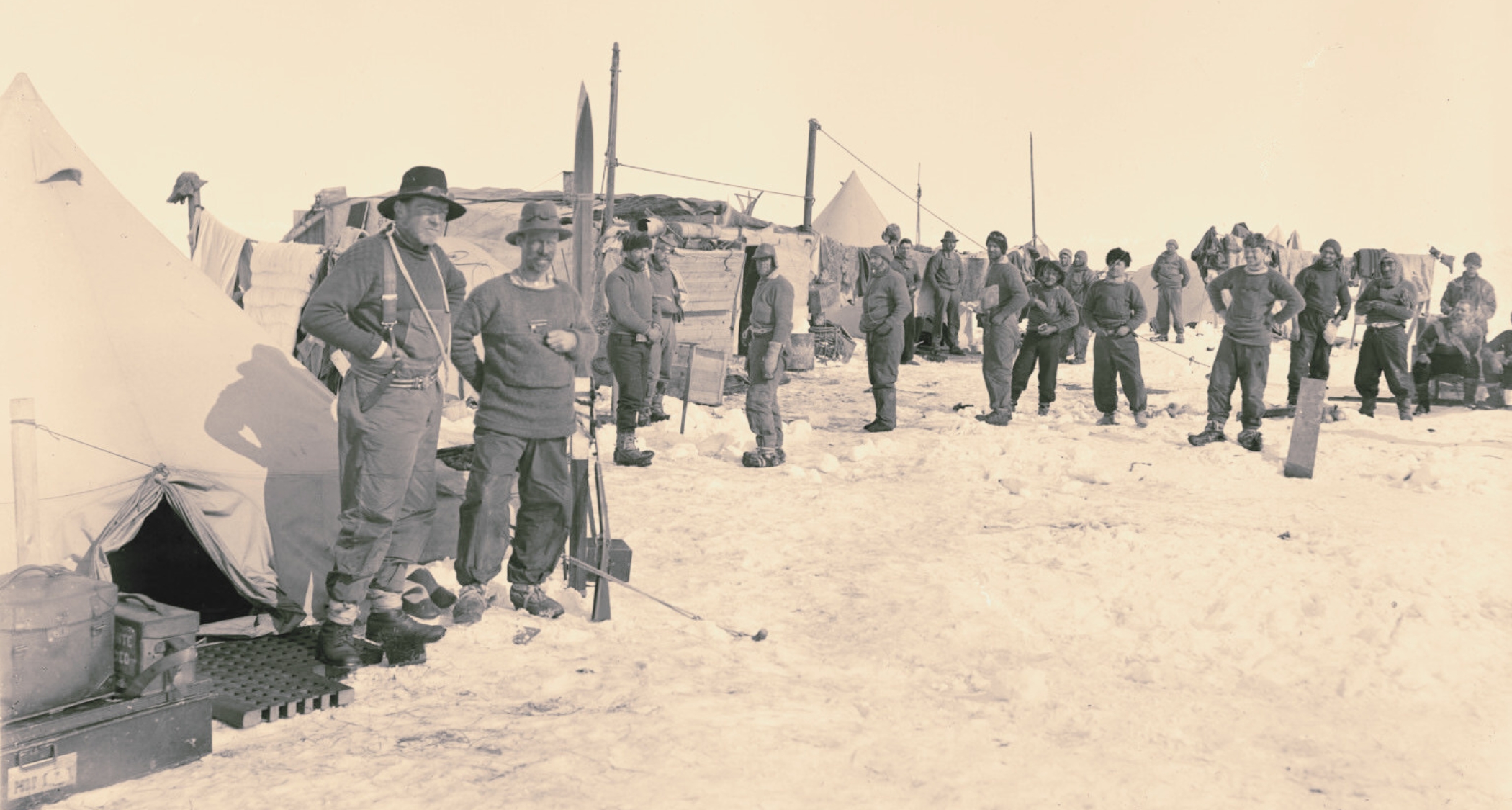
Choosing a favorite among Hurley’s glass-plate negatives is not easy. Without ranking, I would again name a few: the images of “The Endurance Crushed by the Ice” and “Head of Moraine Fjord, South Georgia” (also known as “Lulworth Cove”). The landscape conveys everything. Equally essential is “The Long, Long Night,” that sweeping nocturnal view of Endurance, illuminated by twenty phosphorus flares that cast a spell over the ship. And then there is “On the Drifting Flow, Ocean Camp.” Shackleton stands beside his tent, shoulder to shoulder with his second-in-command, Frank Wild, while scientists, officers, and crew line the rear. The men appear tranquil amid the stark desolation around them. They are living on the ice, with the Weddell Sea’s currents rolling beneath. The future is uncertain, yet the image speaks to humanity’s extraordinary capacity to adapt.
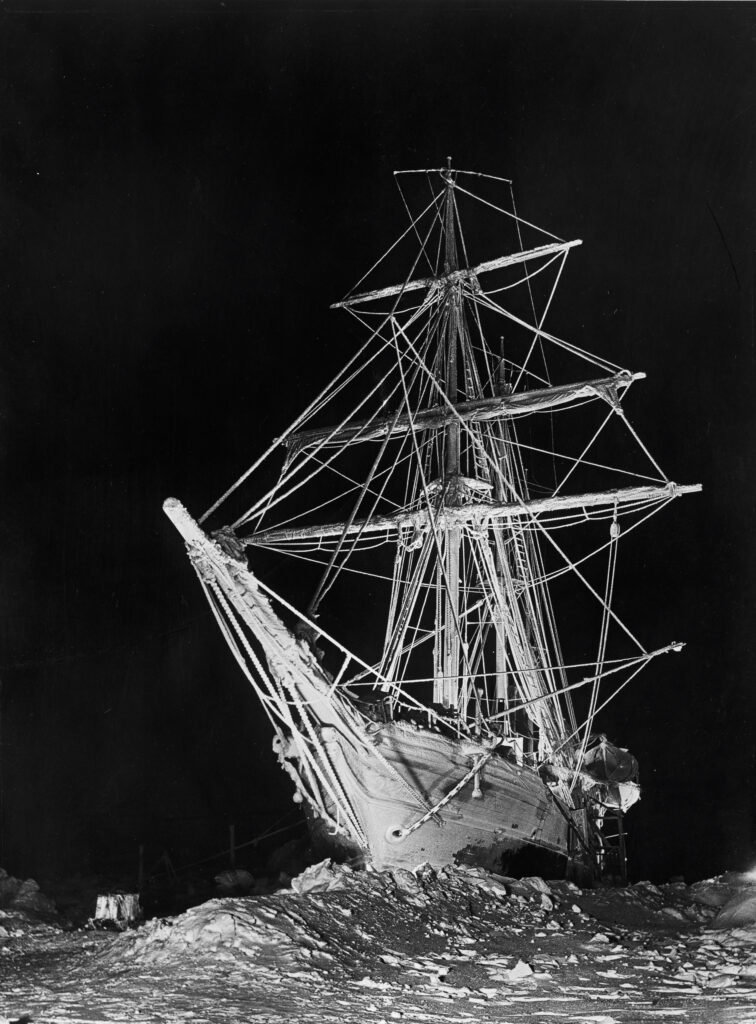 One of the Endurance’s most recognizable photographs, this image by Frank Hurley was captured at night with flare-light to evoke a spectral ship. ©Royal Geographical Society
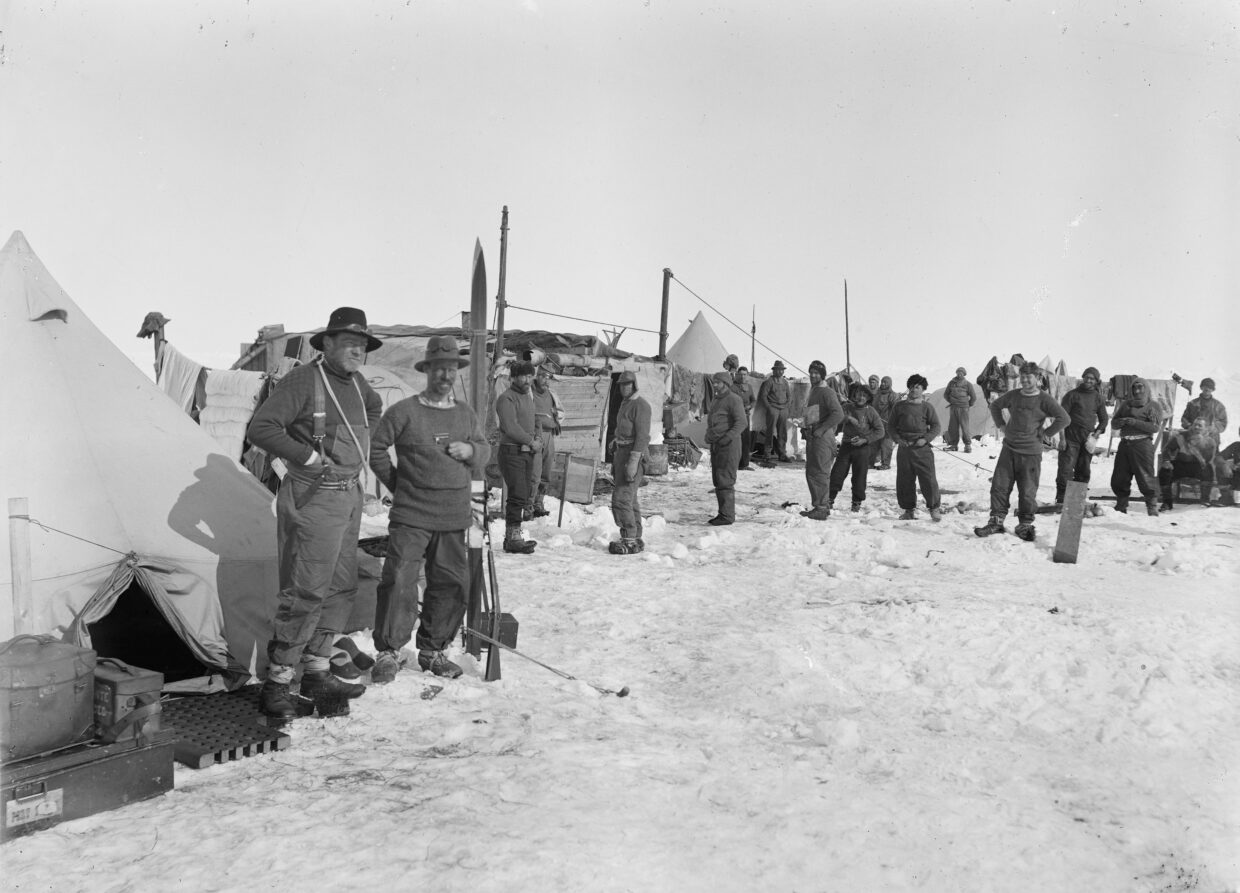 An informal group portrait at Ocean Camp with Ernest Shackleton and Frank Wild in the foreground; one of the final photographs Hurley took with his Graflex glass-plate camera before the heavier gear was shed in favor of a more portable Vest Pocket Kodak. ©Royal Geographical Society
The fascination with Ernest Shackleton shows no sign of waning. Dozens of polar quests have borne his name, and Shackleton scholarships exist; one researcher, Teresa Darbyshire, identified a new species of marine worm and christened it Micromaldane shackletoni. A Shackleton clothing line funds polar-protection initiatives, and numerous books analyze Shackleton’s leadership—studied by the military, NASA, and even a well-known American football squad. In 2002, the BBC conducted a nationwide survey to crown the “100 Greatest Britons of All Time,” placing Shackleton at number eleven. That same year, a television drama, Shackleton, featured Kenneth Branagh portraying my grandfather. In 2016, the Royal Mail issued stamps bearing Hurley’s images, and the Shackleton Symphony by Paul Frith was recorded by the Royal Philharmonic Orchestra. Since 2017 a Shackleton whiskey has also been produced.
The James Caird Society—named after the lifeboat Shackleton and five companions used to undertake an 800-mile voyage from Elephant Island to South Georgia in search of help—meets biannually and remains a bustling organization. In Ireland, the Ernest Shackleton Autumn School has launched the world’s only dedicated Shackleton museum near his birthplace, Kilkea in County Kildare. Across the globe, numerous exhibitions have celebrated the Hurley negatives, and there are sure to be many more. At one point NASA even christened a crater on the Moon “Shackleton,” while a crater on Mars bears the name “Endurance.” In my view, Shackleton’s influence extends far beyond Earth, and Hurley’s negatives have played an immeasurable role in that enduring legacy.
______________________________
From The Endurance Photographs: A Definitive Visual Record of Shackleton’s Expedition by The Royal Geographical Society. Copyright © 2026. Foreword copyright © 2026 by Alexandra Shackleton. Available from Chronicle Books.