
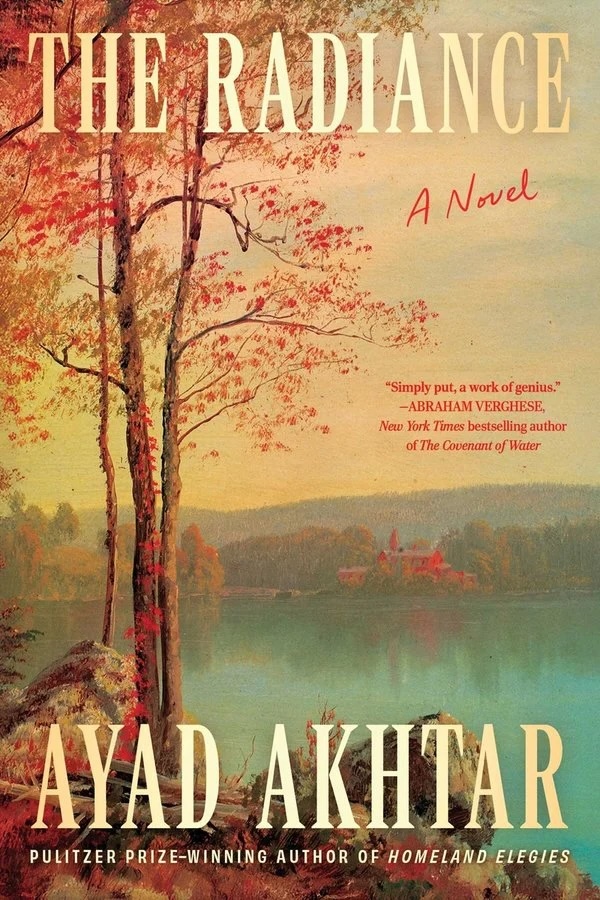
The narrator of The Radiance shares Akhtar’s name and much of his life. After leaving New York for a small Hudson Valley town, he ends up getting hit by a pickup truck during a bike ride. When he awakens from the subsequent coma, something is different: things appear lit from within and bathed in silence; and he’s impotent. The luminous state has since deepened after an evening during which his cousin, Tanveer, disclosed a terrible family secret about his father. Lucie Neroponte, the friend who calls him in the passage below, teaches at a local college; an essay about the affair she had with her own professor when she was twenty made her name.
*
Like Lucie, I carried misgivings about teaching, though mine concerned something other than desire. I worried that the steadiness of an academic post might dull me as a writer. By the time I reached my mid‑twenties, I began to notice a pattern: I leaned toward fantasy rather than fact, stubbornly clinging to illusion long after any evidence could justify it. Reality always asserted itself—most often after the painful humiliations spawned by my own fantasies. I was too drawn to the comforts of imagination, which, unsurprisingly, is exactly why I wanted to become a writer in the first place. Yet those same attachments, I realized, kept my work from feeling tangible.
My early forays into the theater proved beneficial. Humiliation acted as a reliable corrective, and I discovered that the bluntness of a paying audience made the shame bearable. I learned from jokes that fell flat and plot lines that refused to converge. Walkouts mid‑performance and weak applause stung, yes, but not so much that I couldn’t take the lesson to heart. My sketches and plays grew sharper. I developed as a writer. As peers accepted teaching roles with health care, pensions, and just enough money to scrape by, I felt drawn to follow suit. Yet I feared what I might sacrifice if I gained protection from the unpredictable encounter with crowds. Creating for paying audiences without a safety net, I concluded, was the sole viable path forward.
That path would prove long and arduous, and all the familiar words—“discipline, love, luck, but most of all, endurance,” as James Baldwin put it—applied to my struggle as well. I endured—and in my case, it was only through the insights I drew from audiences that I found a way forward. The benefit of communal wisdom, then, became the sole lesson I felt capable of sharing when I finally accepted an invitation to teach aspiring playwrights at a university in St. Louis.
It coincided with the summer Michael Brown was shot; Ferguson simmered a few miles away. I sublet a place within walking distance of Dred Scott’s grave. Twice weekly I rode the bus to a dim classroom, barely larger than the table where my students and I read their work aloud. I couldn’t shake how our responses felt overly curated and opaque compared with the lucid, disinterested clarity of a paying audience. Without the audience’s help, we all confronted how little I actually knew about my craft. When the workshop ended, my farewell was a cautious apology in the form of encouragement: my weaknesses as a teacher could be read as an extension of my strength as a writer—my trust in the public. I told my students to skip the class critiques and deliver their work to paying crowds. The “paying” aspect was essential. Our art, I insisted, was not a gift but a commercial venture. If we wanted the audience’s truth, it had to feel like deserved pleasure in exchange for what they had paid. By the end of that summer in St. Louis, I didn’t imagine I would teach again.
More than six years later—and just a month after that astonishing, somber evening with my cousin Tanveer—Lucie phoned to ask whether I’d consider teaching a newly vacant section of creative writing at the college. I was surprised to hear myself say yes, and mortified to admit it.
“Embarrassed? Why?”
“Who would want to teach after hearing you describe it?” I heard how harsh that sounded. “Sorry—that came out wrong.”
“No, I get it. I complain too much. But it’s the closest thing I’ve ever felt to a calling.” She paused. “A good student, a truly good student, that’s still the best thing. It happens. Not often, but it does. So don’t take me too seriously.”
“What’s the section?”
“Seminar in autofiction. Which is how you and I ended up at lunch with the college president. But I’m sure you can teach whatever you want.” She explained that the original instructor, a memoirist I admired, was hospitalized after what sounded like a breakdown. Lucie hadn’t been supposed to know, which meant I wasn’t supposed to know either.
“I hope she’ll be okay,” I said.
“Had you read her last memoir? About her Hashimoto’s?”
“I thought it was great.”
“My guess? She’ll publish a memoir about this too.”
I shouldn’t have laughed, but I did.
Lucie continued: “So here they are, a week from winter break and with no one to take over the section next semester. The president has become involved. When I mentioned you, he got excited. I told him I thought you might consider it. You’ve seemed bored lately.”
“Bored?”
“Am I wrong? You’re still not writing.”
“I’m not.”
“And still dealing with some trouble… down there?” In keeping Stanford abreast of my urological issue—no nerve damage; the doctor believed the problem was psychological—I hadn’t expected Lucie to be in the loop. “Okay, so maybe boredom isn’t the right word. De-cathected?”
I could hear her smile.
“I feel as if this confirms I was right to be embarrassed,” I said.
“Why?”
“I’m so de-cathected that I have nothing better to do than take up the thing you complain about all the time.”
She laughed.
“If it nudges you toward trying something new, that’s a good thing, right? Let me connect you with Mischa. Is that okay? He’ll want to meet you.”
“College president?”
“And tell you not to sleep with students.”
“Lucie. Jesus—”
“Which I know is unlikely—even if you were more cathected. But Mischa’s main issues lately have involved replacements: a visual artist who hooked up with a student on Grindr, a Muslim biology professor who married one of the undergrads.”
“You’re kidding?”
“Apparently her parents proposed the match when she spoke about how much she liked his class.”
“How do I get the rest of that story?”
“They both left school, so you probably won’t. I told Mischa you were a regular Boy Scout, but I’m sure he’ll still want to test you out.”
“Bored Boy Scout.”
“Bored cisgender straight Muslim Boy Scout—if we’re being precise.”
“If that doesn’t scare him away.”
“On the contrary. He said he could really use a ‘Moslem’ in creative writing.”
“Moslem?”
“I know, I know. Still, he’s an intriguing man.”
“Still living in the nineteenth century. At least when it comes to Moslems.”
“Eighteenth. When it comes to most things.”
“I’m intrigued.”
“Just don’t ask him about Mozart. Unless you’re not in a hurry.”
*
Where Lucie tasted boredom, my experience was closer to the opposite. For three days after that evening with my cousin Tanveer, the world appeared bathed in a radiant, self‑evident flawlessness. No element seemed wrong; every element felt exactly right—even the diseased ash trees by the pond, even the political clamor on the radio. The mind, too, seemed a thing, and no less spotless than the purple finch that perched on the back of the porch Adirondack chair each morning as I brewed coffee. To view the mind as a thing was to sense the constant motion inside it—like the finch, which, perched and still, lived by the flutter of a heartbeat. Realizing I was not that ceaseless motion within my own mind made the illusion of self less convincing, yet I understood why I had mistaken myself for it all my life. Even this confusion, in its own way, felt correct.
One more observation about the mind:
During my final year of college, I came across a paper by the British psychoanalyst D. W. Winnicott, intriguingly titled “The Mind and Its Relation to the Psyche-Soma.” It contained a passage that nobody in class—myself included—could convincingly decode. And yet it compelled me, so I read and reread it until I could recite it verbatim:
The question has to be asked why the head should be the place inside which the mind tends to become localized by the individual, and I do not know the answer. I feel that an important point is the individual’s need to localize the mind because it is an enemy, that is to say, for control of it.
It was true. My mind had always felt inseparable from my head. And moreover: I had always assumed “I” equaled that mind in that head. Why Winnicott found this localization perplexing—and why he labeled the mind as an adversary—remained mystifying. Yet instead of dismissing it as mere fancy, I sensed in those lines a hidden pledge that would pull me back thirty years later, once the brightness of my Tanveer‑induced fever dream began to fade.
*
Two days later I drove north to meet Mischa Morris, the college president. In an Italian restaurant across the river from campus, where he had suggested we eat, a weathered hostess—already reaching for a menu—snagged his name from the air, slammed the card back into its slot, and told me to follow.
Through a long room of empty tables she guided me, up a staircase, through another dining area where chairs were pushed to the walls, to a table tucked behind a five‑panel screen, where Morris sat hunched over a musical score, frowning, his thick white hair raked to one side over a body much leaner than the head. Lucie had warned me he was nearly ninety, though he did not look it. He wore exactly the clothes his online photos suggested: a patterned silk cravat clashing with a dark sport coat and a loudly colored Madras shirt. Seeing us arrive, he lifted his readers from the end of his nose, smiled softly, and spoke in a velvety baritone.
“Thank you, Hope,” he purred to the hostess.
Hope grunted and departed.
As I settled, Morris gathered his papers. “Apologies for the chaos—I lose track of time when I’m preparing a concert.”
“What piece is this?” I asked.
“Cherubini, Lodoïska. I’m teaching a seminar on rescue operas. Lodoïska is the first significant one after Seraglio.”
“Sorry—opera isn’t my strongest suit. Not that I don’t love it. Seraglio is?”
“Abduction from the Seraglio,” he replied with a delicate flick of his wrist, dismissing my apology. “Mozart’s first real public triumph. Do you recall the scene in Amadeus when the emperor tells him there are too many notes?”
“Naturally.”
“An unforgettable scene, though probably fictional,” he said, and I could see him savoring the aside. I smiled, recalling Lucie’s caution about Morris and Mozart. “A marvelous opera, performed less often now, alas, for reasons—well.” He paused. “You see, the Viennese were finally free of the Turks at their gates. The culture overflowing with the usual Moslem tropes: the veil, the harems, and so forth.” I watched him catch the look on my face at that word again. “But the opera’s final gesture is a potent counter‑stereotype; no cruel despot Turk is the pasha to Mozart. Yet since the gesture of mercy doesn’t arrive until act three, it might as well not occur at all, given today’s moral impatience. Which reminds me—” He reached into a bag beside him, pulled out a copy of a book I recognized as my own, and opened it to a marked page. “Mm‑hm. Yes, that’s it,” he said and began to read aloud:
Like everything else, art, too, was drowning in ubiquitous anger. Every word, every gesture read as a pledge of allegiance to some community or creed. The politics of representation were ascendant, increasingly confused with the poetics of narrative craft.
“Well put. So well put, indeed.” He looked at me as he closed the book and set it down. “My dear man, you seem surprised.”
“Or not sure how to react to being read aloud from my own work.”
Again, that graceful, dismissive flick of his fingers—an index finger conducting the moment: “You phrase the matter with admirable sang-froid. Your passage concerns the theater, but you could just as well have been describing opera, or music . . .”
“The tenor of the times.”
He paused again, wagging his index finger—perhaps at an unseen interlocutor he had conjured in the air. “Not that something genuinely good hasn’t arisen from the pressure to be more cautious about what we say, how we think.”
“Think? Really? That too?”
Morris fell quiet.
From behind the screen, a short server emerged with a notepad.
“The food here is wonderful,” Morris said, shifting in his seat. “Better than it has any right to be, honestly. The cacio e pepe is not to be missed, if that’s your thing.”
“Cacio e pepe sounds excellent.”
“Yes?” He appeared delighted. “Francis, cacio e pepe for my guest.”
Francis nodded. “The usual piccata for you, Maestro?”
“But a touch lighter on the salt today, if you can, and perhaps a bit fewer capers?”
Francis jotted a note and disappeared.
I found myself peering past the ribbed screen into the rest of the dining room. Morris explained that the screen served as a sound‑deadening shield. The restaurant’s owner, a fellow opera aficionado and friend, had carved out the quiet corner for him during the height of the pandemic. Morris hadn’t been able to work at home while the campus was shut, and even as things returned to normal, he still found that he produced more here than in his office, despite its “truly fabulous” river view. As he gathered his score and tucked it into a large leather satchel, he asked about my teaching experiences.
I spoke of the summer I spent as a rather uninspired playwriting instructor in St. Louis, which happened to be where Morris was born, just two streets away from the house where T. S. Eliot had grown up. Morris dismissed my self‑doubt as a teacher, but he listened with genuine interest when I spoke of my reliance on the audience. Mozart surfaced again in this exchange—this time as a digression I initially considered relegating to a footnote, given how far the narrative was traveling from the main thread. Yet because my spontaneous response to Morris’s whimsical musings would become the seed of a bond between us, one relevant (in a modest sense) to what lay ahead, I’ve kept the detour—though trimmed:
“It can be dangerous to lean too heavily on the audience,” Morris began, “and I’m sure you know that. He was thirty‑five when he died—divine Mozart. So sudden, so breathless a death: that brief coma—and then gone. How could it be? After seasons of boundless energy, barely interrupted by illness—and then this? Limping to the end, emptied of will to live?”
“Rheumatic fever, or bloodletting, or whatever biographer you choose. Fine. But what about the immaterial cause? Loss of love. So said Elias, and so do I. Loss of a woman’s love he could believe in, and loss of Vienna’s love for his music. Because, mind you, there has perhaps never been an artist more aware of the sacred nature of his gifts. He understood what he was transmitting to us. But tomorrow held no meaning for him. Only the appeal of today. He’d stepped away from court patronage into a marketplace that could not sustain him—leaving him to rely on the fickle Vienna, where the truly unforgivable sins were a useful book, a reasonable discussion, and a decent meal. Where a man of merit was judged by his knowledge of the best dogs at the baiting ring. These were the capricious, shallow people Mozart sought for sustenance. For a time he enjoyed both, Constanze’s fidelity and the adoration of the capital. I’m not saying this is a groundbreaking link, but I’d connect the loss of her love with Vienna’s rejection, Zauberflöte’s success notwithstanding. She confessed—only after his death—that she’d always admired his talent more than his person.
“But here’s the rub. This is why I warn you, my new acquaintance—and I truly hope we’ll become friends. It’s hazardous to put too much faith in an audience; even Constanze’s thoughts about her husband’s extraordinary talent rose and fell with the mood of the crowd. When they believed in him, she did too. When they moved on, her heart followed. A broken heart—that, I contend, was the fatal illness, and it all began with faith misplaced in an audience unworthy of him. Of course, it’s foolish to compare our own lives to Mozart’s—but the greatest artists can teach us all something. And the lesson I draw from Mozart’s heartbreakingly premature end is this: While we must live by the grace, as you called it, of the public, we must not—and cannot—let them define us.
__________________________________
From The Radiance by Ayad Akhtar. Used with permission of the publisher, Summit Books. Copyright © 2026 by Ayad Akhtar.