
“Territorial male flies toward intruder, erects crown feathers, puffs chest, and sings loudly.”
–“White-crowned Sparrow,” Birds of the World
*
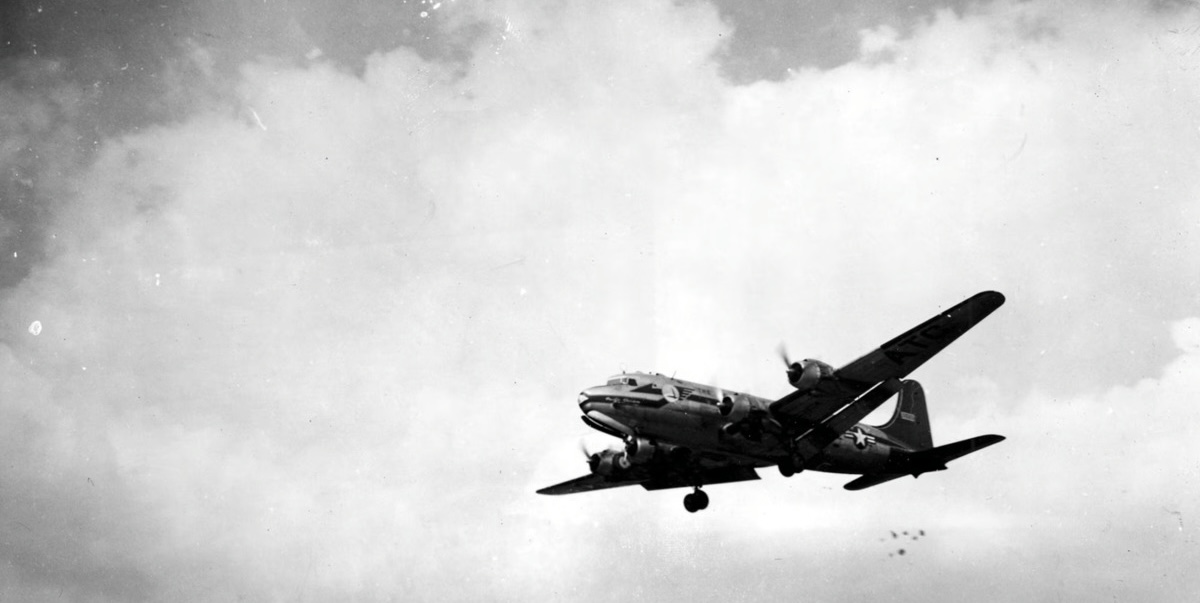
March 15, 1944—the southeast coast of Italy Colonel Florimond Duke peered through a rain-soaked pane at the bomber sitting in darkness on the tarmac. Grounded for three days. The storm over Brindisi stubbornly refused to break, trapping every special-operations aircraft at this captured Italian airfield.
A lavish palace had been converted into the hub from which Allied commandos plotted incursions into Nazi-occupied southeast Europe. Duke looked around the room: antique Italian furnishings intermingled with military gear, British commandos waiting among gilded mirrors and piled crates to team up with resistance fighters in enemy territory.
He checked his watch: 1700 hours. They had four hours to launch, but rough weather might stall them. Tonight marked the last night when the moon would be sufficiently full for a month. In a month, though, it would be too late.
Operation Sparrow summoned Duke to helm a tight three-man commando unit on a covert night parachute drop behind enemy lines.
The plan appeared to be almost impossible—travelling straight into capture, enduring Nazi interrogations, and convincing D-Day fabrications to sound credible.
In a typical war, such a risk would be beyond belief. Yet this was no ordinary war. The Allies knew the broader picture of the Holocaust. If Sparrow and other deception schemes succeeded, the Normandy assault could go forward and halt the Nazis’ killings. If they faltered, the anticipated Allied invasion would become a slaughter. A ruse could decide between a secure beachhead and a massacre.
Everything was in place. Duke had fixed the target area near Podturen, a village in Hungary allied with the Germans: N 46°26′, E 16°31′30″. Radios were packed, codes memorized, and the cover story rehearsed.
Yet the weather remained the sole adversary Sparrow could not outwit. The storm had to lift by nine o’clock. Their Royal Air Force aircraft would not depart if there was insufficient time to complete the drop and slip back across Axis territory before dawn. With the sun rising, a lone Halifax bomber would be a sitting duck for German fighters.
Finally, as the damp evening muted to gray, the storm diminished. An operations sergeant entered the improvised waiting room: “Colonel Duke, your party will depart at 2100 hours.”
The Sparrows got ready in a rush and boarded with little delay. The engines roared to life, and the aircraft rolled onto the runway. The Halifax thundered forward, fast enough to cut through the churn of the sea below.
What made Sparrow irresistible was that it would serve two purposes simultaneously. Like an iceberg, most of its mass lay hidden beneath the surface.
Angry waves crashed at the runway’s end as Duke weighed the odds. If they paid the ultimate price here, at least it would be swift. Mercy wouldn’t extend to those who fell into Adolf Hitler’s brutal Gestapo clutches.
By March 1944, the Second World War had raged for more than four years, claiming tens of millions of lives. Hitler longed for more bloodshed, yet his swift early victories—Poland crushed in weeks, France conquered in forty days—had curdled into a grinding stalemate for the Nazis. The Soviets had shattered the Wehrmacht at Stalingrad. Mussolini had fallen. Allied bombers blazed at German cities day and night. U-boats had been reduced to prey rather than predators.
*
Still, with eight million Axis troops at his command, the Führer dominated most of Europe. Nazi propaganda dubbed it Fortress Europe.
The Channel between England and France touched its narrowest point at roughly twenty miles. But crossing was the easy portion. Landing would confront fortifications the Germans had shaped over four years: reinforced concrete bunkers, minefields, beach obstructions, artillery, and armored divisions poised to counterattack.
The Sparrows understood the stakes. Either the Allies would divert German manpower from Normandy, or the invasion would fail. A failed assault would prolong the war for years, condemn millions more to Nazi camps, and provide Hitler with time to perfect his “wonder weapons”—jet aircraft, ballistic missiles, and perhaps a nuclear device.
Millions of German troops were tied down by fighting on the Eastern Front and in Italy, yet Hitler maintained a million more across Europe to reinforce his lines. Only about 150,000 Allied soldiers would take part in D-Day. Deception was required to compensate for the disparity.
As Churchill quipped, “In wartime, truth is so precious that she should always be attended by a bodyguard of lies.” That maxim gave rise to Operation Bodyguard, the most ambitious deception campaign in military history.
One of Bodyguard’s late-game maneuvers would feature General George Patton’s counterfeit army, complete with phony tanks and radio chatter, near Calais on June 6, 1944. But the opening move belonged to Sparrow. The aim was to misdirect Germany’s defenders into overreacting to the wrong threat. They would be primed for a certain play, but the real strike would already have punched a hole through their lines.
A feint toward southeastern Europe made strategic sense. Hitler pictured the Balkans as the ancient front line that separated his Aryan vision from the Slavic regions he loathed. He also feared that an Allied push through the Balkans would conjoin with Soviet forces, isolating his army in Greece and exposing Germany’s southern flank from behind.
Allied planners wanted to feed his fear. The top-secret Bodyguard directive drafted in January 1944 demanded pressure on the Axis satellites in the southeast while threatening invasions against Greece, Bulgaria, Romania, and the Dalmatian coast, keeping Hitler’s troops far from France.
In spring 1944, Germany maintained 826,000 troops in the southeast—five times what would land on D-Day. If Hitler perceived Sparrow as real, he could redeploy forces to Normandy in overwhelming numbers.
The British had already demonstrated that deception could work. In April 1943, Operation Mincemeat used a decoy corpse bearing forged invasion plans to mislead Hitler into believing the Allies would strike Greece rather than Sicily. A British submarine off the Spanish coast released a body dressed as a British officer with supposed secret documents in a briefcase strapped to the wrist. German intelligence swallowed the ruse. The Sicilian defenses were undermined, and the invasion went ahead.
But the Allies could not rely on a similar stunt twice. The next deception had to be more substantial than a corpse. It required three living operatives behind enemy lines. Elite American paratroopers would make the imminent Allied invasion appear utterly plausible. The ruse had to look authentic to German spies—and fail in just the right way, akin to a football trick that fools the defense just long enough for the real players to break through.
German intelligence knew that forged documents could be fabricated and radio chatter planted. But paratroopers forced behind enemy lines would constitute proof of a southeastern invasion scheme. The Nazis would need large numbers of troops to block the plan, and when the real D-Day commenced, those troops would be pinned down by Allied bombing and later paratroop landings in other areas.
When Sparrow reached Hungary, the budding plan was for Josip Tito’s Yugoslav Partisans to mount an offensive that would prompt Hitler to believe D-Day would unfold in March in the southeast.
Being stationed as live bait carried inherent danger. To succeed, the Sparrows would need to convincingly sell their tale, even in the face of torture.
*
The Halifax accelerated down the last stretch of the dark runway, the rain beating the tarmac and spraying the fuselage. The Sparrows braced for the moment of liftoff.
A surge of power, a stomach-lurching drop—the wheels cleared the water by inches. The wind tugged at the aircraft, but the pilot kept the craft steady.
They were airborne. The mission had begun.
Three men. Millions of lives. The fate of D-Day. It stood as the most audacious deception operation of the Second World War—yet hardly anyone knows the tale.
______________________________
Excerpted from Operation Sparrow: The Incredible True Story of the Spies Who Tricked Hitler and Won the War by Jason Bell. Copyright © 2026 by Jason Bell. Used with permission from Hanover Square Press, an imprint of HarperCollins Publishers.