The present moment is fleeting and sudden, and in truth it is all there is to hold onto: the sensation of our feet meeting the ground, the relentless torrent of thoughts that race through our minds, and the images that unfold before our eyes. We inhabit a world that is flawed yet dazzling in its beauty, and if we seek to understand it, we must turn our gaze toward what came before. To me, that appears to be the project of the poets featured this month: they probe memory and history to discover how we arrived at this point and where our current situation is headed.
Tina Chang, Brenda Hillman and Layli Long Soldier examine what mothers pass along to their daughters, a world shrouded in danger yet illuminated by small, radiant acts of love. Erin Belieu contemplates a lifetime of recollections and steadies herself amid the uncertainties of the present moment. Samuel Amadon transforms the ordinary into something electric with sound and attention. And two translations—Mirabai, the Indian mystic, and the contemporary Romanian poet Radu Vancu—endeavor to inhabit and surpass the histories that sustain the present.
“Be all-in, body and soul,” Mirabai urged more than five centuries ago (with a modern touch added by translator Chloe Martinez); she is right, and she always has been: we must throw ourselves into this moment, however dark or irrational it may seem. These poets are here to help us endure.
*
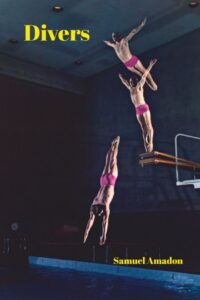
Samuel Amadon, Divers
Amadon uses the sonnet form as a buoyant, springy, sonically alert check-in with the nearby world: a gentle argument for noticing the immediacy around us—the “Pollen settled on the paint of my porch”—and for naming the language that both describes and transforms it: “I find these words/ Real beautiful.” In his pursuit of a Stevensian sense of an underlying order that animates a suburban scene where “cars/ Curve out of driveways in quiet arcs,” these poems quietly elevate the ordinary into an artful realm. The collection also reads as a seasonal diary, tracing a full year through temperature shifts, blossoms, and the eventual fading of life. Nothing dramatic erupts, yet an astonishing number of things manage to astonish.
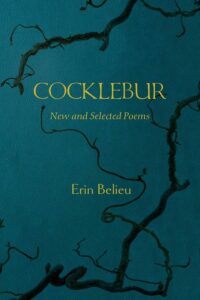
Erin Belieu, Cocklebur: New and Selected Poems
This exquisite retrospective traces Belieu’s evolution as a poet: from the graceful, encoded traumas of her 1990s work to the more fluid, musical political engagement that characterizes her recent books. Across the years, her verse maintains a stubbornly earthy realism, tempered by sharp wit and a capacity for bite. The poems prosper in the ordinary world, where compromise and transgression illuminate life. The newest poems—open, tentative, slowly unfolding—are quietly exhilarating, haunted by the sense that “The stories we’re told as children reside/ permanently inside us.// like measuring cups,// one fear sits snuggly/ inside the next, teaching/ us to tidy our darkness// into the smallest/ amount of space.”
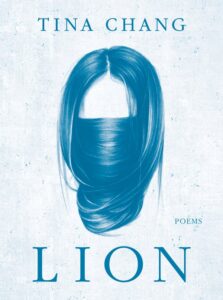
Tina Chang, Lion
Chang’s latest, a fourth volume of varied form, commits to a vigorous meditation on the inheritance passed from mothers to daughters, on the interplay of image and myth, and especially on the threats confronting Asian American women in the era of and after the pandemic. It is perilous to vanish from view, and the poet insists that “If only my people were not dying from being invisible.” The sacrifices of the poet’s own mother—“She offered it all to me. I took and took”—ultimately safeguard the poet’s daughter, “a tender shoot, / mothered, until she is an orchestra of light.” The collection also opens with a stark meditation on the 2022 killing of Michelle Alyssa Go, widening into a lament for violence against a wider circle: “I struggle to live. I carry time that falls/ like chandeliers around me.” While poetry cannot shield anyone, Chang faces risk with deep empathy: “Each time another woman died, I buried myself/ next to her, more of another world than here.”
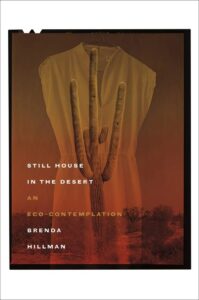
Brenda Hillman, Still House in the Desert
In her most intimate and revealing work, and among her strongest to date, Hillman applies a technique that disassembles time to the lives and particulars of her mother’s days and her own childhood. The short lyric pieces, arranged in sequences and expansive sections, borrow much of their imagery from recent memory and the late twentieth century: “When nuclear testing began north of love/ & the Remington computer was placed in office use.” Hillman continually reorients geological and human history around dates of personal meaning: “It is half a century before you will mourn your mother.” Yet when the poems narrow their focus to the atomic scale, a new sense of time emerges: “The dot/ paused in the pencil// but emerged when/ light offered/ support for the dot.” She sweeps across eras—“Trees emerged in the Devonian/ Period when Gondwana was a continent”—and reclaims the perspective of a child who “does not fear death,// she hasn’t read enough yet.” What results is a grief examined under a microscope: every loss remains alive in some form, and the ache persists while the world changes around it.
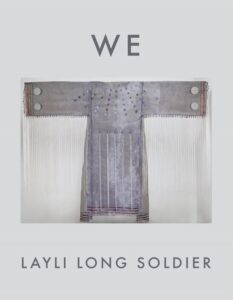
Layli Long Soldier, We
Long Soldier’s eagerly awaited second collection unfolds as a capacious, textured mosaic of poetry and prose. Its lyric sequences, visual poems, and accompanying notes, diagrams and photographs—along with extended prose pieces—bring a wide range of forms into conversation. Long Soldier, a National Book Award finalist this year and a MacArthur fellow, confronts the deep sorrows and disappointments of our moment with a direct, disarming honesty: “the images of George Floyd pierced my soul,” awakening a sense of timeless dread that precedes us all. The book braids rage and tenderness in meditations on mothers and daughters; the enduring truth of treaties signed by Indigenous leaders in 1868; and the fragile yet undeniable role of art. The arc repeats in many forms, insisting that when the author speaks of “our history,” she means a shared inheritance—one that belongs to Native peoples and non-Native alike. Anyone living on this land is, in a real sense, a treaty inheritor.
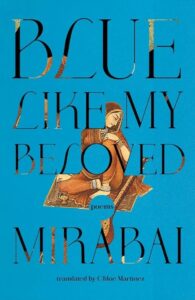
Mirabai, Blue Like My Beloved
Translated from the Braj Bhasha by Chloe Martinez
Mirabai, the sixteenth-century poet, mystic, and spiritual seeker, is a familiar name in India but less so elsewhere; this vivid new translation of her verses could change that. Tradition holds that Mirabai abandoned a life of power and wealth to devote herself to the god Krishna, whom she calls “Mira’s man, Mountain-lifting lord.” In Martinez’s renditions, Mirabai remains fearless, sensuous, deeply earnest, occasionally humorous, always skirting the boundary between body and spirit. Martinez also renders Mirabai as a fluent speaker of contemporary American English with its many informal idioms: “Baddies can go jump in a fire.” These contemporary inflections make the five-hundred-year-old poems feel like brisk, current lyrics—timeless yet urgently relevant. The volume is likely to draw a new circle of admirers to Mirabai’s voice.
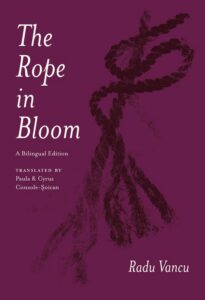
Radu Vancu, The Rope in Bloom
Translated from the Romanian by Paula Console-Soican and Cyrus Console-Soican
This magnificent, somber epic of grief radiates outward from the figure of the poet’s father, who died by suicide and speaks to the poet in a string of imagined metaphysical dream monologues that reflect on life, death, history, and recent events. Vancu’s poem is part of a lineage that includes John Berryman’s Dream Songs, Genesis, Delmore Schwartz’s unfinished epic, and Heaney’s Station Island: the deceased appear in a mirror-world where “in the afterlife it’s all reversed:/ all you say, we at once deny,” and the voices are balanced by the living. After each canto, written in tercets reminiscent of Dante, comes a prose reflection in which the poet considers the poem as it is being written, surveys wider history, and makes striking statements: “we make our loved ones revel in our suffering so that we can love them all the more. This is a tender torture, in which the torturer may as well be the wife, the child, or the lover.” This classical approach lays out a sweeping vision of how the past shapes the present, creating an epic for this unsettled era—a dispatch from a war-torn Europe that nonetheless mirrors the stubborn beauty of human existence.