
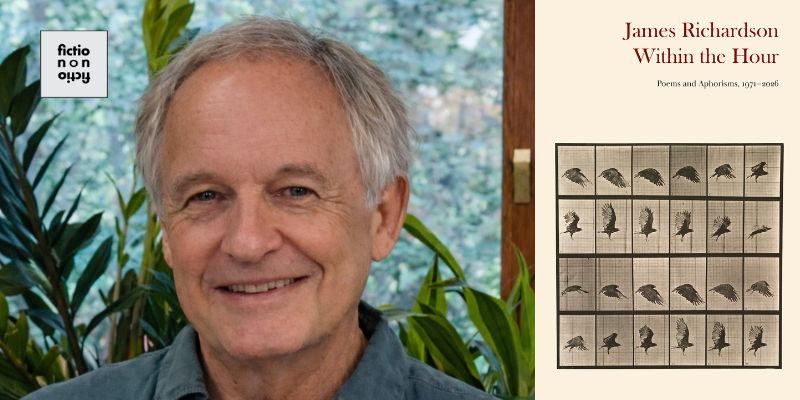
Poet James Richardson sits down with co-hosts Whitney Terrell and Christian Barter to discuss his collection of new and selected poetry, Within the Hour. Richardson describes how an early curiosity about science and a love for science fiction have shaped his verse and considers how his aphorisms balance his more lyrical pieces. He reflects on the influence of literary criticism on his path as a poet and offers listeners a rare glimpse into the source of his inspiration and his process of composition. He also speculates on the growing role of politics in his newer work, especially since 2016, while reading from Within the Hour.
To hear the full episode, subscribe through iTunes, Google Play, Stitcher, Spotify, or your favorite podcast app (remember to include the slashes when searching). You can also listen by streaming from the player below. Video versions of our interviews are available on the Fiction/Non/Fiction Instagram account, the Fiction/Non/Fiction YouTube Channel, and our show website: https://www.fnfpodcast.net This podcast is produced by Christian Barter, Whitney Terrell, Valen Williams, Ashley Holmes, Rylee Adamson, and Lucien Hockaday.
James Richardson
Within the Hour: Poems and Aphorisms, 1971-2026 • For Now • During • By the Numbers • Interglacial: New and Selected Poems and Aphorisms • Vectors: Aphorisms and Ten-Second Essays
Others
“Stopping by Woods on a Snowy Evening” by Robert Frost
EXCERPT FROM A CONVERSATION WITH JAMES RICHARDSON
Christian Barter: This volume reaches back to 1971, and I’d like to begin by asking what it feels like to assemble a book that encompasses so much of your poetic life. You previously released a new-and-selected collection titled Interglacial, back in 2004. A portion of those poems appears here, but others do not. I’ll quickly mention that the earlier volume is worth picking up, Interglacial, because it contains excellent pieces that simply wouldn’t fit in this edition. But what was the experience of curating such a broad, sprawling compilation? And did you uncover anything about your own practice while undertaking the task?
James Richardson: It was enjoyable, yes. I tackled the project with [my wife] Connie acting as my in-house reader. She’s an extraordinary reader, someone who has followed my work for fifty years, so we went through the pages together and selected pieces. I suppose you end up learning a lot. I could feel a twinge of disappointment that fifty-five years would have to fit into a single book, even if it’s a compact logbook, even if it represents only a portion of what I have written.
Although I don’t think I am. I’m satisfied with the book. They tell you that you can’t revise your older poems once you commit to a collection. Initially I thought, “Oh yes, I can.” But you know what? They were right. You can’t do it, because it’s rarely just one small thing that’s off with a poem, especially when the poem has always felt just beyond your reach. In the past, you might perform a little surgical adjustment and sever a nerve you didn’t even realize existed, and then you end up needing to do more edits. So the only viable option for revising old material is either to keep it or to remove it. I chose to remove more than I might have if the book could have run to three hundred pages, and perhaps my editor would have permitted that. But you don’t want to overwhelm readers.
I’m thinking of someone who has not read any of my work before. Most readers who buy this volume probably fall into that category. I don’t want them to land first on a piece I wavered about keeping, a piece that might raise questions. I’d rather the standard be higher. When I revisit it, certain pieces still surprise me.
There’s a poem called “Encyclopedia of the Stones” in my first book, and I still admire that piece. I still read it, though in this selection I cut away a great deal. I focus on the strongest portions. Gosh, I’m not sure I could write something like that today. In general, it takes a long time to reach a point where I’m writing the kinds of poems that feel right for this book. It was probably in the late thirties, perhaps into the forties, before I could write with a certain consistency that felt appropriate for inclusion here. I’m not necessarily talking about the “right” kind of poem I should be writing, just the kind I have been writing. You wonder if every book contains a version of this poem that you ought to be writing but can’t yet. I still feel that sense now. I’ve moved beyond this particular book and I’m already into the next phase. Yet this poem continues to elude me, which is probably a good sign. It keeps me going.
Whitney Terrell: Your work has long engaged with science and exploration in various ways. I think of earlier pieces like “Are We Alone Or Physics You Can Do at Home,” with lines such as “Always the vanishingly small but non-zero possibility: all protons in the room might decay spontaneously.” In the newer poems gathered here, several pieces are directly tied to cosmic scales and the forces operating within vast celestial bodies, as in “Cosmological” and “Momentum.” Could you discuss how your poetry relates to your interest in science—when did that begin, and has it always been part of your approach?
JR: I first encountered the idea of all the particles in a room decaying at once in a science-fiction story I read when I was about nine, and the notion stuck with me in some unexplainable way. I still read science fiction—indeed, it’s a kind of default genre for me. Science feels like a road not taken.
As a child, I imagined I would become a scientist. I taught myself the high school chemistry syllabus in seventh or eighth grade simply to learn how to balance equations that could yield explosives. I completed two years of chemistry in high school, then pursued physics and calculus before I found myself reading Robert Frost’s Stopping by Woods on a Snowy Evening one night and realizing the math was daunting and that poetry might be my path because I was going to die otherwise. I eventually left a physics course and took a long break from calculus. I didn’t study science in college, but it was only a few years later that I began writing seriously. Even now I read more science magazines than literary ones. It’s a reservoir of information that offers a lot to me. Primarily, it’s fascinating in its own right. Perhaps I inherited some engineer’s DNA from my father, and I remain curious about how things function. The sense of scale in science pleases me: on the one hand, there could be two trillion observable galaxies, and on the other hand, this very desk I lean on is composed of vast voids I know almost nothing about. Between those extremes lies a thin skin of life on Earth, and within that skin, the delicate layer we call consciousness, which is largely unconscious. I want to maintain that sense of fragility and adaptability, because without it I’d be too rigid to write poetry. I also feel that science carries a magical literalism that helps me see things anew, and I simply enjoy the facts.
CB: Jim, I’d like to return to a recurring idea in your work: endings and the possibility that things might conclude, or conversely that some things never truly end. One of my favorite earlier Richardson pieces is “As If Ending,” which ends with “when a migration, little different from evening / leveling, took its place on the water, / ending nothing since nothing ends.” That paradox—the idea of endings as something time itself may structure—appears repeatedly in your poems. Could you speak about your reflections on time and endings within your verse?
JR: Yes, I think about endings a great deal. I also keep in mind the aphorism: “A beginning ends. What an end begins.”
Transcribed by Otter.ai. Condensed and edited by Rylee Adamson, Valen Williams, Ashley Holmes, and Lucien Hockaday.