In many ways, I see myself in Sylvie, the central figure of Wayfarers. My childhood unfolded amid the cornfields of southern Illinois, a bit of an oddball in a close-knit community. I spent endless hours with a book in hand and a pen nearby. I wrote poetry, short pieces, and sprawling fantasies about sphinxes, chasms without bottom, and storms that could swallow towns. Tornadoes frightened me—an experience shared by many kids raised in central Illinois—and so, in fifth grade, I drafted a tale about a society that had retreated underground. My teacher, Mrs. Madonia, caught me at work—likely when I shouldn’t have been—and offered to read what I’d created. I handed her a massive stack of pages along with a bunch of awkward poems about middle-school heartache, and the next day she handed them back. “You could do this,” she said. “Become a writer.”
Now that I teach as well, I picture her tucking that heavy bundle into her briefcase, taking it home on weekends, settling into a couch with a cup of tea or a window seat, and carving out hours just to read something that probably wasn’t destined to be the Great American Novel. All because she saw me for who I was: a little girl who loved something deeply and needed someone to tell her it was okay to love it. That it was good to love it.
After college, I spent ten years in graduate school, attending writing workshops and teaching undergrads poetry and fiction. I loved those classes, but I lived for the summers, when I taught in a gifted program for high schoolers. Five weeks with the same class, from eight-thirty in the morning until two-thirty in the afternoon. I’d have eight, or nine, or ten students, from across the country and, sometimes, from around the world, and for those five weeks we would live and breathe fiction and poetry. They composed encyclopedias about the intricacies of their families and their imagined futures; poetry about love, change, and the politics of having a body; stories made up of emails sent into the void, letters left in the mailbox of someone who never wrote back. They wrote with ferocity, with passion, and with astonishing skill.
If you want teenagers to read more, you have to guide them toward books that understand the complexity of their experience and treat it with respect. If you want to write for teenagers, you have to honor that duality. You have to love it, I believe.
I accepted a full-time job teaching high school creative writing at Interlochen. I brought their work home at night. I brewed a cup of tea, settled onto the couch, and picked up a green pen. I marked the lines that sang, tightened the ones that sagged, and highlighted the moments that reminded me my students could be sixteen and, at the same time, larger than the universe. I treasured the moments after class as well as before—students rushing in to share cat videos, temporary tattoos, new haircuts. Students waiting outside my office with hesitant questions that would lead to another question: What should I do with my life? Should I break up with my girlfriend who kissed my best friend, though she claims it was an accident? Maybe I’m a writer. Maybe I’m gay. Perhaps I should move out, or perhaps move in with my grandmother. People tell me we should hate the world right now, but I love it, and I want to fix it. How would I go about that?
And always, at the end: Do you know any books about that?
The way they read, as if words were trapdoors, as if they’re honey, or as if they’re air. The way they react when they finally discover a book that reflects themselves, or part of themselves. It’s hard to be a writer around teenagers without wanting to write for them. My students are simultaneously cerebral readers and emotional ones, and those tendencies can be at odds with one another. If you want teenagers to read more, you have to guide them toward books that understand the complexity of their experience and treat it with respect. If you want to write for teenagers, you have to respect that duality. You have to love it, I think.
When I wrote my first young adult novel with Jeff Zentner, Sunrise Nights, we knew we wanted to capture that tension between the inner self and the outer world, that sense that who you are doesn’t always line up with who the world expects you to be. We devised a hybrid form, what we call a novel-in-verse and conversation, where our characters’ inner lives unfold through poems and then drop into scenes where they banter, negotiate, and reveal secrets to the reader while pretending to hide them from each other.
In Wayfarers, our most recent novel, we’ve used that same form to tell the story of Sylvie, a privileged girl on a post-graduation #vanlife road trip, fleeing grief and guilt, with a golden retriever in tow, and Knox, who has just extricated himself from the nomadic cult his mother dragged him into as a child. On paper their backgrounds could not be more different—Sylvie speaks fluent Gen Z; Knox does not—but in practice they’re both grown up far too fast and are carrying secrets they think they can’t share. After Knox rescues Sylvie’s runaway dog and breaks his arm in the process, she offers him a ride south to his grandmother’s house. On the road, there are secrets, lies, skinny-dipping, yearning, feuding roadside fortune tellers, solar eclipses watched from a Walmart parking lot, and a lot of banter about wants and needs and whether we’re the sum of our experiences or if we can shape ourselves into something more. Also, kissing. Of course kissing. I’m not a monster.
Like all my young adult novels, Wayfarers was written for myself, for the girl I once was, but mostly—I wrote it for my students. For every kid with burning eyes who came into my office and said, This is who I am. What do you have for me?
The world, of course. We have the world for you.
_________________________________________
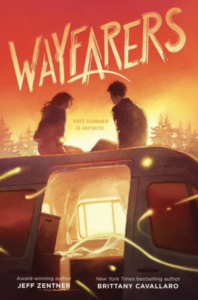
Wayfarers, a collaboration between Jeff Zentner and Brittany Cavallaro, is available through Quill Tree Books.