
My daughter turned four this summer, and it’s been a strangely riveting experience watching her grapple with the morality of secrets at this developmental milestone. I repeatedly remind my daughter that she’s “safe to be honest about anything.” When she sees me and my partner quietly conferring in the kitchen or catches us spelling something out so she can’t understand, she’ll yell, “That’s NOT nice, no secrets!” And yet, when her cousin comes over to play, they’ll whisper pure gibberish in each other’s ears and laugh hysterically over their shared “secrets.”
The way secrets can either pull people close or push them away is an enticing paradox. And, looking at my daughter, it’s one that begins early, in toddlerhood. Why do we feel compelled to hide aspects of ourselves? When does withholding blur into misleading? Which secrets do we keep to protect ourselves and which do we keep to shield others? How does keeping a secret uphold (or undermine) our identity, and how does our sense of self shift over time the longer we live with that secret? It makes sense that some of the most psychologically gripping novels, memoirs, and poetry collections center on the creation of secrets, their revelations, and the subsequent fallout.
In my new memoir-in-essays, Freak Lip, each chapter delves into a different period in my life when I wanted to say a particular sentence aloud, but it felt physically impossible to articulate the secret. I hope to offer an honest exploration of the ways shame and anxiety inhibit intimacy, and also a roadmap toward how to risk excavating the truth. The silences formed in the absence of sharing are challenging to capture on the page but when done effectively, readers can become enmeshed in such moments, co-conspirators of the secret. Or, they can be just as blindsided as the other characters when the truth comes out. Here are nine books that guided my understanding of how holding or exposing long-kept secrets creates a palpable tension between regret and relief.
*
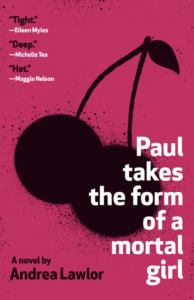 Andrea Lawlor, Paul Takes the Form of a Mortal Girl
I can’t tell you how badly I needed this book back in the late 1990s—which is the era of Lawlor’s storyline—when I was a teenager and quietly struggling with my own gender expression and anxiety around being diagnosed with a sleeve hymen. I wanted to wear tight baby tees but simultaneously disappear into baggy skater pants and androgynously short hair. I felt like my body was a medical mystery, unknowable to me and impenetrable to anyone else.
In this novel, we dive into the twenty-year-old body and mind of Paul, who has shapeshifting genitals: his active sex life in bathroom stalls and his internal monologue as he tries to understand who he wants to pursue and why. He keeps the truth of his body a secret partly because he doesn’t believe anyone can relate and partly because of his fear of rejection, complicated by the boundaries of his partner’s queer community. The book is a study in the dynamic between loneliness and risk-taking: while each new relationship Paul embraces helps him understand himself better and expands his empathy, he also has to confront what anxiety level is sustainable if he can’t fully reveal his shapeshifting abilities to those who love him. I would have felt less lonely and more emboldened to share what I was going through in high school if I had been able to read a novel like this one.
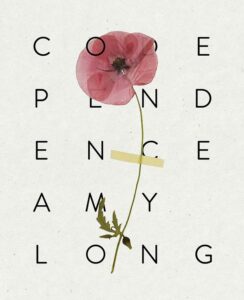 Amy Long, Codependence
Amy Long’s Codependence broke my heart like a long-lost song popping on the radio as you speed down the highway that you find yourself suddenly crying and hoarsely shout-singing along to. In this memoir, Long’s secrets are woven into private patterns—obsessively counting pills, visiting different Duane Reade pharmacies—as she documents with dark humor her chronic pain and the opioid addiction attached to the only medication that makes living sustainable.
I grew up with an invisible chronic illness that was a challenge to explain to anyone my own age. I lost friends who didn’t understand that when I felt too tired to even take a shower and had to cancel plans, it wasn’t because I didn’t want to see them. Without a proper diagnosis, I lost months of my life every year to sleeping and fighting bacterial infections. Long exposes how secrecy builds up when even doctors don’t have the language to identify one’s pain. Long’s memoir spans three decades, deftly jumping into memories that track the development of her unrelenting headaches and the divide it creates in her family. How do you tell your mother you’ve gone back on opioids when she was there feeding you soup and ice cream five years ago during your last withdrawal? How do you tell your father, who thinks it’s the easy way out rather than the only viable choice to survive?
With neurologists unable to find a diagnosis, Codependence captures the unspoken, excruciating choices Long faces when confronting the loneliness in suffering and the cost of making art. Inextricable to Long’s art, though, is a self-awareness and acerbic wit that elevates the narrative and reminds us that humor is integral to survival, too.
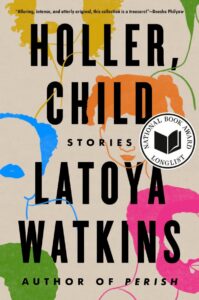
Latoya Watkins, Holler, Child: Stories
Watkins is a master of dialogue, dialect, and narrative intimacy. In this stunning collection, which centers Black women in West Texas, Watkins perfectly balances familial interactions with protagonists’ internal thoughts, creating immersive, local rhythms that invite you right into the living rooms of her characters. Their secrets manifest in different ways: infidelity, the truths hidden underneath the lies mothers tell children to protect them and the secrets children keep to shield their mothers from grief, the apologies never given.
In both “The Mother” and “Holler, Child” mothers keep from their sons their fathers’ identities to minimize potential pain and embarrassment, only to see the negative ripple effect this has on their sons’ choices as they grow. In “Vigil,” the protagonist has a simmering hatred for her childhood friend’s Muslim husband, whose gay relationship with his best friend is an indiscrete secret. She reflects on what no one will say aloud: “Thala and me ain’t close enough for me to tell her that her husband supposed to come home to her at night. Snuggle up to her at night. Not with his best friend, La Mare. La Mare who lived with them for the first three months of their marriage. La Mare who slept on their couch while Wale slept on the floor close to him.” These stories wrestle with the entanglement between desperate love and unknowability, what might be gained from speaking up, and why sometimes, we still can’t.
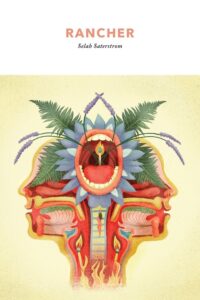 Selah Saterstrom, Rancher
Every writer has certain books they return to when they feel stuck. When I hesitate with directness or need a refresher on how to weave in different temporal moments into a braided essay, I return to Rancher. The very first sentences of this essay reveal a long kept secret in an astonishingly straightforward way:
My rapist bought a house with a swimming pool in El Paso.
One issue I’m having while writing this essay is that I have nothing interesting to say about rape. Not even my own(s). And I literally just started writing this essay.
My friend, however, is harvesting black widow spider eggs and putting the egg sacs in her freezer. I learned this news from another, mutual friend. Meanwhile, I have said nothing to my egg sac harvesting friend about her habit.
Saterstrom invites a conversation about how power dynamics shape secrets: which—and whose—sentences get believed, and why we withhold secrets when those with more power can easily turn truth into public doubt. Growing up incredibly impoverished in Naches, Mississippi, Saterstrom experienced sexual abuse and exploitation. She captures these circumstances succinctly while bringing in the voyeurism of finding her childhood rapist on social media:
The house was a respective rancher with a pool, wife, and two kids active in sports programs at their Catholic school. And Raper doesn’t look that bad, sort of like a puffy Eddie Vedder in a track suit, not remarkable, but it could be worse. At any rate, he seems grateful for everything now.
I notice a poolside pic of his daughter at her fourteenth birthday. It’s a hard age, fourteen. When I was her age, in the moments before her dad would rape me and/or oversee my rape by others, he called me Orca, as in, his words, a fat ass whale. Everyone thought it was hilarious. I laughed, too.
I lived in a situation where there was often not enough food. For most of junior high, I ate day old Piggly Wiggly Bear Claws—four for a dollar—and smoked cigarettes. I would try to spread out the Bear Claws, but would usually still eat all four in a frenzy. Then I’d cry. Then I’d light a Doral Full Flavor. Where I lived, there wasn’t enough of anything, including oversight, so rapers slipped in.
This startlingly direct essay meditates on a life of internal restlessness and the relief experienced once the environment is right for truths to come out, “Stilled things hatch when the conditions become conducive.” Yes, we’re discussing both spiders and rape survivors here. As Saterstrom affirms, “We will find a place where one can rest, where a story can rest.”
 William Shakespeare, Macbeth
In 2005, Sena Jeter Naslund published Ahab’s Wife or, The Star-Gazer, which centered the captain’s wife left at shore during the whaling adventures in Moby-Dick, and humanized the oft-caricatured obsessive Ahab. In 2007, Gregory Maguire gave us the beloved Wicked, which reframed the villainous Wicked Witch of the West as an empathetic, driven, and misunderstood heroine. I’m still waiting for a book to likewise reintroduce us to Lady MacBeth but in the meantime, you can re-read this classic from a different perspective. Assigned MacBeth in eighth grade, I remember the moment when my harrowing attempt to understand Shakespeare shifted, the language suddenly clicking into a melodious psychodrama I could follow. What haunts me today, though, is how easily I agreed with my classmates’ vitriol for Lady MacBeth. We saw her as a devious, power-driven character: the cartoonish devil sitting on MacBeth’s shoulder, pushing him toward regicide.
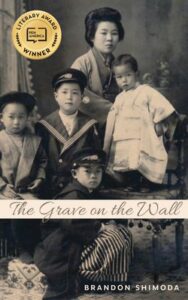 Brandon Shimoda, The Grave on the Wall
Accomplished poet and nonfiction writer Brandon Shimoda brings his love of lyricism to this memoir, a portrait of his grandfather that excavates a century of xenophobia and silence in America. Shimoda describes growing up amongst unspoken family stories: “The obscurity of the past resided in not understanding, when I was young, that there was any past. Everyone existed, as at the opening of a play, as they were, which made their aging strange and terrifying.” This absence drives Shimoda to unearth historical records like FBI files; to visit Manzanar, the concentration camp his grandfather was sent to in Missouri; and to travel to his grandfather’s ancestral homeland in Japan. Shimoda reveals how identities are forged through steamships crisscrossing the Pacific, formed by old family journals and photographs, and also obscured by systemic erasure.
Like searching for matches and candles once the electricity’s already gone out, Shimoda captures how hard it is to pin down any life besides our own: “A grandfather is a strange, somewhat impossible work of conscience, especially when old, especially when in a state of decline, on the verge of appearing to dream. My grandfather’s name is Midori Shimoda. He was born on an island off the coast of Hiroshima. He was born three years in a row, 1909,1910,1911, depending on whose memory is being consulted.” There is a quiet yearning to know himself—to find for himself a more substantial backstory and sense of belonging—in what Shimoda pieces together. He wonders, “When will I be most myself? Will I ever be?”
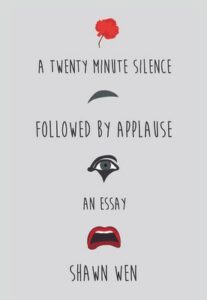 Shawn Wen, A Twenty Minute Silence Followed by Applause: An Essay
Theodor Adorno famously stated, “To write poetry after Auschwitz is barbaric.” In 1949, no one responded by asking Adorno, “But what about silent tragicomedy, eh?” Yet, onto the stage walked a Holocaust survivor: Marcel Marceau, as Bip the Clown, a mime with black and white face paint and a black and white striped shirt.
I love reading books that clearly reveal an author’s obscure obsession and then shine a giant spotlight on a person you’d never find otherwise, giving them center stage. I’m not sure how Wen became enthralled with Marcel Marceau, but I appreciate that there is a book-length experimental essay that documents the birth of his silent performance art and the post-WWII social landscape. A Twenty Minute Silence Followed by Applause is composed of brief vignettes (one to two pages each) that take on the exciting pace of clicking through a 1970s View-Master. Their subject matter ranges from Marceau and his brother’s daring work in the French Resistance saving Jewish children from Nazis to the disappointment of Marceau’s three failed marriages, while their structure rotates between scenes of Bip the Clown acting out various emotional moments; interview transcriptions; and lists of souvenirs collected over the years, turning Marceau’s house into a personal museum.
I thought a lot while reading about the trauma Marceau endured surviving the Holocaust, and about how it makes sense that silence became an essential part of his artistic self-expression. Shawn Wen writes, “Leave speech behind. The body has its own language: weight, resistance, hesitation, surprise.” Marceau’s art kept hidden all that he had gone through but channeled it into a visceral and physical connection that transcended the manmade divisions of race, nationality, or religion. Maybe it’s a stretch to say this book is about a secret, but it felt to me like the silence emanating from the Holocaust’s wound fueled the humor and expressiveness inherent to his survival. Wen shows us the startling range of what the body can emote even when trauma renders words inaccessible.
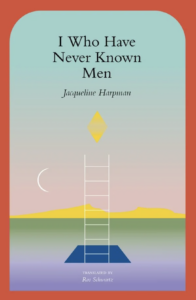 Jaqueline Harpman, I Who Have Never Known Men (translated by Ros Schwartz)
There are secrets within secrets in this work of speculative fiction: a nesting doll of secrets! The protagonist is a young girl who finds herself growing up in captivity, in a cage with thirty-nine older women. They have no privacy and are not allowed to touch each other. They’re given basic provisions to survive but no explanation as to how they got there, why they are being held, or where everyone from their previous lives has gone.
As I read, I felt simultaneously joy and a deep, unshakable sorrow. The joy I experienced was in the writing itself: clear, always questioning, wide-eyed but not innocent. The sorrow was in the palpable way the reader lives through this thought experiment, deeply embodied in an environment with flickers of hope that never quite seem to materialize. The almost unlivable, rough terrain of this novel poses an equally challenging question to the reader: Are the reasons given for holding any group of humans in captivity (ethnicity, sexual orientation, race, non-citizenship status) any less absurd than no reason at all?
When the protagonist makes it out of the bunker, it opens up an otherworldly, similarly disorienting experience of coincident joy and sorrow. I rarely write in the margins of my books, but a third of the way in, I found myself scribbling, “How do we find freedom within captivity? Humor, a sense of memory, time outside of forced routines, curiosity, new information to consider, and the power of secrecy.” At the book’s end, I scrawled, “What works against freedom and humanity? Unanswered questions. Knowing your questions will never be answered (i.e. secrets never revealed).”
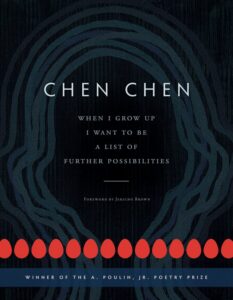 Chen Chen, When I Grow Up I Want to Be a List of Further Possibilities
Hiding in an oak tree, pausing in a middle school hallway on crutches, discovering guanacos at the Syracuse Zoo. In bursts of bright stanzas, Chen Chen transports us through the landscape of his childhood into his early twenties. In this debut poetry collection, the reader feels like they are in on the secret, one which sometimes protects relatives and other times, the speaker himself. When asked by relatives in China if he remembers them from when he was three, the speaker replies, “I say Yes it’s coming back to me, I say Of course, when it’s No not at all… the China of my first three years is largely make-believe.” When talking to a crush about their cross-country team: “I didn’t tell him, I spent all night in a tree / because my mother slapped me / after I had told her I might be gay. / I didn’t tell him that I hit her back, // that my father tried holding us apart like the universe’s saddest referee.” Withholding his feelings and observations from family and lovers while sharing them with the outside world, Chen traces variations of longing and desire.
The joy in this book is how once-secret desire is eventually and fully met by, and with, love. The poem “For I Will Consider My Boyfriend Jeffrey” concludes: “For though he does not fare well on planes he will fly to those he loves. / For his beard is already growing back. / For he looks happy & doesn’t know I’m looking & that makes his happiness free.”
_____________________________________________
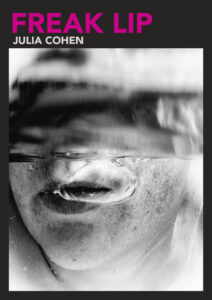
Freak Lip by Julia Cohen is available via Texas Review Press.