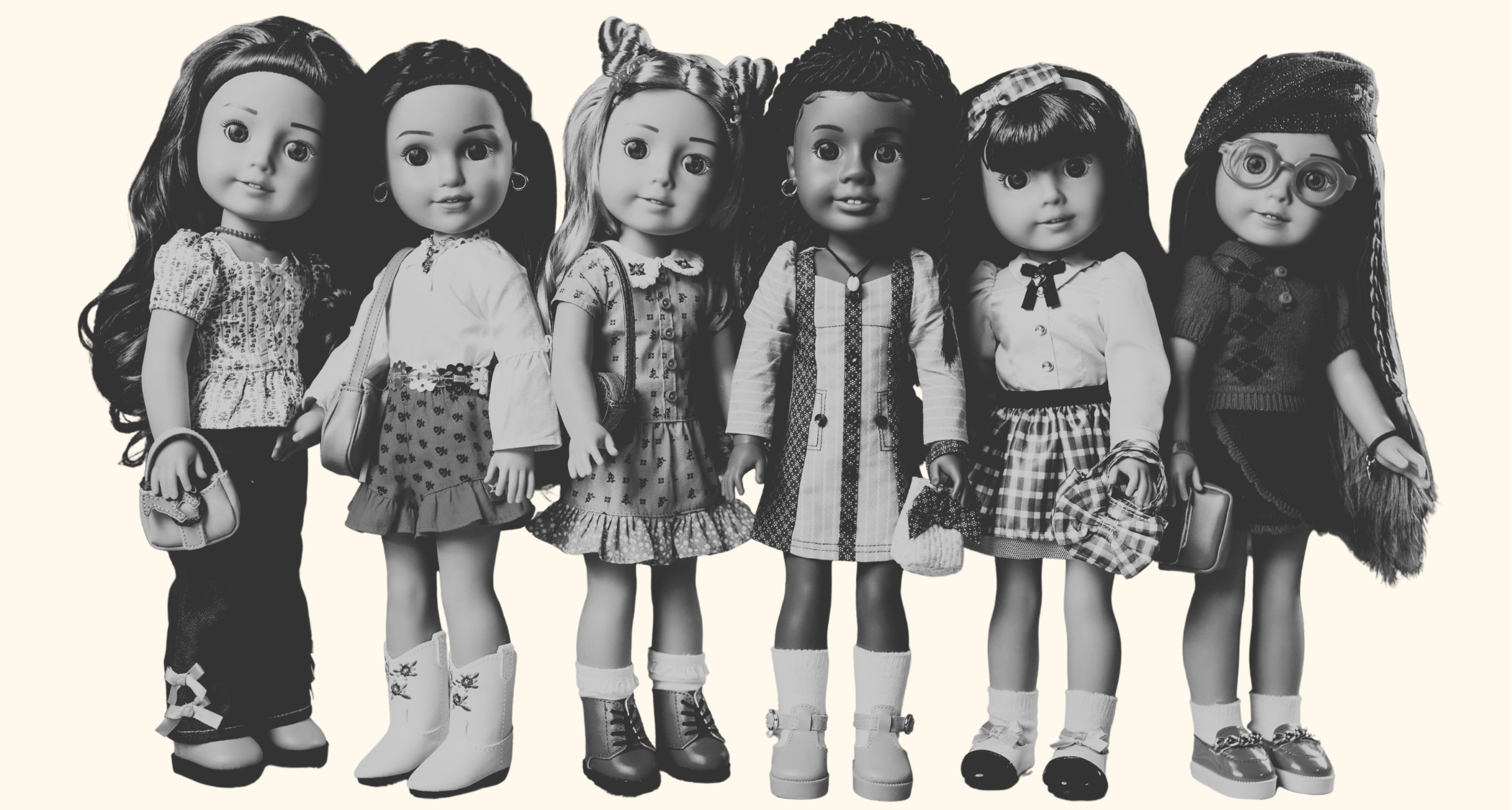
Our 40th anniversary wish list for American Girl included several long-harbored ideas: a revival of Grin Pins, a newly imagined historical doll with a more current backstory (we’ve often proposed something drawn from the 1960s Chicano Movement), a batch of refreshed Smart Girl’s guides (yes, please help us grasp our taxes, American Girl!). Yet one notion never crossed our minds—even in the most imaginative stages of childhood fantasies or grown-up reveries—was the possibility of an American Girl novel intended for adult readers. On February 11th, 2026, American Girl revealed plans for its inaugural book expressly crafted for adults, centered on Samantha Parkington.
The challenge of drawing in a grown-up audience—and monetizing that appeal—has been a familiar topic in the digital era. Time behaves as if it were elastic; nothing truly vanishes online, and it’s easy to plunge back into the warm glow of one’s youth with the click of a button. During the early waves of the COVID-19 pandemic, social platforms swelled with posts from people returning to their parents’ houses and rummaging through long-unopened childhood rooms. The “doll hospital” at American Girl saw a surge in cases; one of us (Justine) can testify to discovering her once-treasured Molly McIntire doll among a cluttered closet, hair rumpled and an arm loose, and promptly using an adult credit card to repair it.
In 2025, we published An American Girl Anthology: Finding Ourselves in the Pleasant Company Universe, partly in response to the visible rekindling across our social feeds, and partly to satisfy our scholarly curiosity as academics with credentials who felt that American Girl had nudged our career paths. Dr. Tara Strauch, contributing to our volume, reflected on the so‑called “Felicity Generation”: women who grew up with American Girl’s characters, books, and line of accessories and eventually became historians (or pursued higher education and academia in a broader sense). That American Girl helped cultivate an interest in history while shaping future trajectories is both undeniable and commendable.
An “official” update to Samantha’s story doesn’t preclude headcanons. But it does narrow the scope of possibility, just a little.
Throughout the anthology’s creation, we collaborated with a dozen authors addressing topics as varied as the brand’s Asian-American representation, adult collectors, and the AGIG (American Girl Instagram) community, as well as the spread of “tag-yourself” memes featuring American Girl characters entering the mainstream. A unifying thread across nearly all the essays was nostalgia. Nostalgia encompasses two facets: the warmth of stepping back briefly into a moment that has passed, and a bitter twin—that the moment is irretrievably gone and cannot truly return.
Ultimately, American Girl still faces the delicate task of remaining a profitable enterprise while continuing to be a trusted safe space for children who are learning to navigate the world. So, what obligations does American Girl and Pleasant Company owe their fans who are older than twelve?
From our perspective, Samantha stands as the natural fit for this audacious venture: she belongs to the trio of the earliest Pleasant Rowland creations; she is often revered as the doll with the finest accessories (rumored to be American Girl’s top-selling figure); American Girl’s 2026 Doll of the Year, Raquel Reyes, is said to be Samantha’s direct descendant. Furthermore, although Samantha’s original book arc grapples with the harsh realities of child labor, hers is among the stories with comparatively less friction.
American Girl is keeping Samantha: The Next Chapter tightly under wraps; as of this writing, no advanced copies seem to be circulating, and Cosmo.com offers only the first four chapters for preview (a nod to American Girl’s decision to share an early look through a magazine platform that once aimed to bridge adolescence and maturity with a brand-new creation: Cosmo Girl). Both American Girl and author Fiona Davis (the writer behind seven bestselling historical novels set in New York and its architecture) describe the work this way:
Set in 1920, Samantha Parkington, now 25, dedicates herself to educating women in New York about suffrage and encouraging their participation in the forthcoming presidential election. But when a substantial inheritance—including her childhood Mount Bedford home—is stolen in a shocking plot, her life shifts from socialite to shop clerk virtually overnight, offering her a starkly different look at the city’s rhythms.
Let us be clear: we do not anticipate radical departures from American Girl’s established framework. Samantha Parkington remains a trademarked figure, and American Girl has a brand image it is keen to protect. It’s inconceivable that Mattel—now the owner and manager of Pleasant Company—would officially place Samantha in alignment with the IWW. Yet it’s equally evident that American Girl isn’t fully comfortable with engaging adult readers on their own terms, in any meaningful way.
Despite the description, Samantha: The Next Chapter reads as a young adult title. There’s nothing inherently wrong with that categorization, but it conflicts with how the book is marketed. The opening beats stay tightly bound to the familiar cadence and reading level of the original texts, such that a reader could forget Samantha is twenty-five and not twelve. If you needed a reminder that the doll’s heart-shaped locket accompanies her—alongside hair color, hometown, suffragist identity, and a primer on what a suffragist did—it’s presented up front. Children require explicit exposition; well-crafted children’s literature guides younger readers to infer patterns and connections. Adults, especially those revisiting a beloved character through a nostalgic lens, should be able to grasp the subtext without hand-holding.
Samantha Parkington stood toward the rear, observant of everything around her. Her dark brown hair was pinned neatly at the nape, a practical silhouette. She ran a hand through it, catching a stubborn curl and tucking it back in place. Twenty-five years old, she had work to do… She touched the heart-shaped locket that carried photos of her parents, the thing that steadied her when delivering a speech. She wanted to help women vote, because the prior elections had left suffragists disheartened by turnout. They had won the vote for New York women, yet many still did not know how to exercise it effectively.
One Redditor remarked, “I don’t mind being marketed to, but this kind of pandering feels… tiresome.”
Fiona Davis has, without doubt, delivered the precise manuscript American Girl anticipated—and the manuscript they felt comfortable endorsing. One can imagine the many meetings that determined exactly what a twenty-five-year-old Samantha Parkington could say and do. There is precedent for this kind of negotiation, and it doesn’t always yield new material; consider the canceled Lizzie McGuire revival, where a character once a preteen would need to navigate grown-up life in New York City while remaining within a PG frame. Disney, which owns Lizzie’s rights, told creator Terri Minsky and star Hilary Duff that the character’s adult experiences would have to stay within family-friendly boundaries. Even Laura Ingalls Wilder faced difficulty presenting adult events (marriage, childbirth) to readers who had long seen her as a perpetual child, a likely reason her The First Four Years was published after her death—and why Justine still recalls Wilder’s stark, blunt remark about labor as a “wave of pain.”
Yet after reading the four available chapters, it isn’t easy to discern which genre guardrails were most crucial to American Girl. In terms of length, the Cosmo chapters range from about 1,450 to 2,000 words, which aligns with typical young adult novels. Of course, readers aren’t tallying words, but the chapter lengths strongly influence pacing and growth. And yet Samantha’s age places her outside the usual YA target range (twelve to eighteen). Curiously, American Girl already uses age filters on its site. The “Books for Adults” category aggregates a spectrum—from the American Girl Character Encyclopedia (Ages 6+) to The Official American Girl Cookbook (Ages 21+, because it includes recipes with alcohol). For adults who read at any level, these classifications align with the brand’s understanding of readers. The sole title without an explicit age label in the adult section is Samantha: The Next Chapter. The brand seems to assume the description, beginning with “Adult fans,” will attract the intended audience.
American Girl gave their core audience the tools to grow as readers. So why does this flirtation with adult fiction feel so juvenile?
This release coincides with a broader shift in adult romance—the publishing world is undergoing a notable transformation. Women readers especially want stories about female growth and nuanced pleasure (a phenomenon many online reading communities describe as “spice”). Not every Adult or New Adult novel includes explicit sexual scenes, but American Girl’s pivot to an adult readership—rather than sticking with Young Adult—naturally invites questions about what kind of adult content will appear. There’s a clear opportunity to explore 20th-century female health and self-care, a topic well within the brand’s historical publishing ethos. While the book’s description omits romance, a twenty-five-year-old Samantha, an inner-city socialite from the era, will likely encounter some romantic tension or at least face a marriage proposal or two up for debate, courted by a meddlesome Grandmary.
Since its 1986 debut, American Girl has pared down its historical line, reducing the six-book arc for each character to two more streamlined volumes. This pruning has disappointed many readers who valued the brand’s comprehensive, historically grounded portrayal of girlhood.
American Girl has provided its primary audience with material to grow as readers. So why does its apparent foray into adult fiction feel so juvenile? Beyond the IP constraints, there is a larger argument about the moment in which nostalgia-driven ventures find their audience: a substantial portion of Americans still read at or below a sixth‑grade level. This isn’t something to be ashamed of, but it does starkly illustrate the gulf between the Samantha Parkington of the original books and the adult Samantha the brand now presents—one that commands a premium price and occupies space in adult consumer culture. American Girl has long positioned itself as a partner in children’s literacy, using its middle-grade titles as stepping stones to more rigorous works as readers mature. There are many adults who enjoy YA for its themes, style, or nostalgia; yet a move to explicit adult-facing material risks diluting the brand’s core mission.
In recent years, American Girl has signaled a stronger invitation to adult fans: in 2021, they revived the original six-character lineup (Samantha, Kirsten, Molly, Josefina, Felicity, and Addy). Along with that reintroduction came a short volume described for adults in press coverage, Everything I Need to Know I Learned from American Girl (though the site marks it as suitable for ages 8+). The brand has thrived on both direct and indirect adult engagement—via Instagram meme culture, the ability to celebrate at the American Girl Place cafés, and collaborations with large cultural phenomena (Harry Potter, Barbie, and more).
In researching and compiling this anthology, we encountered countless fans who participate in “restorying”—a practice drawn from folklore and social storytelling. For fans who found themselves missing from the canonical arcs, restorying creates a space for alternative futures in which Kit runs a zine, Rebecca Rubin deepens Jewish practices, or Molly finds new paths (or even a comic outcome like a jail sentence—inhabiting the internet’s running jokes). An official update to Samantha’s narrative does not erase fan-made headcanons, but it does shrink the field of possibilities, however slightly. Undoubtedly, many readers will welcome Samantha: the Next Chapter for what it is meant to be: a commemorative token marking the brand’s fortieth anniversary.