
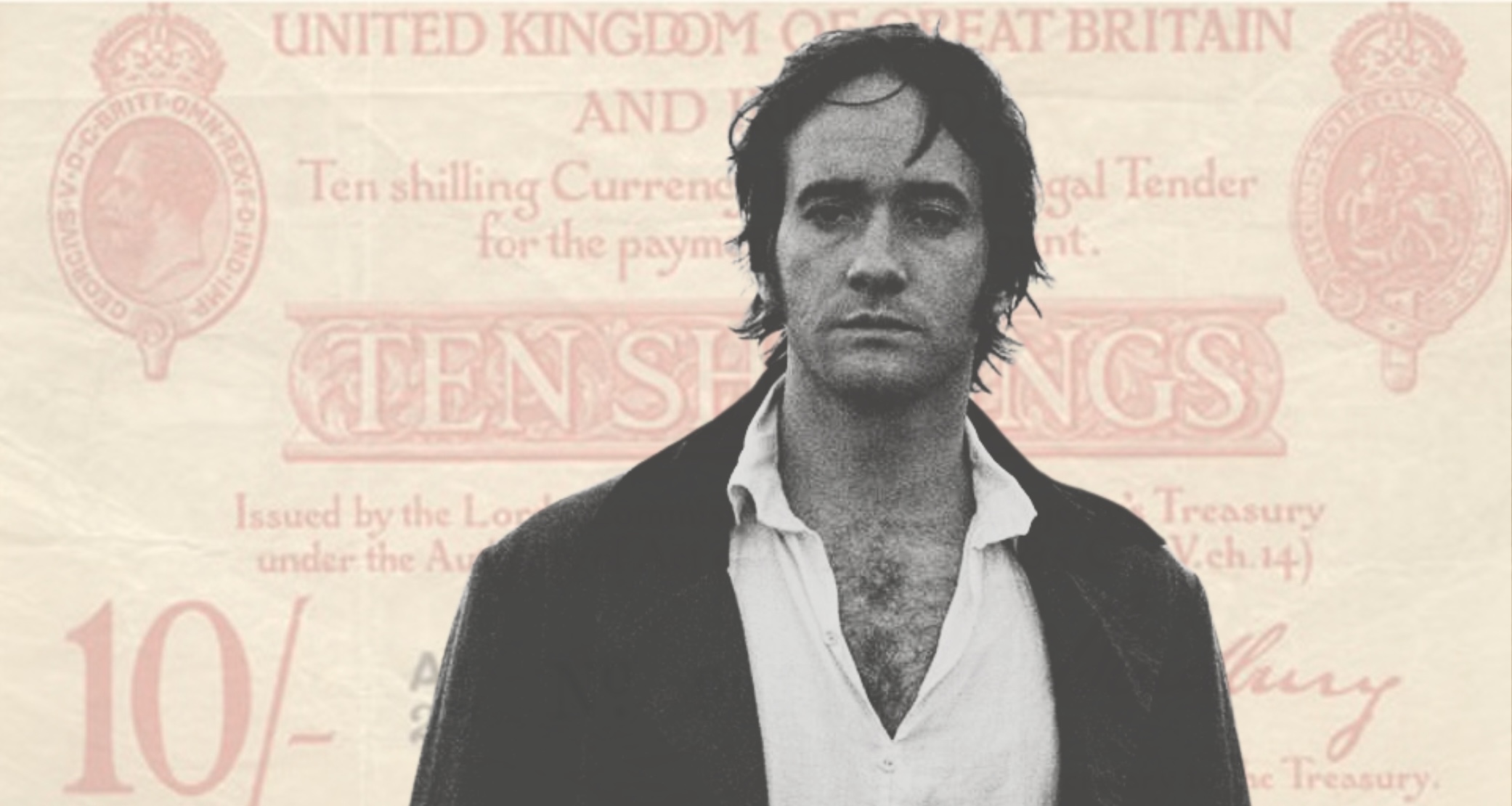
Many readers are puzzled by Austen’s habit of characterizing men’s fortunes as annual incomes while women’s fortunes are described as a lump sum. For instance, Mr. Darcy’s income amounts to £10,000 per year, whereas Emma Woodhouse’s wealth is valued at £30,000. Among the landed gentry, a man’s wealth was typically tied to an estate and not readily convertible to cash. Just as in earlier feudal times, his earnings came from the crops and rents produced by his land. Women with dowries, on the other hand, usually had little control over their money, and the capital was often invested, frequently in government bonds. During Austen’s era, many individuals who had funds but no landed estate put their money into naval bonds, which yielded roughly 4% to 6% annually during the Napoleonic wars; Austen herself referred to these as the Navy fives when that was their expected return.
*
People outside Great Britain frequently struggle to grasp the fundamentals of pre-decimal currency. In Austen’s period, the money units included guineas, pounds, crowns, shillings, and pence (or pennies). Most of these maintained fixed ratios: 1 pound sterling (£) equals 4 silver crowns equals 20 shillings (s.) equals 240 pence (d.). Pence broke down further: a single penny (1d.) = 2 halfpennies = 4 farthings. Farthings were the smallest unit, worth a quarter of a penny. Consequently, there were 960 farthings in a pound. A crown was worth 5 shillings, or a quarter of a pound. Guineas, though, were worth a little more than a pound, around 21 shillings, since their value depended on the relative price of gold to silver. Austen employs most of these units in her novels, and such nuances become lost without an understanding of their relative worth.
It’s important to note that the economy of Austen’s day differed so much from ours that it is impossible to translate their annual income directly to modern purchasing power.
Banknotes could be issued for virtually any amount and bore a resemblance to today’s paper money but were far less uniform. Regency-era banknotes were essentially promissory notes guaranteed by a particular bank. If the issuing bank failed, the notes became worthless. Austen herself experienced this when her brother Henry’s bank collapsed in 1816, inflicting heavy losses on their family.
As modern readers, we also grapple with interpreting the relative value of money from Austen’s era. A central question remains: what would Darcy’s wealth be in today’s currencies? While we cannot determine the estate’s exact value today, the annual income of £10,000 would translate to a modern amount that could be 75 to 225 times its nominal face value, depending on the inflation method used. To offer a simple estimate, adopting a factor of 150 yields an approximate liquid annual income of about $1.5 million. Yet it’s crucial to remember that comparing incomes across two centuries is inherently imperfect, since the two economies and everyday needs diverge so radically.
For the landed gentry, the cost of food and labor tended to be relatively modest, whereas expenses tied to travel and maintaining horses were substantial. Paying a craftsman to install shelves or repair a clock could set George and Cassandra Austen back about 4 shillings per day in 1795, according to a surviving account book; paying three gardeners for three days cost 16 shillings. A skilled craftsman for a full year would cost around £60, including the merchant’s commission. The yearly wages for a housemaid stood at roughly £25 plus lodging and meals, while a male servant earned about £30 with room and board. Astonishingly, such a servant’s wages equated to only about $3,750 to $4,500 per year. As another tangible example, George Austen purchased the mahogany writing slope gifted to Jane, now housed in the British Library, for 12 shillings in 1794 (roughly $90).
Numbers can be especially tricky when reading Austen’s early writings, where they are playfully exaggerated:
Colonel Martin is the second son of the late Sir John Martin who died immensely rich, but bequeathing only one hundred thousand pound apiece to his three younger Children, left the bulk of his fortune, about eight Million to the present Sir Thomas. Upon his small pittance the Colonel lived tolerably contented for nearly four months when he took it into his head to determine on getting the whole of his eldest Brother’s Estate.
(“A Letter from a Young Lady,” Juvenilia)
In Northanger Abbey, the character who loves flaunting large sums is, as expected, John Thorpe: he boasts of his wheeling and dealing in horses and carriages for 40–50 guineas as if such sums were trivial. Money also features prominently in Catherine Morland’s coming-of-age: she must learn to translate fiction into reality. When Catherine leaves for a lengthy stay in Bath, “Her father, instead of giving her an unlimited order on his banker, or even putting an hundred pounds bank-bill into her hands, gave her only ten guineas.” A part of her development as a heroine is learning the value of money.
Setting aside the fact that Austen’s novels do not all unfold within exactly the same period, comparing monetary amounts across them yields fresh insights into relative wealth and, perhaps more importantly, shifting expectations. As historical context, Jane paid close attention to the first marriage within her family: her eldest brother James’s union with Anne Mathew in 1792, when Austen was sixteen. They resided at Deane Parsonage, the former home of Rev. and Mrs. Austen Sr. James and Anne lived there on a curate’s income of £300, supplemented by a contribution from Anne’s father.
Discounting that Austen’s novels are not all set in exactly the same period, comparison of amounts across novels leads us to new insights on relative wealth and, perhaps more importantly, relative expectations.
The variations in income illustrated in the table on the following page were typical of the landed class and their dependents; nevertheless, it seems plausible that Austen has in mind James Austen when Marianne and Elinor discuss a “competence” in Sense and Sensibility. It turns out that Marianne’s “competence is eighteen hundred or two thousand a-year,” whereas Elinor declares, “One [thousand] is my wealth!” James Austen, bright and ambitious, a society habitué who enjoyed riding and hunting with the future Prince Regent and who had indulged in an extended European tour, struggled to adapt to his income, as did his wives.
One can almost hear their objections echoed in Marianne’s defense of her anticipated earnings: “And yet two thousand a-year is a very moderate income,” she insists. “A family cannot well be maintained on a smaller. I am sure I am not extravagant in my demands. A proper establishment of servants, a carriage, perhaps two, and hunters, cannot be supported on less.” Edward Ferrars is surprised that hunters are deemed necessary. James, a curate, was likewise somewhat extravagant, keeping a group of hunters while his wife maintained a fashionable carriage. In their first six months of marriage, he and Anne spent more than £200 at a single merchant—John Ring of Basingstoke—on household supplies and improvements at Deane. Anne’s father supplemented their income by obtaining a military chaplaincy for James.
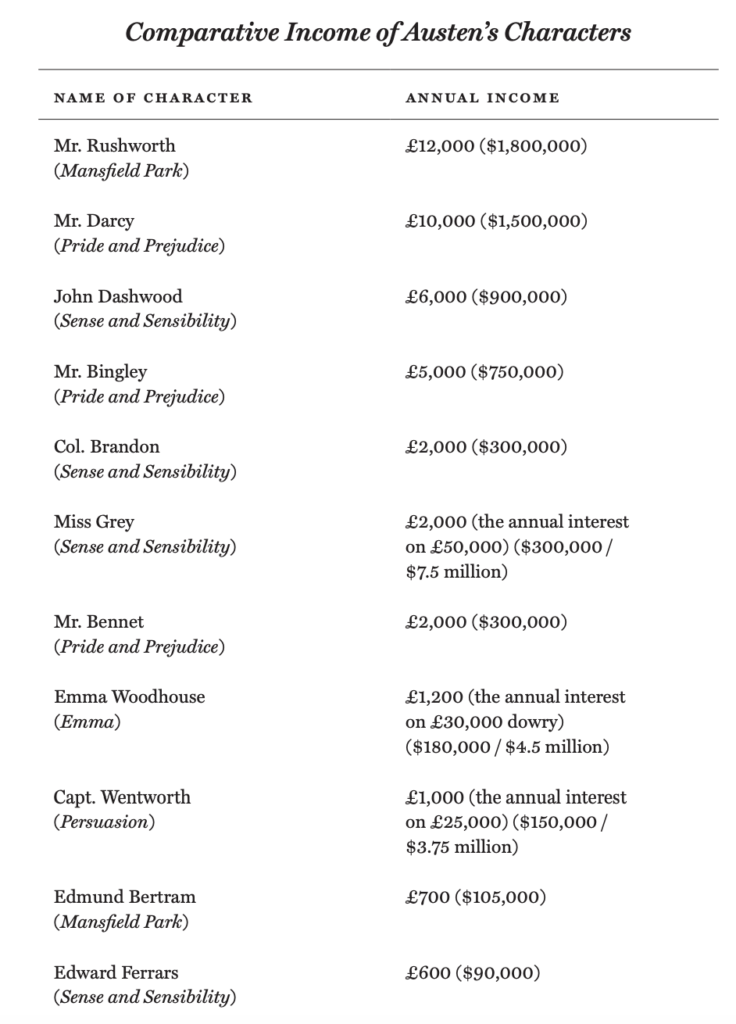
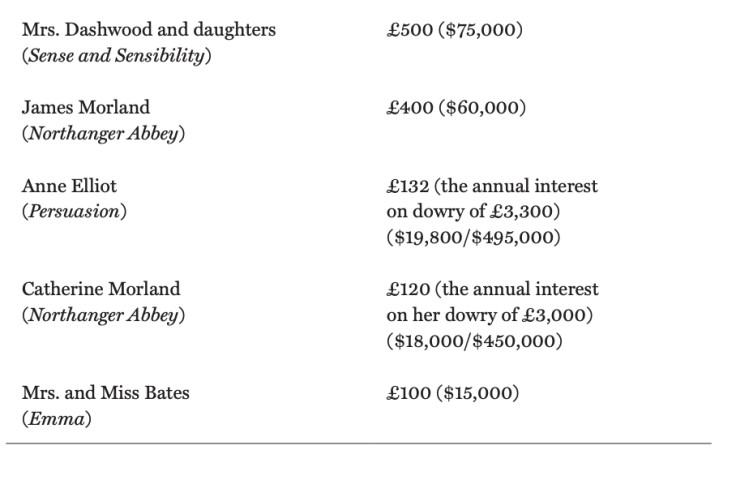
A quick survey of the table above makes it obvious how a marriage choice could dramatically alter one’s future comfort and security. When we place Austen’s own finances, after her father’s death in 1805, alongside those of her fictional figures, we gain a clearer sense of how much the proceeds from her novels mattered to her personally. Without family help, Jane and Cassandra would have ended up with about 60% less than Miss Bates (in Emma) to survive on. Mother Mrs. Austen earned £122 in family income, Cassandra possessed £40 in interest from her fiancé’s estate, and their brothers pledged an extra £200 per year in support. Including lodging costs, £362 (roughly $54,300) would not suffice to keep them financially independent, so they relocated to Southampton to share accommodations with brother Frank and his new wife.
Even though she was undercompensated by her publishers and made some misguided investments, Austen nonetheless earned nearly £700 from her novels (roughly $100,000). She channeled this money into naval bonds, a move seen as both patriotic and prudent. After releasing her first two books, her personal annual income increased by about £30 to £35. With £30 (around $450), she could acquire a cashmere shawl or treat herself and Cassandra to five writing slopes. Cashmere was a luxury, while wood and woodworking labor were relatively inexpensive. More likely, she would have spent it on a lending-library subscription, a few cherished books, small gifts for nieces and nephews, and perhaps a clothing accessory for herself or Cassandra on occasion.
______________________________
Excerpted from An A-Z Guide to Jane Austen’s World by Inger Sigrun Bredkjær Brodey. Illustrations by Harriet Wu. Copyright © 2026. Published with permission of Johns Hopkins University Press.