
The Blind Man on Bloor Street
On my second day in Toronto, buffeted by the wind, taking a morning walk, dwarfed and darkened in the shadows of the first tall buildings I’d seen in Canada, I came abreast of a strolling blind man. In dark glasses, well dressed in a camel-hair overcoat and scarf, he was sweeping a slender white cane ahead of him, feeling his way forward. What surprised me was his confidence, how he strode without hesitation. The sidewalks in central Toronto were very wide, but even so, this blind man seemed fearless. Toronto traffic was relentless, the streets jammed, and cyclists zipping among the halting cars posed a hazard to unwary pedestrians. The blind man was resolute but also wary.
I dropped back a bit and followed just behind him up a long block on Bloor Street, past a woman handing out leaflets—but conspicuously not to him—and past a partial obstruction: a homeless man snuggled in a sleeping bag, inert in the middle of the pavement where a grate emitted warm air. At other sidewalk grates—they were about a yard square—I saw more sleeping figures or else cooing pigeons, huddled and jostling in the rising warmth.
The blind man nudged the ferrule of his cane into the bulk of the sleeping figure, sidestepped him deftly, and moved on to the end of the block, a stoplight, heavy traffic, cyclists, big scary trucks. There we stood, side by side, the blind man patient, using his cane as an antenna, twitching it to gauge his nearness to the curb’s edge.
Walking and chatting with the blind man seemed to me the best possible introduction to Toronto, its temper, its welcome, its civility.
“Can I help you?” I asked.
“Please tell me when the light turns green,” he said, and now close up I could see he was youngish, with an aquiline nose, and the slight underbite that makes a person look grim or meditative, dark—Pakistani or Indian. His lovely camel-hair coat and thick scarf on this cold day gave him an air of elegance.
“Still red. Are you okay?”
“I’m quite okay.” And that sideways wobble of the head that means yes in the subcontinent.
“Just turned green.”
He stepped off the curb without faltering, and we crossed the street together. I watched him poke the curbstone and mount it, to walk on.
“Can you see anything at all?”
“A little,” he said, still walking. “I have macular degeneration. Some peripheral vision, but it gets worse each year.”
“There’s a bench here. Would you like to sit down?”
“Just lead me to it,” and as I did he swept his cane, found the legs of the bench, traced its arms, and seated himself, smiling, seeming glad for a rest and continuing his description of his blindness. “I’ve been blind this way for twenty years. I was an attorney for a number of years, but when I couldn’t function properly I became involved in human rights issues. That’s what I do, with a little help.”
“You live in Toronto?”
“Yes. Not too far from here, but I need to take the Metro.”
He’d gotten off at Bay Street station; we were walking west along Bloor Street.
“No problem?” “No problem.”
“It seems to me that it might be simpler to negotiate Toronto as a blind person than in any other city.”
“I’ve only lived in Toronto, but I think what you say is true. This is such a forgiving city.”
“And orderly?” “That too.” “I’m Paul.”
He smiled and nodded in thanks. “I’m Pattana.” “Born in India?”
“No. Born here, but my parents were born in South India on the border of Tamil Nadu in Kerala.”
“I’ve been there—nice people, fish soup. Where are you headed now?” “To the bank.”
“Can I help?”
“Not really—I think it’s there”—and he lifted his cane to point at the granite facade of the bank.
“That’s it. So you can see a little?”
“Very little. But you know, only fifteen percent of people who have vision problems are totally blind. The rest have varying degrees of sight.”
“So you’re doing all right?”
“At the moment. But as I said, it gets worse. Sometime in the future I will be totally blind.” He spoke without much emotion, he clearly had other things on his mind. He hitched himself forward and stood up. “Now I must go—so nice to meet you, Paul.”
Off he went, sweeping his cane as a feeler back and forth, serenely, without hesitation, to the bank.
A Memory of Margaret Atwood
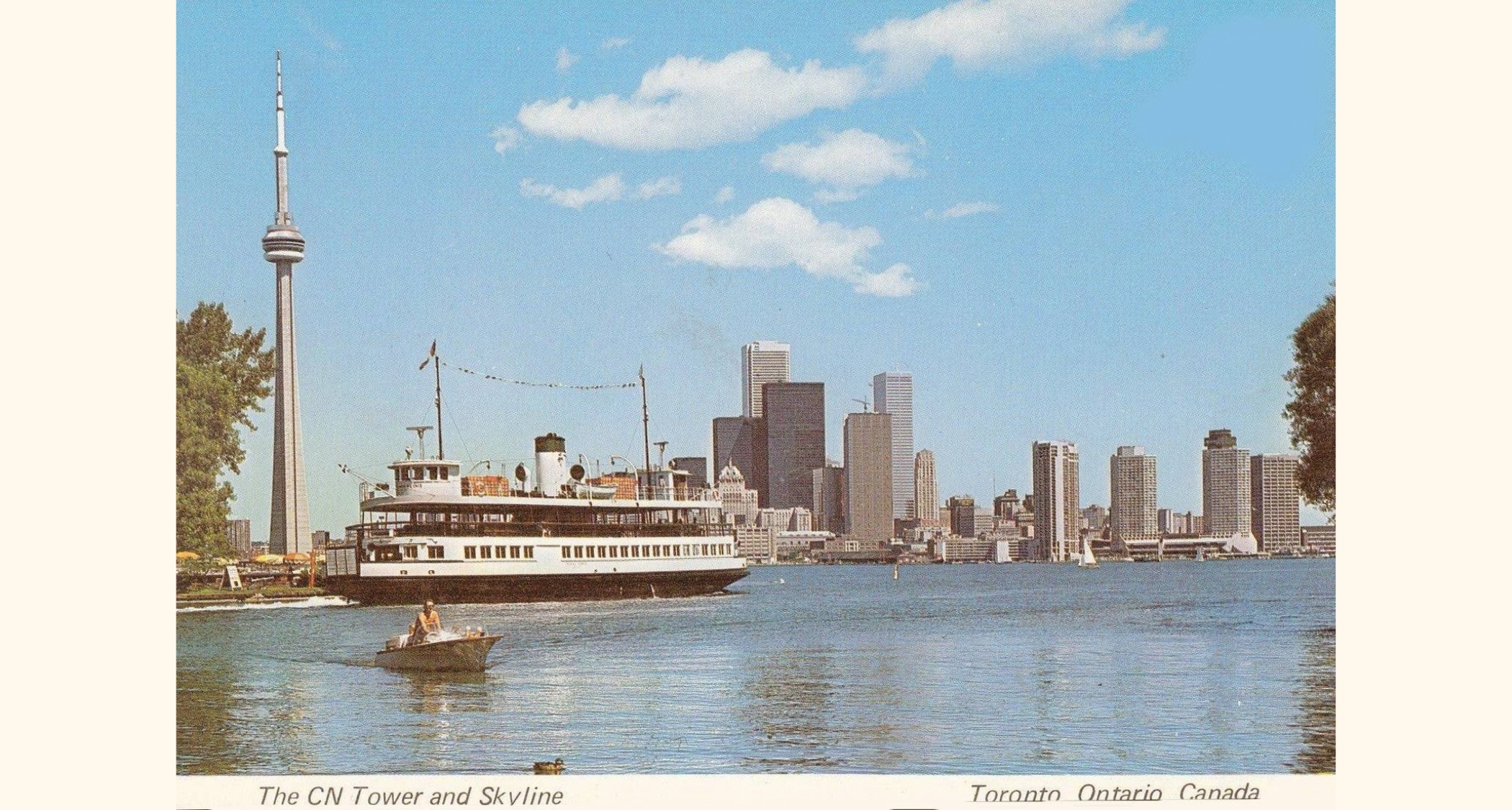
A performance of Swan Lake by the National Ballet of Canada was advertised for that night, and the Toronto Raptors were playing the Charlotte Hornets at the same time at the Scotiabank Arena; day tours were available to a nearby winery and Niagara Falls and dinner cruises on the lake, the CN Tower was described as “one of the seven wonders of the modern world,” and Toronto’s restaurants were praised. I stopped at the Ontario Art Gallery, housed in a handsome building, in which one could sit on a sofa in a cloistered room and contemplate its only painting—a Rothko, say—or wander in a gallery full of Henry Moore sculptures, or a chamber of ten hyper-realistic paintings by the Nova Scotia master Alex Colville. Toronto was a city of diversions and marvels.
Yet walking and chatting with the blind man seemed to me the best possible introduction to Toronto, its temper, its welcome, its civility. This is such a forgiving city, the man had said. It was perhaps the ultimate test of any city: Can a blind person live in it, use public transport, shop, work, find a bank and a restaurant, more or less thrive, and now and then at a cross-walk depend on a stranger to tell them when the light turns green? Most of all, not get robbed, since it is the case in most big cities that the weak and the impaired—blind people, limpers, the elderly and confused—the easiest targets, are most often the victims of pickpockets and muggers.
I had been to Toronto four times before this, visits always related to books—the Harbourfront Writers’ Festival, bookstore talks, interviews with the CBC—but those times I’d been confined to a small area of the city and never stayed long. On my first visit in the spring of 1982, I met Margaret Atwood, who had recently published her novel Bodily Harm. The Handmaid’s Tale came four years later. At dinner with her partner, Graeme Gibson, she spoke with me in a thoughtful way, and proved to be companionable and extremely well read. We talked about inspiration in writing, how it came from the oddest sources.
She agreed—travel in the Caribbean had helped her in plotting Bodily Harm.
“You know the novelist Henry Green?” I asked—of course she did. “He had the strangest inspiration for his novel Loving.”
“Do tell.”
“He said he got the idea for the novel from a man he worked with during the war. This man had asked an older guy what he most liked in the world. The man said, ‘Lying in bed on a summer morning, with the window open, listening to the church bells, eating buttered toast with cunty fingers.’ When he heard that, Green said, ‘I saw the book in a flash.’”
He was a candid Canadian, saying out loud what many Canadians thought but were too polite to confide to me, or who might respond to my asking their opinion about our president, Don’t git me sterted.
This made Margaret Atwood frown. Graeme Gibson fell silent. I changed the subject but what I said, silly me, precipitated a distinct frost over the occasion. I’d been under the impression—and I still feel—that you can say any bizarre thing to a writer—they always seem to welcome it, as long as you don’t disparage their work. Over the years I followed Atwood’s career, read many of her books, and admired her for her stamina and dedication, as a poet, essayist, and novelist, explicator and promoter of Canadian writing. She was that rare thing, a serious novelist whose work brought her many readers and immense wealth.
A Candid Canadian
On another walk later that second day in Toronto—what a pleasure to be able to walk after all that driving—I decided I needed a hat, for the weather. The temperature was just below freezing and the stiff wind off the lake lowered it further. I easily found a store selling men’s wear and fell into conversation with a salesman with a lot on his mind. I’d asked him, “How’s business?”
“Terrible,” he said, and continued in an aggrieved and growly voice. “No one’s buying anything. They don’t know what’s going to happen. Can’t blame them. This is a bad period, and I’m sorry but I blame your president. We’ve been a good friend and neighbor, we’ve fought side by side in all your wars—and what do we get for it? Abuse.”
I didn’t disagree. I listened. He was a man of about sixty, with pinkish eyes, smart in a suit and a silk tie, but red-faced and fussed, leaning against a cash desk where he’d been tapping at a computer, perhaps annoyed that I’d interrupted him. His tone was reminiscent of the indignant woman in Yamaska who’d unloaded on me while walking her dog. I felt that, like her, he was a candid Canadian, saying out loud what many Canadians thought but were too polite to confide to me, or who might respond to my asking their opinion about our president, Don’t git me sterted.
I wondered whether this clerk had been to the States.
“Of course I have!” he shouted. “I know all the places. New York, Boston, Florida. But why would I go to those places now? Toronto’s got everything! What is it you want?”
“I was looking to buy a hat.”
“Hats! I’ve got hats! You don’t want a baseball hat, wouldn’t suit you—you’re an older gentleman. Or a bucket hat, you’d look foolish. You want a real hat—or a toque. Know what a toque is? I bet not a single person in the United States knows the word, but we wear them all the time.”
“Not a cap! A toque! Look—”
He turned to his computer and clicked on the website of his own store to call up an assortment of toques—knitted hats, bobble hats, and beanies—which I pretended to be fascinated by, while I asked him more questions.
“Do you still go to the States?”
“No! Why would I? It’s a shithole down there. All the conflict. They don’t read, they don’t think, they don’t know anything.”
“That would be me,” I said, but this disenchanted old fellow was not listening.
“We’re multicultural! You know what ‘visibly cultural’ means? That’s us. Look around. We’re like this.” He clasped his hands and yanked them, lacing his fingers, an image in hairy hands of national unity. “But it’s not like that down there. They’re at each other’s throats and they want to make us the fifty-first state. Bullshit—excuse me—but it is!”
“About the hat,” I began.
“Sorry”—he had turned, he’d spotted a well-dressed customer at the shirt department. “I have to go sell something.”
______________________________
Excerpted from the book True North: On the Road in Canada by Paul Theroux. Copyright © 2026 by Paul Theroux. From Mariner Books, an imprint of HarperCollins Publishers. Reprinted by permission.