
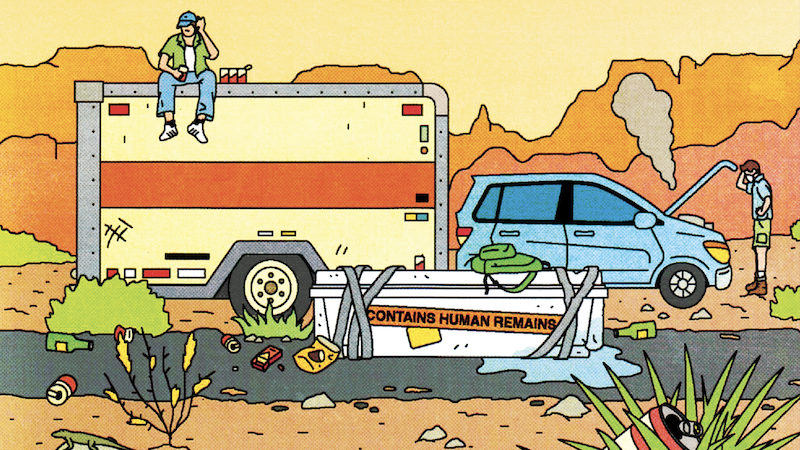
Although the premise centers on a dead father who has been cryonically preserved and transported across two thousand miles in the back of a U-Haul, Adam Wilson’s Fail Sons lands with surprising laughter. It may speak to a particular readership—especially those who recognize which unremarkable Pavement B-side became a TikTok sensation—but at its core it’s a story about being someone’s child and someone’s sibling and someone’s parent. Relatable, yes—and also about navigating the life of a stressed-out person in this ridiculous country at this ridiculous moment. At a trim 224 pages, it stands as Wilson’s leanest, funniest, and most moving novel to date.
Critics and Wilson himself describe Fail Sons as a “midlife-crisis” tale, which somehow makes me feel older than I expected. Yet that aside, the piece you’ll find here is an interview conducted via email as September’s chill deepened. We discuss the vulnerability involved in writing about aging bodies, Knicks fever, and how much Stanley Elkin one can tolerate, among other heated topics. The exchange below has been edited for length.
*
Sam Axelrod: A large portion of Fail Sons follows a cross-country trek from Arizona to the East Coast. That’s a lot of geography to cover. How did you approach the research? Did you venture out, or was everything drafted from your desk?
Adam Wilson: The seed was a road trip from Los Angeles to Denver that my wife and I took in 2014. I also spent a month at a residency in Woody Creek, Colorado the following year. I’d never visited Arizona, Utah, or Colorado before, and the project began as a repository for my impressions of those landscapes, many of which felt like revelation—“What a stunning landscape,” I might have thought at the time (though plenty of people already knew). I started writing it shortly after the birth of my first son. The plan was to retrace the route later on, but then the pandemic happened, and then another child arrived, making that plan impractical. Fortunately, the internet exists. My copy editor, Sarah Lyn Rogers, was a tremendous assist with geography, correcting countless mistakes. It’s worth noting that my other books have been set in places I’ve actually lived, written with a local’s authority. Here, I tried to write with a sense of being an outsider. The narrator, Scott, views everything from behind a car window rather than from inside a community. I find there’s something compelling about observing a place through a visitor’s gaze, even as I worry locals will spot my missteps—much as I gripe about Boston accents in Hollywood films.
SA: Given the current political climate and the lingering shadow of the pandemic, 2019 feels distant from 2020, which itself differs from 2021 and beyond. How did you decide to place the book in the summer of 2022?
AW: I wanted the pandemic to be far enough behind us to no longer drive the plot, but recent enough that its effects still linger. When I imagined coastal elites moving across the country, it became a useful source of tension to introduce a character—Scott’s brother Nick—who remains anxious about contracting Covid. It began as a joke—“wouldn’t it be funny if this guy wears a KN95 in a red-state Walmart?”—but it ended up providing more narrative traction than I anticipated. The pandemic disrupted everyone’s life in distinct ways: single people faced a different set of challenges than those who were married; couples with kids experienced another set of pressures, and there are many other variables to consider—divorced people, stepfamilies, healthcare workers, people with chronic conditions, and so on. I wanted the novel to register that gulf between the brothers, so their lives were shaped by the pandemic in strikingly different manners, making mutual understanding difficult.
SA: The book’s form is more fragmented than your earlier work, with generous white space on the pages. That choice helps propel the momentum. How did you settle on this structure?
AW: I have a fondness for Mary Robison’s Why Did I Ever, and I aimed to model the structure after it. In the end, Fail Sons is more linear than that influence, but the white space gives me room to hop between Scott’s present and scenes from his past without laboring over transitional prose. It also accommodates shorter scenes. One thing I admire about Robison is the way she frames a joke and then truncates the punchline, which shades the entire book in a certain sense of irresolution. I was hoping to evoke a comparable effect.
I find plot difficult, but I enjoy the challenge, and I find satisfaction in tweaking the narrative beats.
SA: Let me oversimplify. Your debut Flatscreen could be considered your least high-concept book, while Sensation Machines is your most high-concept effort. The new one feels like a middle ground. (Feel free to disagree!) Not that I’m evaluating, but it seems you’ve found a sweet spot here. As someone clearly invested in the craft of sentences, have you felt pressure to inject more plot into your novels?
AW: The one you didn’t mention is my short story collection, What’s Important Is Feeling, which sits at a comparatively low concept level beside the novels. I suspect a novel needs a bigger engine to hold a reader’s attention for hundreds of pages, and perhaps to sustain a writer’s own interest as well. I find plot challenging, but I relish the challenge and derive satisfaction from recalibrating the narrative rhythm.
Yet I’m not sure that plot and “concept” are as tightly linked as you suggest. There are plenty of high-concept books that are light on plot; in fact, much experimental writing can be described that way. Kafka is often described as high-concept, yet I wouldn’t call The Trial especially plot-driven. I’ve never read William Gass’s The Tunnel, but I might if it promised anything resembling a conventional plot! There are also plot-forward, low-concept books. Think of writers like Thomas Hardy or John Irving who weave intricate twists and turns into narratives that aren’t necessarily “high concept.”
One mistake I’ve made—at least financially—is that even as I publish high-concept novels, I keep writing screenplays that feel too low in concept to be pitched successfully. I’ve learned that “it’s well written” is one of the harshest compliments you can hear in Hollywood. Why do I continue? I’m not sure beyond a tendency toward self-sabotage. Perhaps I’m drawn to talky, indie films where little happens beyond dialogue and flirtation. Eric Rohmer films, for instance—almost nothing happens on screen except for talk; though everyone in his films has very nice clothes, which might compensate for the lack of action.
SA: Turning to film—Fail Sons carries a strong interior life; we inhabit Scott’s thoughts closely. Yet I can easily imagine it translated to the screen. It has road trips, sexuality, drugs, a corpse in the back of a vehicle, high stakes. Did you ever contemplate writing this as a screenplay or even adapting it?
AW: I’d be thrilled to see it adapted if someone wants to bring it to the screen, but I conceived it as a novel—dense with dialogue, yes, but still a novel. One of its central comedic mechanisms is the tension between Scott’s nuanced inner voice and the foolish things he blurts out loud. In a screenplay, you’d lose that contrast and would have to find another way to convey his depth. It would be a challenge I’d gladly take on, but it would be a different challenge entirely.
SA: A notable amount of urination and other bodily functions appear in the book. Scott endures some pretty unpleasant bladder issues, and you frequently place him on and around toilets. Many writers try to dodge the excretion life of their characters, so it’s refreshing to see this explored at length (even if at times it’s painful). How did you integrate this thread, and did you encounter pushback from editors or early readers?
AW: The only real pushback was over the frequency of Stanley Elkin references; readers tended to tolerate far fewer of those than I’d hoped. The final draft contains more instances of peeing than any prior version. It began as a thread, but I wanted to avoid turning it into a running joke and to capture something truthful about Scott’s experiences with urologists and pelvic-floor physical therapy. I also aimed to align the deterioration of Scott’s aging body with the decaying corpse in the back of the U-Haul.
When men write about their bodies, it’s often heart trouble or erectile dysfunction; I wanted to explore a broader spectrum of how our bodies fail us, beyond those stereotypical concerns.
In many respects this is a novel about bodies that falter and the reckoning that follows. There are numerous books by women that tread this ground, and it’s a subject that men frequently shy away from, perhaps because it feels so intimate to write about—even in fiction. I’ve seen whole college courses labeled something like “Writing the Body,” yet you’ll rarely find cis male writers on those syllabi. When men do write about their bodies, they often default to heart problems or sexual dysfunction, and I wanted to diverge from that template. There are countless alternative ways our bodies can fail us!
SA: Scott’s wife is pregnant for the majority of the narrative. You have two sons yourself, so there’s a clear divide between a pre-kid and post-kid world for you. This story really threads a moment on the cusp of fatherhood. What was it like revisiting that childless mindset?
AW: It typically takes me five to ten years to process major life events enough to fold them into fiction—coincidentally about the same span of therapy I’ve had to undergo to discuss them. When I was drafting Fail Sons, I was still negotiating how this life change had altered me. My oldest is eight now, and only recently have I attempted to translate all I’ve absorbed over the past eight years into fiction. There have already been a lot of stories about Brooklyn dads, or perhaps not as many as we might think. My aim is to write about parenting in a way that feels fresh and unfamiliar while still capturing some meaningful truth about millennial parenting in broad strokes—and that’s not an easy task. All that said, Scott isn’t a father yet, but Nick is, and even though he isn’t the narrator, I don’t think I could have written Nick’s character without having kids myself.
SA: You’re a Celtics supporter, while the narrator leans Knicks. How did you step into such a radically different vantage point?
AW: I wouldn’t tackle a Yankees fan character—empathy would be too hard. Yet I found myself drawn to the Knicks this past year. Initially I resisted because my kids are born and bred New Yorkers, and the only Boston team I’d managed to coax them to root for was the Celtics. My oldest even roots for the Yankees, and he also roots for the rival teams of the English soccer club my British father—who wrote an acclaimed book on the sport—loves passionately. That might be some Freudian undercurrent at play. Anyway, I worried he’d switch allegiance once the Celtics were eliminated and the Knicks still stood a chance, and I was right. But I’m currently steamed at the Celtics for trading Jaylen Brown, and the Knicks are a genuinely likable squad. I’ve spent twenty years in New York, and witnessing the city come alive during the playoffs, shared with my kids, was electrifying. The night they clinched a win, we hosted an eighth-birthday sleepover for my older son, and the apartment was full of hyperactive second graders after midnight—chaotic but unforgettable.
________________________________________________
Fail Sons by Adam Wilson is available via Soho Press.