
Ultra-human characters, swift pacing, fluidity of action, a casual yet precise plotline, and sharp dialogue are centerpieces of Fair Ones, Lydia Millet’s new double novel. She maintains the sardonic edge evident in most of her work, including her 2025 story collection, Atavists. (In one story, when Shelly’s mother suggests she take a progressive agenda with her talent agency clients, she pushes back: “Mom. Noam Chomsky’s a dinosaur. And not even a ferocious T.rex, either. More of a brontosaurus. A lumbering plant-eater.”) Millet’s 2022 novel Dinosaurs also reflects her fascination with long extinct creatures. Fair Ones is on another wavelength. It shifts from Millet’s frequent theme of climate change to gun violence. And it is not influenced as much by her current home in the Sonoran Desert outside Tucson and her work at the Center for Biological Diversity as by an earlier chapter of her life, in New York City.
Fair Ones is set in the aftermath of their longtime friend Claire’s death, as Mara and Jen, two Brooklyn women in their forties, are off kilter, cycling through shock, numbness, denial, distraction, anger, isolation, regret, depression. Adjusting to Claire’s absence, they spend time with others who knew Claire, and try to figure out how she was killed.
Mara is the narrator of Fair, which begins just after Claire is murdered. Ones, told from Jen’s point of view, picks up a year later. What is clear throughout is that they stay connected. “Often, when I was with Mara….Claire was the invisible third party,” Jen muses in Ones. “We didn’t have to bring her up. She lived on the residue of who we used to be.” Fair Ones is an exquisite rendering of the lingering connection possible after the death of a friend.
What inspired you to write this Fair Ones? I asked Millet. “It was just: Can I write something that’s realist, that’s mostly dialogue, that’s mostly social interactions among a small group of people, and not be bored? I don’t mean not be boring, that’s a whole other question, I mean not bore myself as I’m writing. Readers’ potential boredom is separate. Usually what I’m excited by in writing is either a bit of a joke here and there or a bit of a gut punch here and there but tending to rise out of interior monologue more often than conversation. So this was a talk experiment. Not a thought experiment.”
*
Jane Ciabattari: You open with a scene at a wake in a restaurant bar, where Mara and Jen are mourning Claire’s sudden death. A high school guidance counselor, she was shot by a thirteen-year-old boy at a bus stop in what appears to be a random act of violence. The three, friends since college, were as bonded as family, and now one is gone and the others are “stricken,” as you write. How did you map out your exploration of the complexity of Mara and Jen’s individual arcs of grief?
Lydia Millet: No mapping! Terrible at mapping. More of a groping around with a blindfold. I wanted to start the book out in shock a bit myself, as the characters are in shock, but it’s hard to fake. I’ve been in shock before, personally, but can’t you pull it out of a hat.
JC: The first novel, Fair, is narrated by Mara, beginning shortly after Claire’s death. The second novel, Ones, is Jen’s story, beginning a year after Claire’s death. Of course, I have to ask, how did the form evolve?
I like that the word fair has so many meanings. Purely beautiful, decidedly mediocre, or perfectly just. Quite the range.
LM: I was thinking of close friends, their interdependency, how we mimic each other without even meaning to, how we osmose over time. This was two books in one like two people side by side, going forward, distinct but overlapping.
JC: And your title?
LM: I like that the word fair has so many meanings. Purely beautiful, decidedly mediocre, or perfectly just. Quite the range.
JC: The impromptu opening bar scene includes friends of Claire’s from her work, her parents and brother Caleb, flown in from Dubuque. Claire’s ex-boyfriend Jase, a finance bro, shows up with a new girlfriend twenty years younger and her rude BFF. Urged on by Jen, who has a sudden impulse to revisit the drugs of her younger years, Mara and Jen join Jase and the “White Rabbit” crew for more cocaine and a party at his loft in TriBeCa. It’s like a scene in a play, or a film. Did you have any models in mind? Or personal experiences?
LM: Certain books with party scenes in them will always be with me, Robert Coover, Donald Antrim, Virginia Woolf, but movie party scenes are powerful too and easier to follow of course. In general I just like party scenes. Also, I go to so few actual these days I might as well throw them in books.
JC: How did Jon Hamm, the star of Mad Men, find his way into a cameo appearance in the hot tub on Jase’s roof?
LM: Fictional hot tubs are his natural habitat. It turns out Jon Hamm’s played himself multiple times, but I didn’t really know it when I was writing this book. I knew he’d done the “Between Two Ferns” level of self-parody, but not major motion picture self-parody. So I was scooped on the Jon Hamm appearing as Jon Hamm front.
I like him. And his name. And he reminds me of my brother.
JC: Your setting is mostly New York City. What does that mean to you, as opposed to, say, Los Angeles, the Western desert, other places you’ve written about frequently?
LM: It means social life, sped-up time, pedestrianism, Europeanism.
JC: How did you develop Jase’s signature behaviors?
LM: You mean like being an asshole? Those didn’t take a great leap of imagination. Jase is running the country.
JC: Did the end of Jen’s story arrive unexpectedly? Or did you have it in mind for awhile?
LM: It’s a version of an ending I had for a while but softened. Endings are always the most euphoric parts of a novel to write. Beginnings can feel energetic and chipper and game, kind of, but endings are fireflies in the dark.
JC: What are you working on now/next?
LM: A novel called Duchy Keep about a city-sized future kingdom ruled by a fake archduke. The story happens over a couple of weeks around his annual summer jamboree.
______________________________
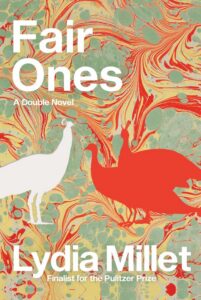
Fair Ones by Lydia Millet is available from W.W. Norton & Company.
