
Finding someone who is both a premier scholar and a skilled analyst, who can also become a formidable organizer, is not common—yet Leah Stokes embodies that rare blend. A political scientist teaching at UC Santa Barbara, she authored the definitive study on utilities in the United States, Short Circuiting Policy, and subsequently helped shape what became the Inflation Reduction Act, the most extensive climate law in American history and already one of the era’s defining pieces of legislation. Part of that work occurred in the neonatal intensive care unit, where her prematurely born twin daughters spent weeks while she contributed to drafting the bill. Her new volume, The Carbon Wave: A Story of Democracy, Parenthood and the Race to Protect Our Planet, provides an inside account of that saga, drawn from the White House, the Senate floor, and the streets.
I should note up front that I’m not a detached reader. Leah is a friend, I endorsed the book, and I appear a few times within these pages. When we sat down to talk, I aimed to ask questions that only she could answer: what it’s really like when a bill becomes law, what Joe Manchin was thinking, and how one keeps going when the onslaught comes from one’s own side.
*
Bill McKibben: So, to begin, you’re frequently in the thick of a climate-policy fight, you’re a professor, you have a thousand other tasks—why choose to carve out time to write a book?
Leah Stokes: I’ve always wanted to produce a book like this. There aren’t many works that offer an intimate view of how political change happens and how ordinary people can participate. Your own Oil and Honey is a perfect example: it lets readers ride along during the campaign against the Keystone XL Pipeline and witness the improvisational nature of activism.
Policy work centers on power, and people who feel they lack power sometimes lash out at those nearest to them rather than at the real power holders.
Sharing a behind-the-scenes perspective matters. Without it, when people ask, “What can I do about climate change?” they’re offered hollow, token suggestions—not the actions we truly need people to take, such as joining campaigns and organizations. And that story is too intricate to be captured in a hundred words, or even a few thousand. I needed to write a book to tell that story.
BM: Let me pose another writing question. You crafted this book while playing a central role in the climate fight, teaching at UCSB, and—most importantly—being a mother to two very young daughters. What was your writing process like? How did you find the time and mental space?
LS: I began with what an anthropologist might call “field notes”—essentially a sprawling Google document where I jotted late-night reflections on campaign problems. Sometimes a person would say something sharp on a call, and I would capture it as a quote. I collected these fragments in a loose, stream-of-consciousness fashion, and they became the seed of the project.
But I wanted to tell this story from others’ viewpoints. That meant identifying the characters, then interviewing them—sometimes for twelve hours or more—visiting them in person, gathering emails, texts, and videos so readers could feel like they were in the room as this landmark bill was negotiated. That portion of the writing stretched over many years and required a variety of approaches.
BM: Your first book was scholarly—well written and approachable, but still scholarly. What did it feel like to write something so different now?
LS: We recently held our annual political science conference, where authors present a draft to senior colleagues for feedback. I was anxious, because this isn’t an academic book. It’s a work of narrative nonfiction and memoir.
However, my colleagues responded positively, I think, because the book works on multiple levels. You can read it as a straightforward story filled with suspense, or you can read it in a deeper, theoretical way through its concepts and arguments.
My guiding aim was to make the narrative as accessible as possible—so that someone who has never heard of Senator Joe Manchin could still feel connected. And many readers tell me the book moves them to tears. That’s a tremendous compliment. Evoking emotion is essential for a climate movement to endure.
BM: Staying with your role as a political scientist for a moment. You now have intimate knowledge of how policy is actually forged, a process far from idealized principles. How did your view of how a bill becomes law change compared with the standard political-science—or Schoolhouse Rock—depiction?
LS: A colleague on that political science book panel joked that I should team up with Schoolhouse Rock for a new version of “I’m Just a Bill,” because the reality isn’t so simple. It’s far more dramatic. There is tremendous conflict in policymaking. People know this at the White House and in Congress, but I also learned that it exists within coalitions and activist groups. Policy work is about power, and those who feel powerless sometimes take aim at the people closest to them rather than at the actual power holders. One concept I developed in the book is the “fight of enactment”: once a bill’s text lands on the table, factions must decide whether it is good enough, and that can trigger intense disputes.
There’s a story about you in the book as well. When we anticipated the bill’s arrival in July 2022, I called you and said, “I’ve heard Manchin might insert poison pills, but there will still be far more good than bad. How will this be received?” You replied, “I think this could really split the movement.” And you were right, unsurprisingly.
BM: Let’s stay on that thread. You faced harsh, very personal attacks from some activists at the end of this process. How difficult was that, and how did you move past it to continue your work?
LS: You know better than most how tough that was. When it happened, the bill was on the Senate floor for the final votes and I was home with my kids. We all had COVID. They had just turned one. And the morning I woke up to see the bill become law, I was targeted by individuals within the climate movement, very personally. By that point the attacks had been ongoing for days, and it felt like I was being hunted by a bear. I was in a constant state of fight-or-flight. It’s one thing to be attacked by the fossil-fuel industry, and another entirely to be attacked by your own side.
I called you that Sunday morning, Bill, and you listened with care. That was a true gift. You offered the broader perspective of someone who has spent decades in the movement: at that moment I was under personal attack, but there is a larger history and pattern of infighting in progressive spaces. I found that depersonalizing these moments made it easier to continue.
I’m more hopeful than I’ve ever been, and yet the clock is running short. We seem to have written the very suspenseful version of this story. Now we have to live it.
And Bill, this is another lesson I learned from you. Before we met, I read a piece you wrote about being harassed by fossil-fuel-aligned groups—basically, they’d photograph you for the smallest things, like carrying a plastic bag at the grocery store. In that piece, you broadened the point: look at what happens to environmental activists in other parts of the world, in Latin America for example, where people are literally murdered for protecting a forest or a river. When we compare the emotional pressure we face—from the fossil-fuel industry, from colleagues—with the dangers faced by activists who are killed for speaking out, it is a blessing to work within a democratic system where, for the most part, we are safe.
BM: Here’s hoping the system remains democratic. And with that, let’s return to the negotiations over what became the Inflation Reduction Act—an extended, arduous, and, in some respects, disheartening process. It started as the Green New Deal and gradually narrowed at each turn, largely due to Joe Manchin, the West Virginia Democrat who held the critical 50th vote. In the end, despite insisting on painful concessions, he voted in favor. First, what was that process like? And second: why do you think he changed his mind?
LS: Getting that bill to the finish line was incredibly challenging. Some readers have told me the book calls into question whether our democracy functions well when the process is so hard. I aimed to present the process from multiple angles and tell a truthful story: participating in shaping these laws requires real personal sacrifice. Adrian Deveny, Chuck Schumer’s lead climate negotiator and one of the book’s central figures, puts it this way: “To be part of historic legislation, you put yourself on the line and make sacrifices because it matters. It’s bigger than you, bigger than your needs or sleep. That stuff doesn’t matter next to the scale of the work you’re doing. And everyone who lasts shares that mindset.” I wanted to capture those tradeoffs precisely because that is what this work is really like.
As for why Manchin voted for it—I did my best to understand his motivations. I tried to portray him as a real person with legitimate concerns. He worried about West Virginians missing out on new clean-energy jobs and the Black Lung Disability Trust Fund extension. Moreover, when he walked away from the package in July 2022, he faced a fierce backlash. Europe was in the grips of a heat wave, and the global anger toward the climate crisis felt directed at one man, whether fair or not. I don’t think he wanted to doom the planet for his grandchildren. Despite his flaws, he had genuine concerns about inflation and the economy, which prolonged the process. I aimed to humanize him and view the issue from his vantage point. Whether readers end up more sympathetic will depend on the reader, but I tried to be fair.
BM: For what it’s worth, I’d describe this as, in some respects, a victory for the long-running climate movement. I don’t think Manchin intended his legacy to be the vote that prevented meaningful climate action in the United States—if anything, that would have been the result.
Let us close with thoughts on the next generation, especially the two who now share your home, whom I’ve met and found to be extraordinary. First, reflect on the NICU experience—being with them while your attention was split between them and this pivotal battle, an experience few of us can fully imagine. Then speak about the world they will inherit from all of us.
LS: While I was working on this bill, I learned that I was pregnant with twins, and the pregnancy proved high risk. My daughters were born prematurely and very small, and we spent 75 days in the NICU. I took work calls from hospital storage rooms surrounded by medical equipment, while pumping. I flew to Congress to testify while my daughters were still hospitalized. I did it because this was a chance to pass climate legislation, and I felt I could not let it slip away.
When we think about keeping our kids safe, we often focus narrowly on things like car seats or outlet covers. My sense of safety is broader—it’s about safeguarding all living beings—and that means confronting the climate crisis. When we join with others through groups and campaigns, our impact multiplies. That is how we ensure the world we leave to our children, grandchildren, nieces, nephews, neighbors, and cousins remains livable. The current El Niño event, along with the recent tragedy in Nepal, illustrates what happens if we fail to act together to change the course of history.
So I’m cautiously optimistic. Bill, your latest book, Here Comes the Sun, ends at a point I recognize in myself: the technologies we need exist, and we can achieve this. I’m more hopeful now than ever, yet time is short. We’ve authored a very suspenseful chapter of this story, and now we must live it.
BM: Precisely. That feels like a fitting place to pause. With thanks for this book—especially for the personal touch it brings to a monumental effort—a saga that will captivate readers for years to come. I’m grateful that we have such a powerful and moving account of how a climate bill becomes law.
*
Leah C. Stokes is Anton Vonk Associate Professor of Environmental Politics at UC Santa Barbara. As a leading climate advocate, she has championed climate policy across all levels of government in the United States and was chosen for Time Magazine’s Time100 Next list and Business Insider’s top 30 global climate leaders. A recipient of a Harvard University Radcliffe Fellowship, she is the author of the award-winning Short Circuiting Policy, which was named one of the top five climate books of 2020 by The New York Times.
Bill McKibben is the founder of Third Act, which mobilizes people over 60 to take action on climate and justice. His 1989 book The End of Nature is widely regarded as the first broad-audience work about climate change and has been translated into 24 languages. He has authored twenty books, with contributions to publications ranging from The New Yorker to Rolling Stone. He serves as the Schumann Distinguished Scholar in Environmental Studies at Middlebury College, is a fellow of the American Academy of Arts and Sciences, and has received the Gandhi Peace Prize as well as honorary degrees from twenty colleges and universities. He was awarded the Right Livelihood Award—often called the alternative Nobel—in the Swedish Parliament. Foreign Policy named him among its inaugural list of the world’s 100 most important global thinkers.
McKibben helped found 350.org, the first global grassroots climate campaign, which has organized protests on every continent, including Antarctica. He played a leading role in opposing large oil pipelines like Keystone XL and in driving the fossil-fuel divestment movement, which has become the largest anti-corporate campaign in history, with endowments totaling more than $40 trillion stepping back from oil, gas and coal. He stepped down as board chair of 350 in 2015, and left the board and stepped down from his volunteer role as senior adviser in 2020, taking emeritus status. He resides in the mountains above Lake Champlain with his wife, writer Sue Halpern, where he spends as much time outdoors as possible. In 2014, biologists honored his career by naming a new species of woodland gnat—Megophthalmidia mckibbeni—in his honor.
______________________________
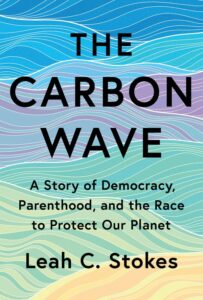
The Carbon Wave: A Story of Democracy, Parenthood and the Race to Protect Our Planet by Leah C. Stokes is available from MIT Press.