

We don’t usually regard literature as a conversation. Generally, publishing insiders consider readers primarily as a market to be drawn in to purchase the book so they can enjoy hours of cultural nourishment or enrichment. The author’s name appears repeatedly—on the cover, along the spine, on the front matter, on the credits page, sometimes up in the margins, and even within the epigraph, as if to signal that the book belongs to a single owner. A traditional epigraph, one that quotes another writer, functions as a genealogical marker; it reveals to readers where what they are about to read comes from, subtly tracing the work’s lineage and introducing its predecessors. I have witnessed instances where an author borrows an epigraph from their own work without acknowledging the source; in such cases, they bypass a lineage to their predecessors and begin the book by gazing inward.
A well-chosen epigraph can illuminate the rest of the book, yet when it is merely a vanity exercise, it merely adds gloss to the writer’s biography, which is usually printed on the inside flap or the back cover anyway.
To some extent, signaling the author’s role through these markings is fair. It praises the artistic achievement, but it also embodies a culture that elevates writers above readers—the same dynamic seen in other arts, where the artist stands before cameras, on stages, at dais, and on gallery walls. In this light, readers and audiences aren’t considered part of the work; they are passive consumers. Yet it’s worth recalling that this was not always the case.
Fictional texts awaken entirely personal resources of the imagination at both the moment of writing and the moment of reading. In this way, the book that remains etched in each reader’s mind is unique to them.
The book itself draws a subtle, ongoing power struggle between author and reader. By design, during and after reading, one might ask with some legitimacy: Whose book is this?
I have always sought out studies that investigate how a spark from a writer’s memory and imagination travels into the printed pages, whether first sketched by hand or drafted on the blank surface of a computer screen.
I yearn to pursue a more systematic inquiry into the psychology and neuroscience of artistic creation, to grasp better how memory operates and its ties to literary production. Time may not permit a thorough exploration until retirement, which would feel almost cruel: I might understand my craft more clearly after I’ve stepped away from it. I would revisit the history of the profession I have devoted my life to as if I were a first-year student of literature or publishing, as if I were returning to the early days of my internship at Brasiliense—when I began with nothing but a love for books and a sense that I could not live without them. This rigorous inquiry would fuse with countless memories of guiding hundreds of authors through their creative processes without ever venturing into theory. I doubt that any original, theoretical study is feasible for me as an editor. Editing is a vocation in which we accumulate knowledge about many things without ever delving deeply into such a complicated subject. There are, of course, exceptions. Still, our primary concern remains the reader, a duty we shoulder at the outset of our collaboration with an author, easing some of the worry about how their work will be received and how it will fare commercially.
That said, my earliest lesson about the essence of writing came from reading Sigmund Freud’s brilliant essay “Creative Writers and Day-Dreaming.” In that piece, the Viennese psychoanalyst describes writing as a form of fantasy or daydream that substitutes childhood play with something as serious and profound as grown-up creativity. Fantasy and daydream, far from opposing seriousness, oppose reality itself. When an author offers up their multiple selves, they do so with craft and technique that allow us to traverse the barriers separating us from the many other selves we encounter in ordinary life. This—and many other eminent writings—helps explain why Freud was rightly awarded Frankfurt’s Goethe Prize.
As we mature, our capacity for play tends to diminish. We become orphans of that early, effective way of countering reality we learned as children. We drift toward daydreaming, a new form of adult play. In this sense, writing and fantasy help adults release themselves from the self-indulgent flights of fantasy that generate tension within the psyche. Hence the strong bond often felt between author and reader, as fantasies meet and the pleasure sparked by another person’s flights of fancy can soothe the guilt tied to adult “play.”
With this brief digression into Freudian theory, I still have a lot to learn about the unconscious realms of writing, but it’s a promising start. Until I can delve deeper into the hidden workings of the writer’s psyche that underlie literary creation, I’ll focus on another puzzle: how a book’s memory forms in the reader’s mind. In this sense, what a reader takes from a fictional text depends as much on the author’s innermost depths as on the reader’s. After all, fiction awakens wholly personal reserves of the imagination at both the moment of writing and the moment of reading. Thus, the book that lingers in a reader’s mind remains uniquely theirs.
But if the author’s name dominates everywhere and the work is ultimately a product of its dialogue with readers, where does this second protagonist physically enter the text? What signs reveal the dialogue between these two imaginations? If the author is omnipresent, where does the reader reside? Or, more precisely, how is the clash between two imaginations represented in the design of the book?
I believe that the reader’s signature at the opening symbolizes many things and marks the dialogue, or the loving dispute, that begins on the very first line of a book and which can be expressed in infinite ways.
From my perspective, the reader inhabits the book’s unoccupied spaces. The margins—the top, bottom, and sides—as well as the gaps between lines, known as the leading, are the places that signify the reader’s presence. The blank spaces, the areas not filled by the author’s text, hold nearly as much importance as the ink that forms the letters. That is where the reader resides. A dense, solid block of text, apart from being visually unappealing, is inappropriate because it implies that ownership of the book, while it is being read and after, belongs solely to the author. It plainly asserts that only one presence matters in the book: the author’s.
*
Constricted line spacing suggests that the editor, despite all their authority, failed to recognize that the space right beside the author’s words is where the reader’s imagination stakes its claim. When lines are packed too tightly, they reinforce the author’s supremacy in a graceless way.
The way a book has been handled—underlined, annotated, and the creases in its corners—serves as a reminder of this struggle and of the reader’s enduring claim to ownership that will linger on their shelves.
For this reason as well, I think a good book ought to begin with a blank page (or flyleaf), or simply with the book’s title, so that the reader can inscribe their name, a signature, or, in older times, a bookplate, thereby becoming the new owner of the text and, in turn, the author’s neighbor.
I recall how, in school, we would write our names on textbooks to prevent them from getting lost on benches or in a classmate’s backpack. Could this practice have given rise to the custom of signing a front page after finishing a book, before placing it back on the shelf?
I believe that the reader’s signature at the opening symbolizes many things and marks the dialogue, or the loving dispute, that begins on the very first line of a book and which can be expressed in infinite ways.
The blank page available to the reader mirrors the blank page or screen the author faces before starting a new tale. These are deliberate spaces that hold countless possibilities and seem to contain the infinite, much like a Jorge Luis Borges story.
The first line of the text, the strokes that begin to fill the white expanse, signifies a decisive moment that will determine everything that follows. It might start like this: “As always, the writer woke up that morning full of questions…”
______________________________
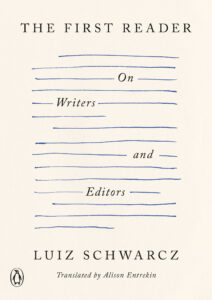
Excerpted from The First Reader: On Writers and Editors by Luiz Schwarcz. Published by Penguin Books, an imprint of Penguin Publishing Group, a division of Penguin Random House LLC. Copyright © 2026 by Luiz Schwarcz. Translation by Alison Entrekin.