
Forty years ago in October 1986 I attended my first Frankfurt Book Fair. On the opening day of meetings my friend and colleague Gary Fisketjon and I were introduced to Heinrich Maria Ledig Rowohlt, a refined, magnetic 78-year-old German publisher whose family house, Rowohlt Verlag, stands among the most eminent literary publishers in Germany. Ledig asked about the authors we represented and regaled us with tales of drinking with Hemingway in Berlin, of escorting Thomas Wolfe to the Olympic Games in 1936, and he welcomed us with warmth into the circle of international publishers. He became a friend and mentor, and I always looked forward to our yearly encounter in the Hessischer Hof Hotel lobby during the fair.
Following Ledig’s passing, his wife Jane established a foundation that, since 1996, has honored translators for the vital work they perform. Each year on a Friday night—the fair’s final day—there is an intimate dinner where the winners are celebrated. It remains one of my favourite moments of the fair, not only because I pause to remember my friend Ledig, but also because after a week packed with meetings, publishing chatter, and more business, the translation dinner offers a chance to slow down, set aside the industry fizz, and center attention on the core achievement: the literary text. And, of course, to applaud the remarkable labor of translators who render authors’ works accessible in new languages and for new audiences.
Every year the speeches are notable—astute, entertaining, and often deeply moving, reminding me of how fortunate I am to be part of this world. To give a sense of the tone here are two lines from a past edition: the laudation by Jo Lendle, the accomplished publisher of Hanser Verlag, introducing Stephan Kleiner, who has translated books by Irvine Welsh, Keith Gessen, Michel Houellebecq, Tao Lin, and Charlie Kaufman; followed by Stephan’s gracious acceptance remarks.
Note: if you’re a young international publisher attending the fair and you’re reading this, consider contacting Karsten Kredel, the prize administrator, to inquire about an invitation one year. And if you’d like to know more about the prizes and the foundation, you can visit the Heinrich Maria Ledig-Rowohlt Foundation website.
–Morgan Entrekin
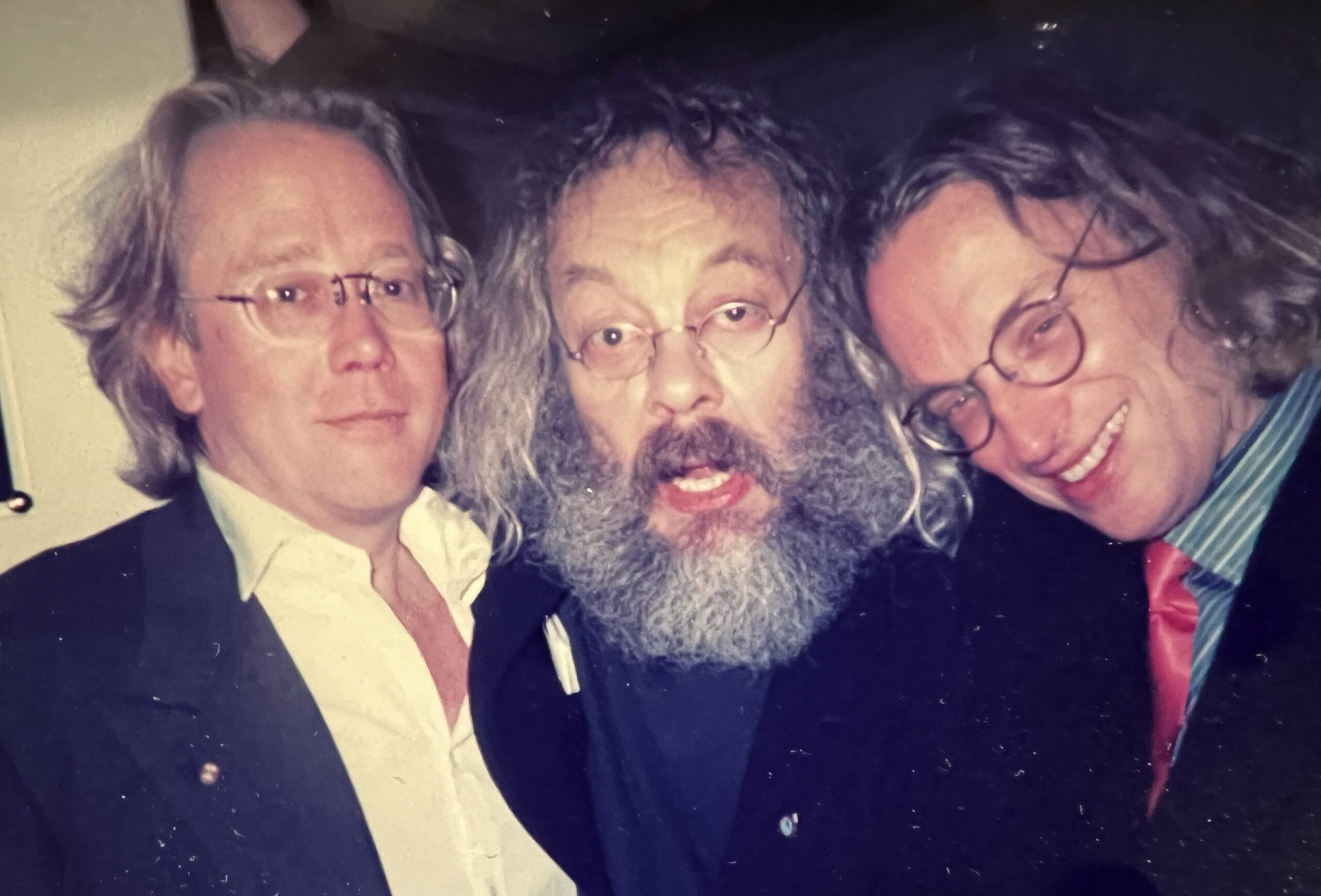 Gary Fisketjon, Harry Rowohlt (half brother of Heinrich), and Morgan Entrekin, c. the late 1980s.
Jo Lendle
Words of Praise for Stephan Kleiner
Heinrich Maria Ledig-Rowohlt Prize 2024
We’re witnessing your defeat of the outsider’s shell, dear Stephan, a lone wolf who has long strayed from the core troupe. You hovered at the distant edge of the bustling world of business, radiating a cool glow that drew the center closer, while still keeping a certain independence. The observer at the edge of the dance floor could feel the rhythm without fully joining the crowd. Yet you haven’t kept yourself beyond reach; we’re pulling you in.
With a strategy of wholehearted inclusion we’ve drawn you into the center of the fray. When free hugs were the trend, today there are paid embraces as well. You deserve both—the warmth and the reward. I’m afraid you won’t be able to dodge this embrace. Welcome to the Heinrich Maria Ledig-Rowohlt circle, our admiration shining like bars of a gate behind which you now roam. Yet it is a large cage, leaving room to wander.
You deserve this recognition. The translations you have produced across more than a decade and a half are formidable; no surface can bear such weight—a rough preview of what you’ll carry later. In 2009 you first demonstrated your range with a double hit: Tao Lin’s Gute Laune (Eeeee Eee Eeee) and Keith Gessen’s All die traurigen jungen Dichter (All the Sad Young Literary Men). From the start you commanded a full spectrum of tones and moods.
For seven years thereafter your work leaned heavily on DuMont Verlag. That isn’t accidental, given that you served as its editor. A master of sushi spends seven years boiling rice in the back room too. Yet you didn’t stop there; from the outset you pulled out the knife and rolled and chopped the authentic maki—the real thing.
The publishing world lets us trace your path as a translator. Deep in your heart, I’d argue, you remain an editor, if one defines the editor as the skeptic—the ideal seedbed for everything else. And you are a consummate skeptic. Having observed you for five years as you established a foothold in this unusual craft, it was no surprise when you were invited to an in-house training program in 2008, following a self-assured application. And it was hardly surprising that you quickly became indispensable. What did astonish us was your ability to become indispensable as a translator as well, slipping through a back door and establishing yourself there.
If you wander through Stephan Kleiner’s oeuvre of translated works looking for shoes, you inevitably come across Charlie Kaufman.
I’m not sure the name Erwin Helmchen rings a bell for any of you. No matter. With nine hundred goals to his credit, he remains Germany’s all-time top scorer, a legend of Silesian roots. The latter half of his career as a coach saw him stepping onto the field and scoring a few goals when his team needed direction, easing the tension in the process.
The same fate befell today’s recipient. Rather than lingering on the sidelines as editor and watching a translation struggle in the midst of the action, he threw himself into the fray and proved his mettle. If Thomas Bernhard were alive today, he might call Stephan a prevention artist; since Bernhard has passed on, we rely on new, rugged masters.
Poems by Michel Houellebecq or Chad Harbach’s The Art of Fielding—Kleiner has played every position. With his rendering of Hanya Yanagihara’s bestseller A Little Life, he surpassed himself in a striking way. Getting from there to tonight’s prize ceremony was simply a matter of time.
In the recent discourse around literary prizes, some air has been sullied. There was, for instance, Caroline Wahl’s public grievance about not being shortlisted for the German Buchpreis. Justified to an extent, though the statistics don’t always align with sentiment. A prize may come or may not. If Kleiner recited a lament, it would be a soft, measured melody, a slow waltz that swells into a triumphant fortissimo—culminating in the applause we deliver tonight. Wahl concluded with the lament that she now has two new books atop the Spiegel Bestseller List. The Süddeutsche Zeitung offered: “Don’t grieve too much, Ms. Wahl. Your prize is simply the recommended retail price.” Which leads us to the heart of my brief speech tonight—the metaphor of the shoe.
The literal price of a book, as fixed in perpetuity, was once defined by Joseph Caspar Witsch among a long line of legendary publishers, sitting just after Ledig-Rowohlt on the list. Long ago he said, “The price of a book equals the price of a single man’s shoe.” A line both joyful and resistant to inflation!
If you explore Kleiner’s translation portfolio in search of footwear, you’ll inevitably encounter Charlie Kaufman. You would reach that junction sooner or later anyway, tracing one of tonight’s defining talents—his love of humor. In the dizzy heights of allusion, cadence, and punchlines, Stephan Kleiner truly excels, soaring above the treetops where others wandering through fields and woods might cry out “untranslatable” at a pun. Language becomes vertiginous when it nears the comic edge.
Take, for example, Hipster Hitler, one of Kleiner’s beloved works, where history collides with the present; and in Charlie Kaufman’s substantial Ameisig (Antkind). A word of caution: translating Kaufman is a path to madness if you don’t relish humor. Ameisig runs on over nine hundred pages in which the characters mishear, misunderstand, and never respond in the expected way—translators’ hell. On top of that there’s an almost pathological shoe fetish. It’s time for Kleiner to stoke the fires of punny hell with a few examples:
A character in the novel imagines every conceivable kind of footwear, including shoes for dogs and designer baby shoes bearing such names as Gucci-Gucci-Goo, Marc-Fisher-Price, and Toddler Oldham. Charming, but Todd Oldham isn’t a familiar name in Germany. So Stephan renders it as “Designer Babyschuhe mit niedlichen Namen wie Gucci-Gucci-Goo, Marc-Fisher-Price und Kuckuck Chanel.” Put into the novel’s own frame, where a whole film is told from the perspective of shoe soles—“Acting from the sole,” or, in Kleiner’s German, “Zäh wie eine Schuhsohle.” Gerrit Bartels described this as “linguistic creative madness,” deftly translated into German by Kleiner with admirable aplomb. Put that on your foot!
All told, shoes serve as the perfect metaphor for translation. You seek the right pair and then must locate the left one. The starting point and the transfer. The original and its reflection. The same yet entirely different, as seen through a mirror. Of course you could 3D-print a matching object, but can you polish such a thing? More importantly: can you walk in it? What use is a shoe without understanding what it shelters—namely, a person and their foot. Don’t feet possess souls?
While Robert Frost claimed that “Poetry is what is lost in translation,” Kleiner would reply that “then there is no poetry.” He lives by the orthopedic maxim, “There is a shoe for every foot.” As Klaus Walter remarked on a WDR program about Marlon James’s A Brief History of Seven Killings, an ostensibly untranslatable novel has been brought into German—and that’s a good thing.
Dear translation cobbler, we miss you as an editor, yet you remain within the same boot. You have stepped into the big footsteps of those who came before you. My warmest congratulations.
Translation: Susanne Höbel
*
Stephan Kleiner
Words of Thanks: Heinrich Maria Ledig-Rowohlt Prize 2024
Some reflections on receiving the Heinrich Maria Ledig-Rowohlt Preis 2024.
I’m standing here in front of you because I wasn’t good at math.
I wasn’t great at math; numbers never clicked, but languages did. There was no “Language” subject, so a choice had to be made. My young, relocated parents decided—here comes a plot twist—on French as my first foreign language because it helped them obtain subsidies for a bus pass. Our French class in fifth grade resembled a tiny Gallic village. We were a close-knit bunch in worn-out shoes and hand-me-down clothes, hunched over the Cahier d’Exercices, the first sentences of which embedded themselves in my memory beneath a bowl haircut. “Il pleut. La rue est grise et triste.” Could that have been the opening line of a Houellebecq poem? I didn’t know then. I simply thrilled at being able to speak another tongue and tell people on the street that it was raining, and to share all the other wonderful possibilities language could unlock.
I want to explain what starts the translation process for me—curiosity, a fierce hunger to understand, to pierce, to decode. To wrench the secrets from a text …
It turned out to be a zero-sum game financially, since the bus-pass savings quickly disappeared into extra math tutoring. My tutor, Torben, was a young man, yet timeless in his breadth—an almost uncanny polymath who rode a racing bike, wore the look of someone always listening for a signal, and played chess and exotic wind instruments. In other words, we could hardly have been more different. But in the long after-class conversations, which were painful for both of us, we began to talk about books.
Torben was, of course, incredibly well-read, and he read foreign-language books in the original. Perhaps out of pity and a wish to bolster my confidence, or to nourish a talent far from math, he allowed me to borrow a book from his shelves. I chose Tolkien’s The Hobbit, a book I had devoured as a child in German under the title Der kleine Hobbit, and which opened the door to the world of The Lord of the Rings.
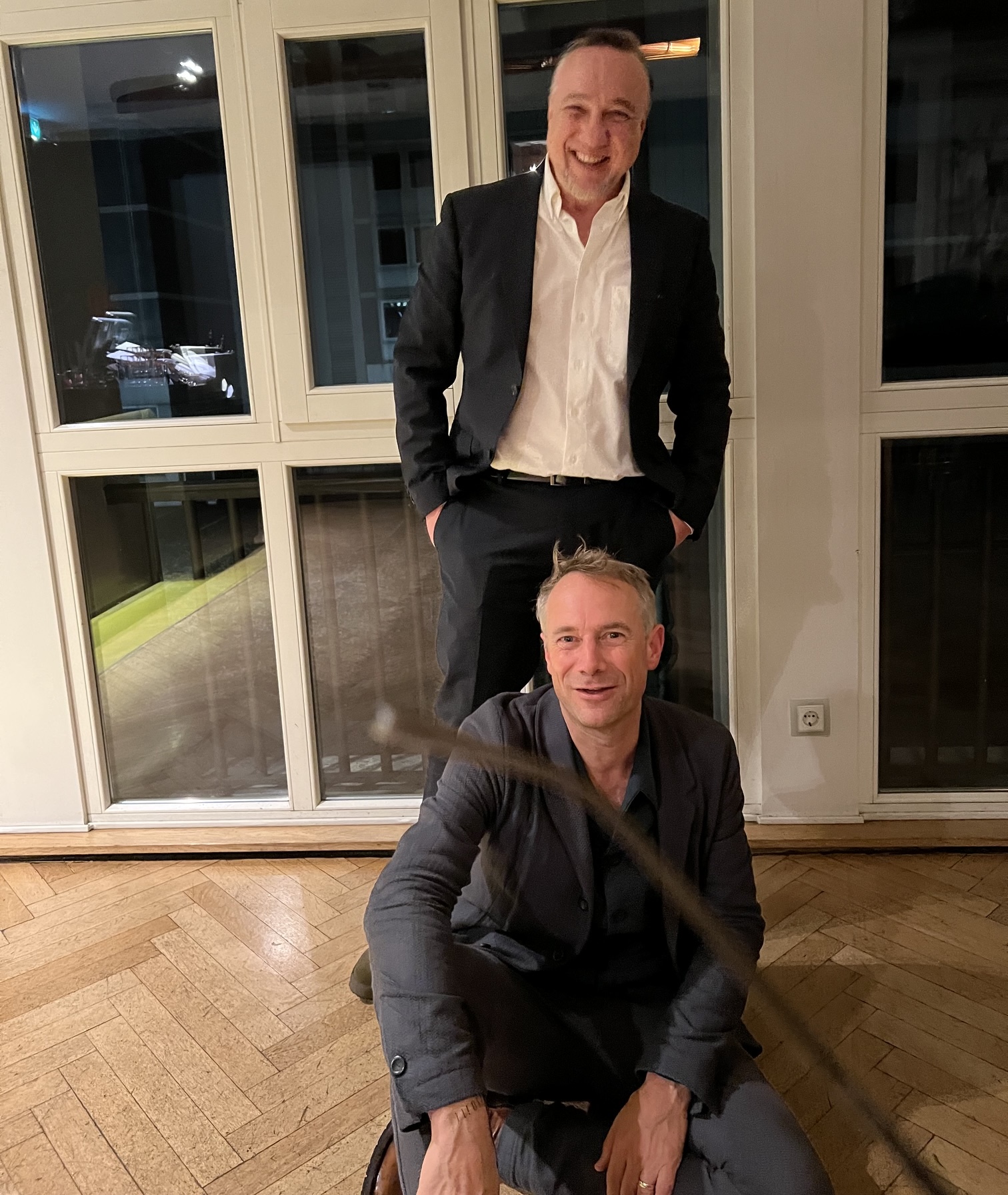 Stephan Kleiner and Jo Lendle (seated), 2024.
What can I say? On the ride home I began reading (there were no smartphones back then, so we occupied ourselves in other ways while pedaling). With the book resting on the handlebars, I devoured the initial pages during the journey home. I was intoxicated, merging with the book, reading it at home between classes. I didn’t grasp every word, yet I captured the meaning. When I encountered an unfamiliar word a second time, I judged it important enough to look up and commit to memory. The dawn of epiphany arrived, and I started to notice false cognates. No, this isn’t a reference to artificial intelligence, but I learned that wand isn’t “wall,” and actually doesn’t simply mean “aktuell”—it gains many meanings depending on context. How captivating!
Soon my second foreign language grew more familiar than French. I plunged into Anglo-American pop culture, producing stilted translations of lyrics using dictionaries (before the internet was ubiquitous) and coaxed my somewhat reluctant peers into reading them. Soon after, I encountered Irvine Welsh, whose phonetically rendered dialect made an impact similar to Nadsat in Anthony Burgess’s Clockwork Orange. The jargon hit me like a Moloko Plus with blades. Hermeneutics as a doorway to the core of spoken language—the same thrill I felt during my early experiments with secret codes.
Why share all this? I’m not sure. After all, I’m not an author, merely a translator. Or perhaps I’m trying to explain what kicks off the translation process for me—the curiosity, the fierce desire to understand, to dig in, to decode. To strip the secrets from a text and then—disinterestedly—render them comprehensible for others.
Years later, at one of the usual book fair parties, I bumped into Jo Lendle again, who, as ever, seemed to have just stepped off the stage from the Ledig-Rowohlt translators’ prize ceremony. He said to me—likely to all translators—“You’ll receive one of these someday too.”
At the start of the year I resolved to translate the Murdle Series puzzle books for hanserblau, coming full circle in a sense, and I told Jo with a touch of irony that none of the prestigious awards would ever come my way. A few weeks later I received a call from Karsten Kredel—whether because of the puzzle books or in spite of them, I can’t say—and I want to express my deep gratitude to the members of the jury. My thanks go to the publishers Sabine Cramer, Britta Egetemeier, Kerstin Gleba, Margit Ketterle, Barbara Laugwitz, and Felicitas von Lovenberg; to the editors Helga Frese-Resch, Mona Lang, Emily Modick, Simon Lörsch, Ricarda Saul, Thomas Tebbe, and Annette Weber, among many others whose trust I have always sought to honor.
Finally, thanks to the authors, those giants upon whose shoulders I stand because I am nothing without you. Please keep writing.
Thank you, dear Heinrich Maria Ledig-Rowohlt, even though we never met. Thank you, Jo. Thank you, Torben.
I would like to dedicate this prize to my family—to my father for his inadvertent post‑Dada-era puns. To my mother, who would have preferred if I had written a book myself, to my patron, whose generosity funds this costly hobby, and especially to my daughter, who sometimes seems unsure whether there’s meaning behind my antics or merely cringe-worthy play. I regret not being able to urge her to follow in my footsteps. It’s possible to succeed without math, but if you can do it with math, even better.
I’d like to close with words borrowed from Christoph Marthaler through Dieter E. Zimmer:
Thank you for this good morning
Thank you for this splendid prize
Thank you that I am free now
of all worries. (Line untranslatable.)
Thank you.
Translation: Susanne Höbel
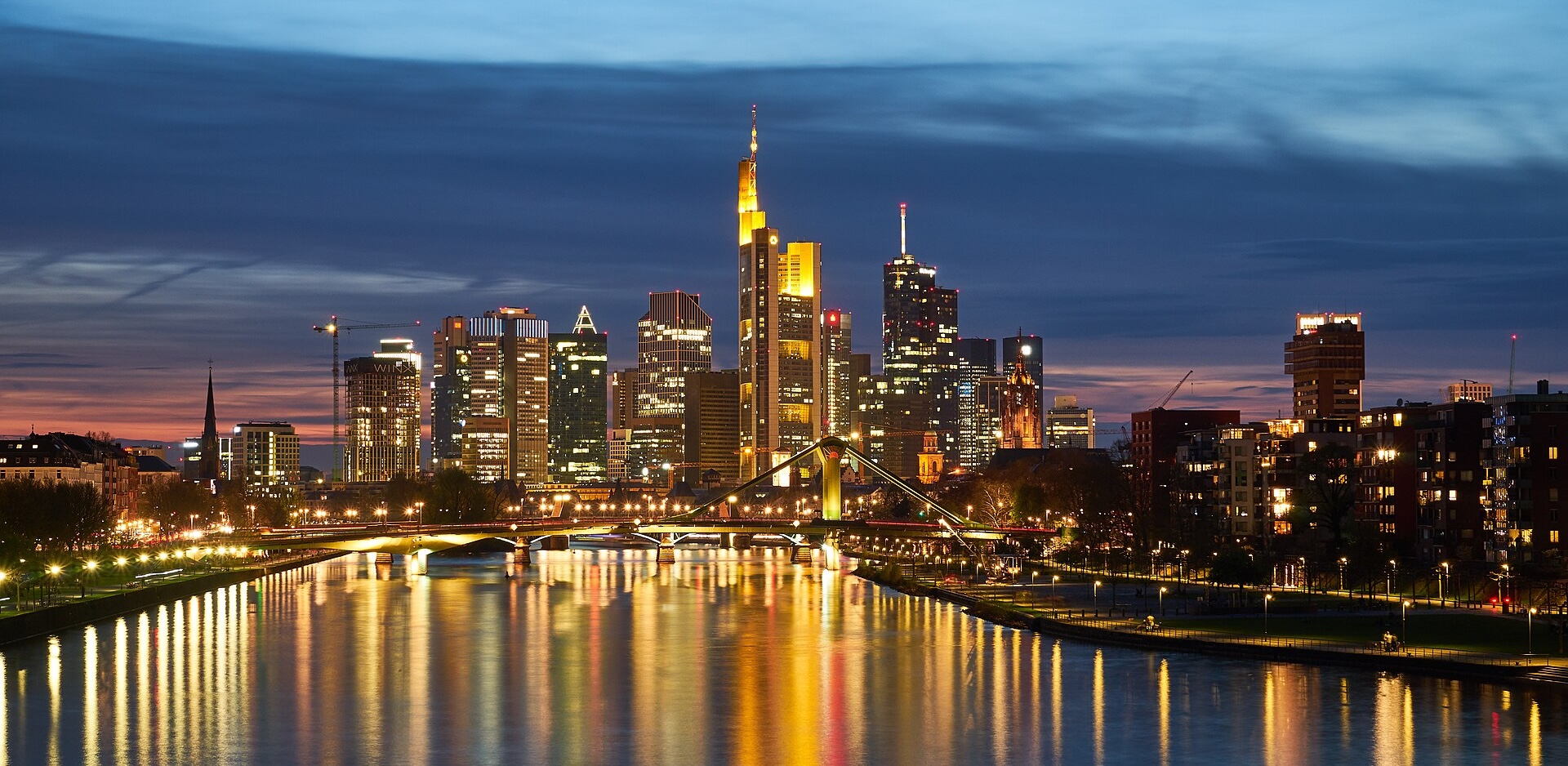
Featured image of the Frankfurt Skyline at night by Mathias Konrath, courtesy.