
I matured as a writer while absorbing N. Scott Momaday’s The Way to Rainy Mountain, House Made of Dawn, and Angle of Geese—a memoir, a novel, and a poetry collection all at once. Momaday, much like Louise Erdrich, Leslie Marmon Silko, Joy Harjo, Gerald Vizenor, and other Indigenous authors, frequently forged works that crossed artistic boundaries. Joy Harjo, who began her life as a visual artist, is now celebrated as both a musician and a poet. My Indigenous literary forebears moved freely across genres, dancing between forms.
My own path began in journalism, a field that naturally pulled me into other people’s stories. Over the years I have written scholarship on Native American literature, created plays, and consistently produced photographs of wildlife and the watery landscapes I paddled through. Before my first collection of short fiction appeared, I published six poetry volumes and held the position of Wisconsin Poet Laureate. Influenced by Anishinaabe pictographs and Native American ledger art, I fused my photography with poetry into a form I call picto-poems. Yet when the narratives I carried grew insistent, this latest expansion of my work—from haiku, lyric, and concrete poetry to prose fiction—demanded a thoughtful blending of established skills with newer ones.
What happens when a poet known for spare lines and precise gestures turns to fiction? She carries with her the disciplined structure of the line.
Reading each draft aloud from start to finish, as I do with poetry, becomes impractical ten or fifteen pages into a story. I learned to begin each session with lighter preparation. In the margins of early drafts I kept writing the same directives to myself: Expand. Build the scene. Include an example. While the desire for more often aided the narrative, I began to notice how my poetic tendencies also guided craft choices that infused the fiction with energy and gave it a distinctive voice.
What happens when a poet of spare lines and gesture turns to fiction? She carries with her the tight construction of the line. Word play. The training in sound and rhythm. The turning, the image, the gaps. Each of these elements of poetic craft can serve prose well—sometimes in unexpected ways.
Dialogue, for instance, can trip up many fiction writers. When my story “Waiting, A Quintet” received an O. Henry Prize, one comment highlighted this idea: “The five voices that comprise the quintet are so strikingly unique, yet the poetry and plot weave them together.” In fiction, each character’s voice—a distinct music of its own—emerges from a blend of cadence and linguistic fingerprint; here the poet’s attention to rhythm and precise wording carries over.
I lean heavily on poetic suggestion in my fiction. This practiced restraint can show up as understatement, unexpected phrasing, or fruitful ambiguity. Restraint in fiction, like in poetry, may involve absence. An early review of Red Ants noted “a nuanced ending that… allows some things to remain unspoken.” Indeed, the gesture and the gaps in my stories invite readers to complete part of the meaning. In this approach I follow the example of Indigenous storytellers I grew up with, who often rely on the listener to help shape the tale.
Absence is invitation. Gesture builds energy for the narrative. Both what is not said and what remains unsaid—the ineffable—pull new elements into a telling. Just as in poetry, the range of what is possible expands beyond the printed words.
In my dark futuristic tale, The Making of Monsters, the narrator insists, “Don’t ask for the blood-and-gore war story. I could not bear to tell it, nor you to hear it.” Here, the line points toward the realm of possibility; the decision not to tell functions as a secret that whets the listener’s curiosity. The way to that knowing is to enter the story and imagine what is left unsaid.
In my teaching, I often discuss strategies of generosity. Gesture and absence, as invitations, are always part of them. I tend to leave an opening for the reader rather than seal a poem with a fixed interpretation or narrate every detail. I bring that approach into fiction as well. Ambiguity multiplies intrigue.
Yet there are times when gathering the “whole” creates a strong foundation for a narrative. Like poetry, details layered upon details—the sense of being—evoke the core of a place, a person, or an event without blunt statements. Rich, sensory particulars let the reader experience the moment rather than settle for a summary. With a background in catalogues and list-poems—textured, sense-lilled detail—I frequently employ those specificity strategies to conjure time or setting.
In “River Dreams,” I lay out a sequence of images across several paragraphs: “water glinted in the sun, trees along the banks bent toward the river as if ready to wash their hair… the damp cedar scent soothed me. I fell into the river world’s endless present… a breeze lifted the petals of the lily pads… a beaver glided from one shore to the other, a small branch clenched in its mouth. The tail’s splat warned me back.” Readers familiar with northern waterways recognize the landscape and can bring to the scene what haiku scholars call their “funded knowledge,” while others gain a grounded entry point to follow along.
Both the not said and the unsayable—the ineffable—pull new elements into a telling. Just as in poetry, the range of the possible expands beyond the printed words.
The above sequence of place-based imagery also showcases several of poetry’s sonic techniques: alliteration, assonance, and sibilance. I cultivate the aural side of the text, encouraging it to function in fiction much as it does in poetry. The s and z sounds of cedar scent, soothed, breeze, petals, pads, crossed, shore, and small craft a calm line that mirrors the river’s smooth current. The beaver’s tail-splat, with its hard t, disrupts the pattern just enough to underscore the action and tilt the imagined water of the scene. That dual impact intensifies the moment depicted on the page.
Other editorial choices around sentence or paragraph length—standing in for lines or stanzas—shape the page’s visual architecture. I favor stark, one-word sentences or single-line paragraphs for contrast and emphasis. Their visual and acoustic movement also governs the story’s cadence. In Copper Traces, a bare, one-line declaration communicates the narrator’s isolation: “I have told no one; I have no one to tell.” The first half of the line climbs in tone as a hopeful inquiry or plea, while the latter half sinks into a painful admission of loneliness. These craft decisions about the musicality and presentation of a solitary line stem from my poetic training. The concise turn within the line underscores a pivotal moment of the narrator’s profound aloneness.
My long tenure in poetry means I instinctively deploy its techniques. A powerful image—central to much poetry—resonates within fiction as well. A story can hinge on a single image or be remembered for a haunting visual. In Red Ants, one tale features the Wintermaker constellation, another traces a wolf’s flank with a half-moon scar. I find the tools of lyric poetry complement storytelling, broadening its impact. Do I consciously weigh every choice as I draft a story? Not always. I write fiction with a poetic lick because my decades of work in poetry have trained those habits.
Nor do I consciously attempt to craft an Indigenous storytelling aesthetic as a rigid framework. I write from an Anishinaabe vantage because that is my identity. Mythic figures, water knowledge, the Anishinaabe language, trickster vitality, rez humor, and occasionally unconventional narrative structures arise from a long immersion in a culture whose storytelling can blend song, dance, and irreverent humor; a culture where stories may refuse to “end” in tidy, conventional terms. After all, our stories must stay alive, ready to be retold in new eras and circumstances.
______________________________
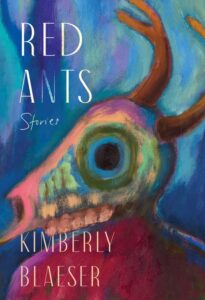
Red Ants: Stories, authored by Kimberly Blaeser, is published by Counterpoint Press.