
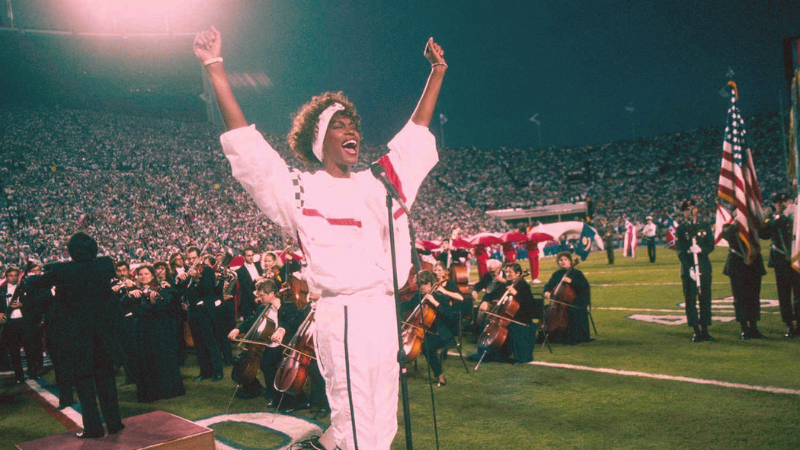
In the opening weeks of 1991, Whitney Houston sat across from Arsenio Hall on his famous talk show, while Roseanne Barr—who had sparked controversy the year before by performing the national anthem at a San Diego Padres game—sat just a few seats away as the other guest. The host pressed Barr for counsel Whitney might rely on before she took the stage at the upcoming Super Bowl XXV in Tampa. Barr’s quip—“Don’t grab your crotch and spit”—was both witty and absurd in light of the enormous pressure Whitney would face, singing the Star-Spangled Banner on January 27 amid heightened security and a nation rattled by the early Gulf War.
Whitney’s selection for the Super Bowl seemed rooted in the force of her Olympic ballad “One Moment in Time,” a track that underscored her readiness to align with a broadly nationalist sports narrative. Yet her approach to the anthem leaned more toward Black musical expression than patriotic celebration. She and her collaborator Clive Davis’s associate Rickey aimed to honor versions she admired, particularly Marvin Gaye’s spare, daring treatment of the anthem at the 1983 NBA All-Star Game. Gaye’s reinterpretation stands out as one of the most inventive, and perhaps subversive, Black takes on the anthem since Jimi Hendrix’s Woodstock rendition in 1969.
But as the taping rolled, she poured herself into the performance with a fervor that left the mic silent—an interpretation so fully realized and perfectly synced to the backing track that most viewers wouldn’t notice the silence between voice and track.
The footage presents a supremely self-possessed Gaye, decked out in a sleek blue suit and tie, his gaze hidden behind shaded lenses. His sole accompaniment—a drum machine and a keyboard—had already begun when he steps onto the court, adjusts the microphone, and delivers the song with a cadence that feels more intimate and seductive than ceremonial. He disperses his phrases in a rhythm unique to him, then nudges the piece back toward the familiar lines at “rockets’ red glare,” almost as a challenge to prove he knows the conventional route yet chooses not to follow it. The crowd responds with a mix of exhilaration and disbelief; it seems as audacious as it is captivating.
Gaye’s delivery, while possibly veering toward mockery (he murmured “thy star-spangled banner” rather than the conventional wording), also possessed a tenderness and craftsmanship that recast the grand saga of American power as a celebration of Black artistry. By the close, the notion of “home of the brave” shifts away from a national symbol and toward a space where anyone can plant their feet and be entirely themselves amid the chaos of the country.
Whitney did not dismantle the anthem in the same fashion, but she drew from Gaye’s example as proof of the song’s fluidity. “It wasn’t hurried,” she later told Rickey. “He could let the moment breathe.” Gaye altered the time signature, moving away from the 3/4 waltz feel to a steadier 4/4 march grounded in gospel sensibilities.
Whitney and Rickey followed suit. Rickey also enlisted jazz bassist and bandleader John Clayton Jr. to craft an orchestral arrangement that fused jazz, classical, and gospel idioms. (Clayton had performed with the Count Basie Orchestra and the Amsterdam Concertgebouw Orchestra.) As Rickey recalls, the result emerged as “an exuberant patchwork of classical coloration woven with jazz and gospel, all set to a 4/4 pulse.” He traveled to Tampa to record with a full symphony, but the conductor protested that the arrangement sounded dissonant and unusual. He argued that Whitney might have to re-record it. The Whitney camp’s response was unequivocal: no.
The plan called for a sleeveless black cocktail dress paired with heels, Robyn notes, aligning with the orchestra’s formal attire and the expectation of Florida’s warmth. During soundcheck, Whitney realized the garb might leave her chilled, so Robyn suggested the tracksuit she had brought along. Whitney did her own makeup, slipped into Nike Cortez sneakers, and tied a light-colored bandana around her head. It’s hard to imagine the moment any other way now.
The entire appearance—Whitney’s posture, hand gestures, and wardrobe—reads as a choreography designed to convey a studied ease, as Danyel Smith notes in a 2016 ESPN piece. Even the way she clasped her hands behind her back reads as a deliberate signal of “military at ease,” Smith adds. Whitney had prerecorded the performance, a necessity in a setting swamped by crowd noise. Yet when the track played, she delivered a performance that was fully felt and utterly aligned with the recording—so much so that most observers would be unaware of the absence of live singing.
Whitney wasn’t pursuing a message of Black representation for its own sake. Rather, she understood that her confident, intricate performance could empower other Black people—perhaps especially young women and girls.
The anthem’s words amount to only four sentences, and Whitney’s version runs about two minutes. In that brief stretch, she crafts a sweeping American narrative. She renders the first verse with unadorned sincerity, then glides into a hushed, suspenseful vision of the flag “o’er the ramparts,” and re-harmonizes the line’s climactic push—“our flag was—still there”—to remind us that the struggle continues. When she punctuates the moment with a butterfly-like flourish—“free-ee-ee!”—she plants her own flag on the anthem, claiming it as hers.
In the stands, spectators wept; viewers at home cheered; and Whitney quickly became the people’s champion, their “girl.” Requests for the track flooded radio airwaves, prompting DJs to air home-recorded tapes until Arista released the recording as a single. Proceeds from the release benefited the Red Cross Gulf Crisis Fund. (After the 9/11 attacks, Arista released the single again and Whitney contributed the proceeds to charity.) Whitney’s rendition was widely accepted as the definitive version. When trumpeter Wynton Marsalis performed the anthem at the NBA All-Star Game in Philadelphia a couple of weeks later, he echoed Whitney’s “free” flourish. Cinque Henderson notes that others—Christina Aguilera, Justin Timberlake, Carrie Underwood, Jennifer Hudson, Patti LaBelle, Mariah Carey, and Beyoncé—have since adopted a similar gesture.
Some have since asked what it signified for a Black woman—representing a demographic often considered the country’s least free—to reassure fellow citizens that their nation remained a land of liberty. Farah Jasmine Griffin argues that Whitney and other Black women who have sung the anthem on such grand stages can be read as comforting figures within American power, symbolically accompanying the country even as they lacked many formal rights themselves.
Yet the approach Whitney chose—what Rickey recalls as her very first take—expressed a form of inclusive freedom that felt especially meaningful to Black artists and listeners. Robyn writes that her gospel-tinged inflections “claimed the song for African Americans,” many of whom felt a personal kinship for the first time. The power she conveyed was more nuanced than Beyoncé’s bold, headline-grabbing 2016 Super Bowl moment, which featured a choreographed march of Black-empowered figures onto a field of dancers in Panthers-inspired attire.
Nevertheless, Whitney fused the ideals of Black artists from the era of revolution: Nina Simone’s understanding of freedom as fearlessness, and Gaye’s right to express oneself with every idiosyncratic nuance. In the gesture of her clasped hands, the emancipation of her predecessors becomes a display of unshakable confidence. She was a vocalist whose talent burned with a ferocity that could match any ambition, and she invited others to share in that greatness. The final glimpse—a knowing, sideways look and an upward stretch of her arms—felt like a quiet message: We’ve got this.
Whitney wasn’t pursuing a bid for Black representation in isolation. Yet she recognized that the layered, confident complexity of her performance could embolden other Black people—perhaps especially young women and girls. The impact resembled, in spirit if not in substance, Joan Morgan’s description of Lauryn Hill’s emergence in The Miseducation of Lauryn Hill (1998): a multifaceted figure who offered permission to become what one believed one could be, even if it hadn’t yet been seen.
In an era when most pop stars still relied on live bands rather than pre-recorded tracks, Whitney—and her peers Michael, Janet, Prince, and Madonna—were backed by some of the most formidable live ensembles in the business.
Long before Hill found her voice in songwriting, Whitney expressed a different kind of authenticity—an immediacy born from moods and impulses that she could translate into performance. Watching her rehearse and then deliver “All the Man That I Need” on Saturday Night Live—shifting through tonal shading within hours, then stamping the moment with a palm-battered beat and a church-inflected plea—reveals a singer whose artistry was driven by instinct and tempo, even more than by conventional structure. This was a form of noncommercial authenticity that preceded any simple restoration of her gospel or R&B roots.
Her ability to convey these ideas on stage sprang not only from years of practice but also from the support of a world-class, on-stage orchestra—“a band of extraordinary talents,” in pianist Bette’s phrasing—poised to carry her to the most memorable performances of her career. In a time before the ubiquity of pre-recorded backing, pop icons relied on top-tier live ensembles, and Whitney stood among the best alongside her peers.
In 1989, Rickey assembled the ensemble that would accompany her for nearly a decade, paying them well enough to keep them from collaborating with other stars. Wayne Linsey, a jovial soul who described himself as a “civil rights baby” from Atlanta, played keyboards beside Bette, the lone white member and the sole woman. The guitarist, Ray Fuller—a big-hearted Chicagoan who had worked with Quincy Jones, George Duke, and Dionne—brought his warmth to the group. The drummer, Rickey Lawson, hailed from Detroit and had toured with Stevie Wonder and Michael Jackson. Bashiri Johnson, a thoughtful, prodigiously talented New Yorker, had studied under James Mtume and played with Madonna, Michael, and Luther. Kirk Whalum, another preacher’s son—a soulful saxophonist from Memphis—approached his craft as a devotional mission as much as a musical one. Bashiri recalls that their aim was simple: to lift Whitney so high that she could simply sing, while they supported her with all their might and talent, and that is exactly what they did.
After that Super Bowl triumph, Whitney, invigorated and fearless, set her sights on entertaining the soldiers in the Middle East. Many people—Cissy notes—felt uneasy about such a trip. Military officials and Washington insiders cautioned against it, warning that Whitney could be endangered. Yet she went on to perform for 3,500 troops returning from the Persian Gulf. HBO had long wanted to document a special, and on Easter Sunday, March 31, 1991, NBC aired a program that would become a milestone: Welcome Home Heroes with Whitney Houston, filmed at Norfolk Naval Air Station in Virginia. HBO re-transmitted the signal to reach forty-something million households, creating one of the era’s most ambitious live musical broadcasts—technically and culturally monumental in scope.
__________________________________
Excerpted from Holding Lightning: The Life, Loves, and Art of Whitney Houston by Emily Lordi. Copyright © 2026 by Emily Jeanne Lordi. Published by Mariner Books, an imprint of HarperCollins Publishers. All rights reserved. Reprinted with permission.