
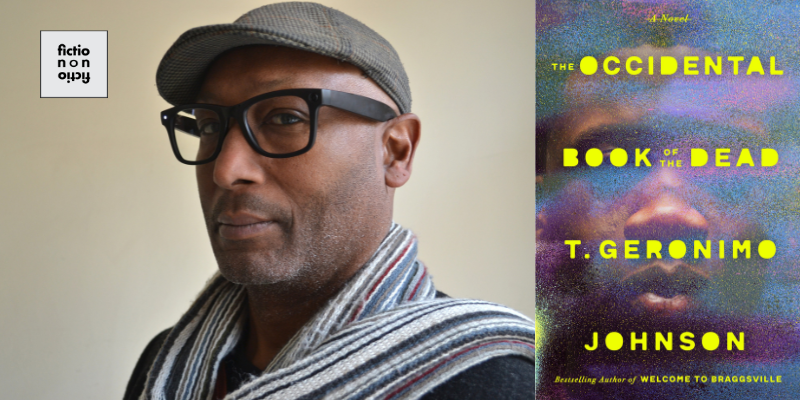
Award-winning fiction writer T. Geronimo Johnson sits down with co-hosts V.V. Ganeshananthan and Whitney Terrell to discuss his latest work, The Occidental Book of the Dead. He explains how the novel interrogates white supremacy and the enduring, racist mythology of the United States through the viewpoint of George Washington Jonson, a Black police officer in a fictionalized version of Atlanta. Johnson shares how he researched policing but deliberately avoids depicting on-page crime scenes, and he clarifies why the narrative shifts from a third-person perspective to a first-person voice. He also notes how motifs from The Egyptian Book of the Dead and other classics inform the storytelling. He offers a reading from The Occidental Book of the Dead.
To hear the full episode, subscribe through iTunes, Google Play, Stitcher, Spotify, or your favorite podcast app (include the forward slashes when searching). You can also listen by streaming from the player below. Check out video versions of our interviews on the Fiction/Non/Fiction Instagram account, the Fiction/Non/Fiction YouTube Channel, and our show website: https://www.fnfpodcast.net/ This podcast is produced by V.V. Ganeshananthan, Whitney Terrell, Archer Walsh, Elizabeth Willis, and Eric Thong.
T. Geronimo Johnson
The Occidental Book of the Dead • Hold It ‘Til It Hurts • Welcome to Braggsville
Others
A Man in Full by Tom Wolfe • The Handmaid’s Tale by Margaret Atwood • Autobiography of an Ex-Colored Man by James Weldon Johnson • The Egyptian Book of the Dead, translated by E.A. Wallis Budge • The Consolation of Philosophy by Boethius • Confessions by St. Augustine
EXCERPT FROM A CONVERSATION WITH T. GERONIMO JOHNSON
V. Ganeshananthan: The novel is divided into sections, with the opening portion told in the third person, followed by a shift to [George Washington] Jonson’s first-person voice, which begins with a note advising that it should not be read aloud. Yet the text also carries extra material that makes it feel like a different kind of narrative altogether—episode credits, a spoof copyright page, and then this rupture in perspective. I’m curious how you designed this structure and whether you always anticipated this destination.
T. Geronimo Johnson: No, I didn’t always know I was heading in this direction. At one point the book stretched to about a thousand pages, spanning four centuries, and we discovered that Anthony and George Washington Jonson belong to family lines that share a common root, much as descendants on a plantation might. That version also incorporated several trials and was framed around those inquiries into the Founding Fathers, religious belief, and similar matters.
There was another legal framework at play. It concerned a long case, and after I stepped away from that, an early reader remarked that the book felt overly saturated with racism, which I didn’t agree with at all. Still, I understood why they felt that way, because in that version the racism existed more in the atmosphere than on the page. The work felt haunted, yet it wasn’t actively grappling with racism, so I decided to bring in a first-person narrator to process what was happening. It was the only way to keep the piece cohesive. I needed a human consciousness that the reader could directly access, while also feeling as though that consciousness could reach the reader in return, so to speak.
And then, after that point, I think it was a sequence of small miracles. Honestly, it was mostly a matter of stubborn persistence—keep pushing, keep going—and eventually everything clicked, reaching the emotional objective I had carried with me all along. But the most significant formal choices, I’d say, were twofold: first, introducing George Washington Jonson as the narrator, and second, bringing in a handful of medieval works I admire—Boethius’s The Consolation of Philosophy, Augustine’s Confessions, and a few others—and letting some of that material provide a structural framework to hold the whole thing together. There came a moment when I felt I could hardly take credit for writing the book; I could only claim the discipline of showing up, again and again. That was the sense in which it began to feel self-sustaining.
Whitney Terrell: For someone who has worked on projects that take a long time, there’s that moment when you realize you’re essentially standing at the brink with nowhere to go except forward. It’s scary, at least for me, when I’m in that spot.
TGJ: It is, in some ways, but I’m also stubbornly determined. I’m a Black man in America with something to say, and I intend to finish this book. That outcome is inevitable. And I suspect that momentary fatigue gives me a bit of extra energy because there are so many things that must be voiced, and so many people have died to give me this opportunity to read and tell this story. And I don’t mean just Black people—world events have conspired to make this moment possible for me to exist as a writer. I owe it to them to finish the book; stopping now would feel like a betrayal of all that came before me.
VVG: Yes.
TGJ: It would be nothing but nonsense to stop now. What’s the point of wallowing? It’s a cue to return to the desk and finish the manuscript. I feel a duty to everyone who came before me, and to all of my teachers and colleagues in the writing world who have inspired me or read my work. I owe it to them to complete the project. If I don’t, I fear I’d be wasting the chance I’ve been given.
Transcribed by Otter.ai. Condensed and edited by Eric Thong, Archer Walsh, and Elizabeth Willis. Photograph of T. Geronimo Johnson by Elizabeth Cowan.