
In recent days, Donald Trump barred three news organizations from access to the White House because of the way they covered him and his administration. “There’s something fundamentally flawed about a nation that allows outlets to publish deliberately negative reports,” he told a journalist invoking the First Amendment. “If they want to publish such pieces, that’s fine, but I don’t have to admit them into the People’s House.”
Although Trump’s blunt bid to suppress hostile press coverage ahead of the November midterms did not succeed, the move bears striking parallels with Adolf Hitler’s own manipulations of the political system in the lead-up to Germany’s elections on March 5, 1933.
Just like Trump, Hitler was not actually on the ballot. Just as Trump framed the upcoming vote as a referendum on his administration, Hitler faced a national polling figure around one-third of the electorate—roughly mirroring Reuters’s latest portrayal of the sitting president’s support. And, just as Trump would, Hitler turned to the courts when results did not go his way.
Amidst all the turmoil, everyone understood that the March 5 election was a make-or-break moment not only for the Hitler chancellorship but for democracy itself.
Before taking office as chancellor, Hitler had run for Reich president against the incumbent, Paul von Hindenburg. When Hindenburg defeated him decisively in spring 1932, Hitler pressed to overturn the result, alleging ballot irregularities with mail ballots and miscounts by state officials. The judiciary dismissed the suit, concluding that Hitler’s approximately six million-vote deficit—against roughly 36.8 million votes cast—represented too large a gap for remedy.
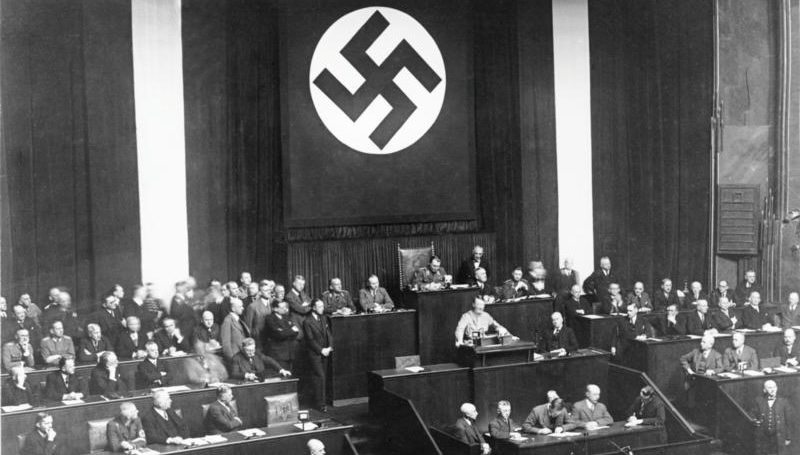
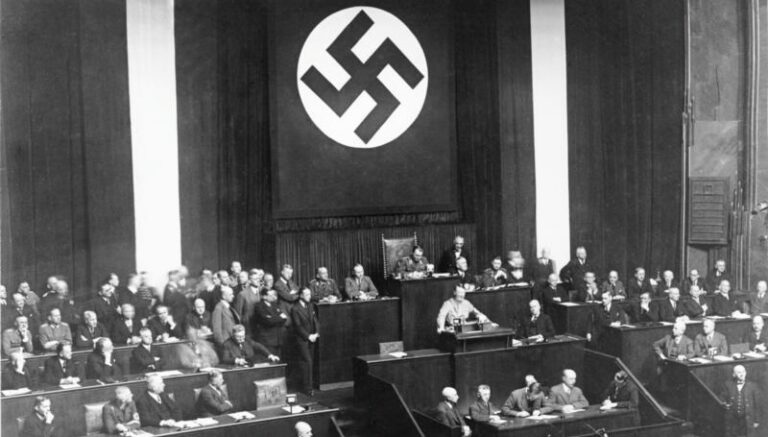
Subsequently, Hitler was appointed chancellor by Hindenburg in January 1933 after his party had won a relative majority in the 1932 elections to a 600-seat Reichstag. At Hitler’s urging, Hindenburg dissolved the Reichstag and called for new elections set for March 5, 1933. Hitler’s aim was to stage a popular referendum on his government, buoyed by assurances from his Gauleiter and local operatives that the party would easily surpass 51 percent, enabling him to rule without coalition constraints.
He used his executive levers to tilt the electoral playing field. An emergency decree, signed by Hitler and Hindenburg, curtailed press freedom and banned public demonstrations. Newspapers challenged these bans in courts. Hitler attempted to rewrite the electoral laws. He even contemplated mobilizing the army to keep public order, only to be told unequivocally by his defense minister that directing troops to fire on German citizens would be unimaginable.
There were even whispers of a pre-election stunt. A week before the ballot, the Reichstag burned in a dramatic arson attack, reducing the symbol of representative democracy to ashes. In the wake of the blaze, Hitler persuaded Hindenburg to issue a second decree suspending civil liberties and due process protections guaranteed by the constitution.
Amidst all the turmoil, everyone understood that the March 5 election was a make-or-break moment not only for the Hitler chancellorship but for democracy itself. “It may almost be said that it is a referendum on the republican form of government under which Germany has lived since the close of the Great War,” The New York Times wrote on election day, noting Hitler and considering the broader implications of the vote. “If he fails to secure a majority in today’s ballot, it will reflect a broad public repudiation of his party and program.”
As it happened, the March 5 vote drew the highest turnout since parliamentary elections began in Germany in the 1870s, with nearly 89 percent of eligible voters casting ballots. Hitler won by a landslide, yet not in the way many expected. Despite representing a heavy suppression of left-leaning parties, the Social Democrats achieved only a single-seat loss. The Communists retained 81 of 100 seats even with their leadership jailed or in hiding. Meanwhile, centrist-conservative support collapsed, with up to half of their voters defecting to Hitler. Perhaps most strikingly, roughly two million new voters—predominantly young—cast their ballots overwhelmingly in favor of National Socialism.
Elections are driven by political contingency, not historical inevitability. Prescience is only evidenced in retrospect.
Like their American counterparts following the November 2024 elections, German Social Democrats girded themselves with despair, blame, and introspection. Emil Gumbel, a key statistician who had worked with Albert Einstein, wondered in a postmortem: “Why did the youth abandon us in such numbers for the opponent?” How did Hitler manage to convert what he called “the basest impulses of humanity” into a force that appeared virtuous in the eyes of many voters?
Historians now view March 5 as a sham election in which Hitler tilted the odds through political maneuvering and intimidation. Yet contemporary interpretations and the election data suggest the outcome was by no means foreordained. The New York Times’ own Fred Birchall, who would later win a Pulitzer for his coverage of Germany, had forecast in mid-February 1933 that a negative result for Hitler could consign him and his party to “the forgotten annals.”
Elections hinge on political dynamics and contingencies, not on inexorable historical inevitabilities. The same truth applies to the United States in the months ahead, as voters confront a pivotal contest in November that could redefine what the republic—small “r”—has stood for for more than two centuries.
Pundits line up with forecasts, many predicting a Democratic surge, even as President Trump pushes provocative strategies—such as offering monetary rewards—to tilt the outcome in his favor. In the end, the decision will rest with the voters, just as it did in March 1933.
______________________________
53 Days: How Hitler Dismantled a Democracy by Timothy Ryback is available from Atlantic Monthly Press, an imprint of Grove Atlantic.