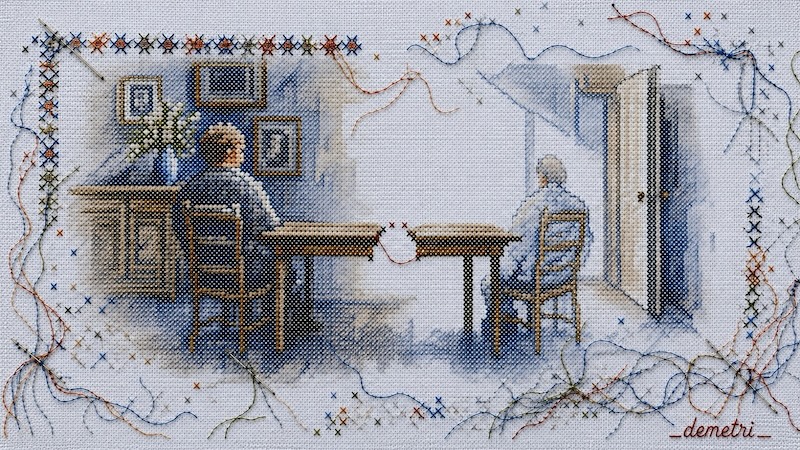
Cross-stitch watercolor by Demetris Papadimitropoulos
When Aly altered hir name, hir mother heard more than a fresh sequence of syllables. Margaret confided to researchers in Rin Reczek and Emma Bosley-Smith’s study that Aly appeared to have “divorced the whole family.” Before the shift, Margaret and her husband sent Aly funds every couple of weeks. Afterward, Margaret stopped. Later, when Aly described the disputes over what hir mother should call hir, ze pared down Margaret’s authority to a stark simplicity: “she named me, and that’s the most important.” Parents christen a baby before the child can select a name. The puzzling question arises years later, when the child can decide and the parent wonders whether that choice should surpass the one made first.
Recognition is the natural term for this clash, though it does not fully encompass its depths. Margaret wrestles with Aly’s trans and genderqueer identity, yet she also experiences Aly’s self-definition as something performed upon her. Hence the jarring image of divorce. A new name threatens not only her understanding of Aly but a sense of parenthood that she once believed she had earned. What happens to the powers acquired when a child could not yet decide for itself once that child grows into an adult who can?
National Coming Out Day, observed every October 11, foregrounds a threshold: someone tells, or chooses not to tell. Current Human Rights Campaign guidance stresses that disclosure does not have to happen all at once, to everyone, or on anyone else’s timetable; its materials stress that individuals should control whether, how, where, when, and with whom they are open. Disclosure is not a mandate. Withholding, delaying, or restricting what particular relatives know can also function as agency. The tougher questions, which two recent books attempt to answer, often begin after disclosure. What do the people who receive that knowledge imagine is required of them?
Reczek and Bosley-Smith’s 2022 Families We Keep: LGBTQ People and Their Enduring Bonds with Parents spends much of its energy on that aftermath. Tricia cannot identify the precise scene in which she came out to her mother, Charlene. Women simply began entering her life. Yet Charlene clung to the belief that beneath it all her daughter remained, in effect, drawn to men. Asked to characterize their relationship, Tricia finds a more precise expression than either acceptance or rejection: “It’s like we’re close, but not close.” She still seeks Charlene’s counsel; they share holidays and support each other through illness. Their closeness is neither sham nor complete. Incompleteness is one of its conditions.
The space between knowledge and any form of confident recognition is hardly marginal. In a 2025 Pew survey, 23 percent of LGBTQ adults said none of the people who raised them knew about their identity. Among those whose parents did know, only 46 percent said all involved were accepting. But acceptance is a fluid end. A family can know and doubt, know and refuse to discuss, know and still use an old name, know and love. What catches Reczek and Bosley-Smith’s attention is what that information is permitted to disturb.
They name the force that sustains many fraught parent–child bonds compulsory kinship, the sociocultural pressure that renders family origin relationships—especially parent–child ties—seem primary, inevitable, natural, and enduring. More revealingly, they show how much activity remains hidden within that apparent permanence. Their term conflict work describes the labor of contending with serious disagreements while keeping a family functional: concealing, teaching, accommodating, redirecting, sometimes leaving and returning. What initially appears as endurance begins to resemble maintenance.
Leslie shows how peculiar that maintenance can become. She comes out as trans to her mother, who largely denies acknowledgment. Years later, after Leslie experiences acute financial hardship and ends up in the hospital, both parents become more present. Her father contributes to hospital bills and her car, invites her over, makes dinner, and provides gas money. He also refuses to acknowledge that she is trans. They reach what Leslie calls an “agreement and standstill”: some topics simply do not get discussed, and being trans is one of them. Leslie says that, if given the choice, she prefers this imperfect arrangement to having no relationship at all.
A family can know and doubt, know and refuse to discuss, know and use an old name, know and love. What interests Reczek and Bosley-Smith is what the information is allowed to disturb.
“Partial recognition” is an accurate label, yet it can become a verdict too swiftly. Leslie deserves more acknowledgment than she receives. Nevertheless, her father’s dinner does not erase his refusal to recognize her gender; that refusal does not render the dinner or the hospital bill imaginary. Care and recognition have separated. Leslie has chosen, at least for the moment, that the gap between them is a space she would rather inhabit than sever the relationship entirely.
That is what keeps the verb keep in increasing significance as the book unfolds. Families endure through discretion, teaching, lowered expectations, hope, money, distance, forgiveness, and silence. “We stayed close” begins to require a second sentence. How? Who shifted the topic? Who learned? Who yielded? Who kept calling?
Reczek’s 2026 solo Families We Lose: A New Explanation for Family Estrangement begins with people for whom at least one of those calls has ceased. Its 68 interviewees were all currently without contact with one or more parents, though most had previously oscillated in and out of estrangement. Unlike the earlier project, it is not strictly a study of LGBTQ families. Reczek describes the alternative family logic she uncovers among many participants as democratized kinship, in which inherited status carries less weight on its own while accountability, growth, connection, mutual respect, and safety become more important.
The distinction between the two works becomes clearer when kept in mind. The earlier volume follows people as they strive to keep a difficult tie alive. The later volume listens to people explain why inherited status no longer suffices to sustain a relationship.
Luna offers that second position with particular sharpness. Estranged from a father who repudiates her queerness, sexuality is only one facet of her explanation for the rift. She tells him that a relationship cannot exist without mutual respect. His stance, as she recounts it, reduces to this: “I’m the father, you’re the daughters, we do things my way.” The harm is not merely disapproval of who she is. She perceives him as believing that his role within the family grants him a moral veto over her life.
Aly’s quarrel begins with a name; Luna’s ends with the rank implied by paternity. Neither instance proves that parental rejection is simply a desire to control. Religion, fear, prejudice, affection, money, family history, and bewilderment can crowd the same room. The cases uncover a narrower fact: adulthood is expected to settle who has the final say over a life, yet families do not always receive that directive. What, exactly, remains for a parent to decide?
The research designs keep the two works from becoming a straightforward sequence. Families We Keep interviewed 76 LGBTQ adults and, with their consent, 44 parents connected to 40 of them. Reczek and Bosley-Smith acknowledge that individuals with especially contentious parental ties were less likely to authorize interviews with their parents, leaving that sub-sample skewed toward relatively warmer relationships. Families We Lose interviewed 68 adults who are presently estranged from at least one parent, not the relatives from whom they are estranged. One book captures people doing the ongoing work of maintaining ties. The other captures people explaining why, for the moment, that work has halted. The difference between their conclusions may hinge on where the researchers stood.
Jackie stands out as a key reason the earlier book resists becoming a straightforward advocacy for more voluntary family contact. Jackie describes physical abuse by her parents, and she does not feel safe telling them she is trans. The bond is damaged enough that she says, “If they were just my friends, I wouldn’t speak to them.” Reczek and Bosley-Smith understandably hear compulsory kinship at work there: behavior that would end a friendship has not terminated this family tie.
Yet Jackie’s comparison also faces its own objection. Her parents are not her friends. A parent–child relationship carries a history of friendship that does not exist in the same way for a friendship. It includes dependency before both parties can meet as equal adults, memories and injuries accumulated before adult consent becomes possible, care given or withheld when the child could not provide it for themselves. None of that grants permanent authority to parents. It is not morally weightless either. An adult can know that culture helped teach them to value the parent–child bond and still decide that particular history leaves them with obligations they wish to honor. Knowing where a duty originated does not settle whether it should survive.
And sometimes equality is simply not available. An aging parent may develop dementia; illness can render recognition intermittent or apologies impossible. None of this restores a right to obedience. It does reveal a limit in any framework that ties relationship quality and ongoing obligation neatly together. Reciprocity can vanish even as obligation persists.
Families We Lose offers a less theoretical version of the problem. Elena asks both parents for accountability for the failures of her childhood. Her mother declines to provide it. Her father acknowledges the wrongs, offers an apology, seeks forgiveness, and changes. “He’s changed a lot,” Elena says. “And now we’re really, really close.” She does not need to erase the family category to insist that the relationship shift. Hope for growth and growth itself are different kinds of evidence.
Money often accelerates the shift from abstract to practical. Margaret’s response to Aly’s name change includes halting the routine payments. When Aly later explains why zir engagement resumed in part, the rationale is notably administrative: “I can’t afford my own phone bill, and my health insurance is with my father.” The confrontation over recognition arrives with paperwork.
Aly cannot stand in for everyone who remains connected to a difficult parent. Love, hope, fear, habit, sincere care, and need cannot be boiled down to a household budget. Yet zir phone and health insurance reveal the fragility of discussions about choice that assume exclusivity. An opportunity can exist in principle while the life beyond it remains unaffordable. Family can be both relationship and logistics at once.
Tabitha proves difficult to pin down for either side. In Families We Keep, she recounts years of clashes with her parents over sexuality, faith, identity, independence, and a legal name change. Reczek and Bosley-Smith also document serious mental-health struggles and previous physical confrontations with Tabitha’s parents; at the final confrontation, Tabitha says she left, partly because she feared the conflict would escalate. She moves away, stating that she loves her parents but will not live her life for them.
Years later, she returns.
Tabitha tells her mother that she is homeless. Deanna remains wounded by the estrangement, yet she opens the house again. Deanna adds that her husband helps enable reconciliation with one of the oldest propositions in Families We Keep: “That’s our daughter.” Material necessity clearly matters, as does the conviction that a daughter names something a family cannot simply revoke.
But the old arrangement does not return exactly as it was. Tabitha describes her parents as “not as parental as they used to be.” At first they behave as “mom-and-dad clingy”; eventually she asserts, “we’re all adults.” She believes the estrangement helped them realize that she could be “good either way with or without them.” They remain parents, but they no longer occupy quite the same position.
National Coming Out Day understandably centers the person deciding whether and how to say: This is who I am. These books shift the camera toward the people who hear it. What will they relinquish, if anything?
Reczek and Bosley-Smith interpret the return as partial evidence of the durability of compulsory kinship, and the data backs that view. Family status exerts pull, as do family resources. Read alongside the estranged adults in Families We Lose, however, Tabitha reveals another possibility. Return is not restoration. The relationship resumes; not every power embedded in its former form re-emerges. She cannot claim that estrangement generally makes families better. She can, however, state that once leaving becomes real, its possibility may linger even after someone comes back.
National Coming Out Day understandably centers the person deciding whether and how to say: This is who I am. These books shift the camera toward the people who hear it. What will they relinquish, if anything? An old name? A preferred future? The expectation that parental discomfort should dictate the pace of an adult life? What may endure: care, history, concern, obligation, and the desire to remain part of a family?
Aly chose a name. Tabitha left a house and later walked back into it. Neither action definitively answers whether recognition, love, understanding, or reciprocity will follow. The more telling questions revolve around the verbs: who names, who recognizes, who teaches, who pays, who apologizes, who cares, who refuses, who leaves, who can return.
“Parent” is a name too. It may be among the first we learn for another person and among the last whose meaning we think has been settled long ago. An adult child can claim authority over the meaning of a life without proving that everything inherited is thereby illegitimate. A parent can lose the right to define a child without becoming a stranger. Obligation can survive scrutiny. Sometimes contact cannot.
When Tabitha came back, her parents remained their parental roles in a sense. They were also, in her precise, peculiar wording, “not as parental.” The title endured; much of the hierarchy within it had not. National Coming Out Day provides a public language for saying This is who I am. Families We Keep and Families We Lose linger over the answer that may follow: I am your parent. The unsettled portion is what that answer still permits anyone to ask.