

The summer immediately after my daughter’s death brought with it a surprising email: an invitation to deliver a keynote speech the following spring. The colleague who reached out was unfamiliar to me, yet she had been informed of my loss and offered her condolences. The request felt puzzling. How could anyone who knew about the death of my daughter expect me to accept academic invitations? How could anyone presume I would ever think about my work again?
That invitation proved to be a gift.
I was in a daze that season. My daughter had fallen asleep on a late Sunday in April, vibrant and seemingly well. Sometime during the night or early morning she endured a massive stroke. In the ensuing week she suffered additional strokes in the hospital. She passed away that Friday, April 30, 2010. Barely weeks before finishing her senior year, she was suddenly, inexplicably gone.
I responded viscerally to the idea that these professional achievements were relevant to who I was, to “the course of my life,” but the death of my daughter was not.
In the aftermath, well-meaning friends and colleagues urged me to resume my research, thinking perhaps I would find relief or solace there, or be reassured that I could re-enter life. Yet the topic I had been pursuing offered no refuge for a parent who had just lost a child: it concerned the mid-century tragedy of children burned when the fur lining on cowboy playsuits—intended to be joyous—erupted in flames, leaving many burned and some dead. This was Americans’ first confrontation with “flammable fabrics.”
The episode I termed the cowboy suit tragedy was itself part of a planned, broader project—a sociolegal history of product liability in twentieth-century America. These two lines of inquiry had been interrupted by a third, a book about law, personhood, and citizenship in the long nineteenth century, published in March 2010, Law and the Borders of Belonging in the Long Nineteenth Century United States. Together, these endeavors formed the foundation for my promotion to full professor in May 2010.
Frances’s death struck in the midst of this research and these professional milestones—the sort of events scholars accumulate on a CV. I reacted instinctively to the idea that my professional achievements signified who I was, tied to “the course of my life,” while Frances’s death did not.
When the first copy of Law and the Borders of Belonging arrived, Frances was eager to scan the acknowledgments to see if she appeared there. She did not care for what she found. “Why do I have to share sentences with Wilder [her brother]?” she asked. “Dad gets his own sentences. I want my own sentences.” It was such a tender moment. I remember laughing, promising that in my next book she would have her own sentences. And then a month later, she was gone.
*
I accepted the invitation. I did not know at the outset what I might speak about; even surviving Frances’s loss felt like a challenge. But a few weeks after saying yes, a concept for the talk took shape: I would craft a braided narrative that interwove the cowboy suit tragedy, my personal experience of loss, and the curriculum vitae itself. It felt like gulping air after a long, suffocating pause.
Although it would be another five years before I returned to the cowboy suit tragedy, Frances’s death intensified the urgency of the project. I began to wonder what a history that fused the personal with the intellectual—embracing emotion alongside reason, seeking a meaning beyond the usual “so what?”—could teach us about knowledge and human experience.
I had long resisted seeking out survivors of the cowboy suit tragedy, fearing that it would reopen old childhood wounds. Only after Frances’s voice was silenced did I grasp the importance of letting survivors speak for themselves. The conversations I later had with survivors, spouses, siblings, and children revealed that although the injury evolved over time, it was never truly finished. This realization shifted my understanding of law and its claim to finality. Through those conversations, I glimpsed how this event shaped the lives of the families involved. The original Latin meaning of curriculum vitae led me to imagine telling their history as the course of a life.
I also turned to archival research to investigate the history of the curriculum vitae itself. My aim was to show how the vitae’s structure and categories embed and reproduce institutional and disciplinary boundaries, privileging certain kinds of training, experience, and research, while excluding others. Put differently, I began to see including a history of the vitae in a book chiefly about another history as akin to wearing an external girdle to expose the girdle’s construction and the constraint it imposes.
Only with the silencing of Frances’s voice did I understand the importance of survivors having the opportunity to speak for themselves.
The idea for the talk, that huge gulp of air, included a third element: speaking to my own experience of losing Frances. Yet when I finally faced composing my remarks, I could not imagine addressing an audience with my personal story of losing my daughter. So I turned to letters I began writing to her the month after her death. Although I wrote to her daily, often more than once, I never revisited them. While I drew from those letters for the lecture I delivered, I did not reread them until winter 2020. In the book, I draw on letters I wrote during the first year and a half after her death. By doing so, I claim a form of knowledge that disciplinary training and structures like the vita tend to obscure, and I establish a bridge to a fuller understanding of the grief and losses experienced by the families affected by the cowboy suit tragedy.
I gave that lecture, “Telling Stories: A Meditation on Love, Loss, History and Who We Are,” at the annual meeting of the Western Association of Women Historians in April 2011, just weeks before Frances’s first anniversary.
Since then I have thought often about that invitation. It marked a particular convergence of time—the painful collision of the personal, professional, and intellectual in my life: my daughter’s death, the parallel professional milestones, and a project about grievous, unforeseen harm to children. If Carole Srole, upon learning of my daughter’s death, had not extended the invitation to deliver the keynote, I might not have conceived the braided narrative that later became the seed for the book Writing with Fire: The Cowboy Suit Tragedy and the Course of a Life. The forum itself mattered—a group of women historians formed precisely as women challenged their exclusion and subordination within academia—an audience, in other words, potentially receptive to a talk that spoke from personal loss and breached the rigid borders between personal, professional, and intellectual life.
And the format mattered: a lecture. The stakes were, in one sense, terribly high: standing before an audience to deliver a profoundly personal talk while I remained deeply grieving. Yet the format also lowered the stakes in another sense: it was a keynote address, a single event, with words under my control rather than a published piece that would circulate widely. So, although public, it remained, in a crucial way, private. Finally, the response to the talk mattered: a warm, sustaining embrace, a reception that affirmed the possibility of pairing feeling with thinking. Audience members expressed hope that I would publish the talk, something I could not imagine at the time and would only consider with time.
Incremental steps, each with no predetermined plan for what came next, allowed me to move forward. I accepted the invitation because it gave me something to point to—a distant date on a calendar, a kind of proof to others that I was reentering life. Its distance meant I did not have to act immediately. And yet, it ultimately offered a critical route back to life, both personally and professionally, and intellectually. What I have come to understand only after finishing the book is that the lecture, followed by the research and writing, formed a path back to life—not to live without Frances, but to live with her, through her, and alongside her.
______________________________
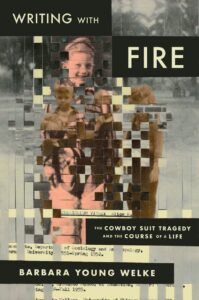
Barbara Young Welke’s Writing with Fire: The Cowboy Suit Tragedy and the Course of a Life is available from University of Chicago Press.