
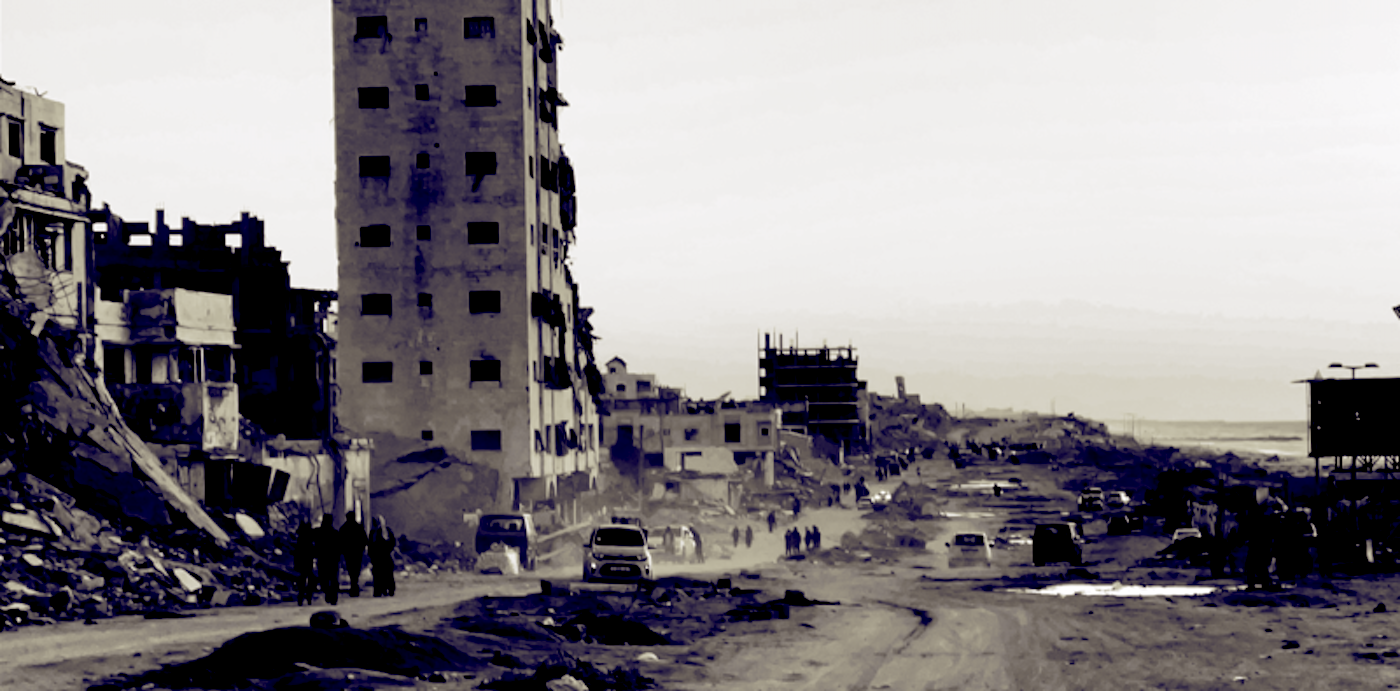
I have reported on many wars before, yet nothing—absolutely nothing—could have prepared me for the brutal reality, the merciless cruelty, and the raw savagery of Israel’s campaign in Gaza. I was not alone in that impression. Veteran colleagues at Al Jazeera—battle-hardened reporters who had traversed the ruins of Afghanistan, Iraq, Libya, Yemen, the Balkans, and Ukraine—admitted they had never witnessed such ruthless devastation.
The unrelenting bombardment of the small Gaza Strip following Hamas’s devastating assault on the southern communities of Israel on October 7, 2023, has been compared to the most brutal conflicts in memory. In merely two months, the Associated Press reported, the Israeli war had “wrought more destruction than the razing of Syria’s Aleppo between 2012 and 2016, Ukraine’s Mariupol, or, proportionally, the Allied bombing of Germany in World War II. It has killed more civilians than the US-led coalition did in its three-year campaign against the Islamic State group.” It has been described as “the conflict for children in modern times,” as well as the war that has seen an unprecedented targeting of journalists, doctors, humanitarian workers, and United Nations staff. No one was spared. Nothing was sacred. A Brown University study concluded that “more journalists have been killed in Gaza than in the US civil war, both world wars, the Korean war, the Vietnam war, the wars in Yugoslavia, and the US war in Afghanistan combined.”
Israeli prime minister Benjamin Netanyahu also viewed Israel’s war through a historical lens. A few weeks after the October 7 attack, Netanyahu defended the obliteration of civilians in Gaza by likening it to Operation Carthage, a World War II British air raid that struck the Nazi intelligence headquarters in Copenhagen but instead hit a school and killed eighty-six children. He argued that those deaths were the tragic cost of a legitimate act of war, but not a war crime. Drawing an equivalence between Nazi Germany, which dominated much of Europe in World War II, and Gaza, the world’s largest open-air prison home to the oldest refugee camp, goes beyond overreach—it is grotesque and absurd.
Israel’s war in Gaza echoed the Nakba of 1948. Once again, communities were driven from their homes; only this time, they did so under drones and satellites.
Israel’s war wasn’t merely a historical analogy. Many of us lived the conflict, in real time, twenty-four hours a day, through phone screens we clasped in trembling hands. There was nowhere to turn, nowhere to hide. It tested our sanity to maintain any sense of normalcy amid the carnage. Each day opened a new abyss. Nonstop footage of panic and chaos, of children crying for parents they would never see again; of parents clutching the mangled remains of their toddlers; of entire families massacred.
Israel’s war in Gaza echoed the Nakba of 1948. Once again, communities were driven from their homes; only this time, they did so under drones and satellites. Israeli soldiers filmed themselves in high definition, laughing, looting homes, tearing down entire rows of buildings, humiliating civilians, even killing them. Gone were the days when Israelis saw themselves “shooting and crying,” projecting an image of a people averse to killing. They now broadcast their exploits live, unashamed and proud. To call such televised brutality sick would be to insult the sick. This was something else. This was cruelty made spectacle.
It soon turned personal. Our colleagues, friends, and loved ones were gone, blown into fragments by faceless drones, victims of Israel’s vengeful war. These were not random casualties or collateral damage; they were deliberate erasures. Faces we knew, people we had laughed with, vanished in an instant. And yet those who survived kept reporting, undeterred, chronicling massacres as they moved between funerals and hospital shifts.
Curious about what the perpetrators of this war were thinking, feeling, and saying, I scanned Hebrew-language newspapers and watched Israeli television, but the horrific images of civilian casualties in Gaza seldom reached the screens. Instead, Israeli networks broadcast spectacles of hate. News anchors, generals, and even celebrities vied to see who could shout the loudest: “Punish them!” “Kill them all!” “Nuke them!” A government minister openly mused about dropping a nuclear bomb on Gaza. A former Knesset member warned, “Every child in Gaza is the enemy.” A pop star demanded, “Erase Gaza completely.” This wasn’t a matter of rational debate. It was racist dehumanization. The Israeli media were, in effect, enlisted to the primary goal of winning the war, as Raviv Dror, a senior Israeli investigative reporter, noted in January 2024. The country that prided itself on democracy had replaced freedom of expression with an unfettered drive to incite vengeance.
What began as Israel’s military response to Hamas’s brutal assault on October 7 swiftly transformed into one of the most destructive campaigns against civilians in modern history. By the time the UN Security Council adopted a weak, American-diluted ceasefire resolution in March 2024, Gaza had endured six months of relentless bombardment, medieval siege conditions, and engineered deprivation.
The images from this period were unbearable. Children were not merely wounded; they were left utterly isolated; the grim acronym WCNSF—wounded child, no surviving family—should not exist in any language, yet it entered our everyday vocabulary. Entire families were vaporized by a single two-thousand-pound bomb. The violence was not completely indiscriminate; it was enormous and selectively engineered to maximize devastation, engulfing homes, hospitals, schools, UN shelters, and refugee camps. Nothing was spared.
The destruction was enormous, almost industrial in scale. By March 2024, about 90 percent of Gaza’s population, more than two million people, had been displaced. Over 92 percent of Gaza’s homes had been damaged or destroyed. Neighborhoods lay flattened. Schools, bakeries, clinics, civil infrastructure—all vanished. Open markets were turned into graveyards. This wasn’t a battlefield; it was an extermination zone. Gaza’s health system collapsed. Its largest medical complex, Al-Shifa Hospital, was besieged, bombed, and raided under false pretenses, leading to hundreds of deaths inside. Medical staff worked without anesthesia, electricity, or proper sterilization. Patients died untreated in corridors. Gaza’s health system, already fragile after years of blockade, was crippled further.
Over a million Gazans faced catastrophic hunger as Israel tightened its blockade, bombed farmland, and destroyed water supplies. In the north, children perished from malnutrition and dehydration. In March 2024, Josep Borrell, a leading EU diplomat, accused Israel of creating a famine and weaponizing hunger as a tactic of war. “In Gaza we are no longer on the brink of famine,” Borrell warned, “we are in a state of famine affecting thousands.”
International law appeared unable to halt the carnage. The International Court of Justice (ICJ) ruled in January 2024 that it was “plausible” Israel’s actions in Gaza could amount to genocide under the 1948 Genocide Convention. The ICJ ordered six provisional measures, including a halt to genocidal actions, unhindered humanitarian aid, and punishment for those inciting genocide, yet these were not heeded. The International Commission of Jurists confirmed that Israel failed to comply with the ruling. A UN Commission of Inquiry found in May 2024 that Israeli forces had committed numerous serious violations of international law between October and December 2023. These included war crimes and crimes against humanity: weaponizing hunger; deliberately targeting civilians and civilian infrastructure; murder; sexual and gender-based violence; torture; arbitrary detention; and the forcible transfer of civilians. Israel again rejected the commission’s findings. In November 2024, the International Criminal Court (ICC) issued warrants for the arrest of Prime Minister Benjamin Netanyahu and former defense minister Yoav Gallant, accusing them of using starvation as a method of warfare. (The ICC also issued warrants for Hamas leaders Yahya Sinwar, Muhammad Deif, and Ismail Haniyeh, but they had all been killed by Israel.) The warrants marked a rare instance of the ICC targeting an ally of the United States. Predictably, Washington retaliated by sanctioning the court’s prosecutors rather than reprimanding Israel.
Despite giving Israel a free hand, U.S. president Joe Biden could not persuade Netanyahu to permit aid into Gaza through Israel or even via one of the Egyptian crossings. In March 2024 Biden announced that the United States would construct a special offshore pier off Gaza’s coast to receive international aid, which would be shipped from Cyprus after inspection by Israel. Built at a cost to U.S. taxpayers of $300 million, the pier operated poorly and sporadically for just twenty days before being retired. It was a textbook boondoggle, a quintessential Biden moment—failing to confront Netanyahu at U.S. expense. To call it absurd hardly covers it.
To add insult to injury, Biden’s other plan—the so-called Day After peace initiative—ignored the escalating genocide and proposed diplomatic normalization between Israel and Saudi Arabia. The plan promised Saudi recognition of Israel, including security guarantees, in exchange for a pathway to Palestinian statehood that sounded “clear and credible” but was, in reality, vague and impractical. Despite Biden’s willingness to reward genocide by brokering an unprecedented peace, Netanyahu rejected the proposal. Instead, he pressed for a prolonged war that would secure a decisive victory, eliminate Hamas, and leave Gaza uninhabitable. The generals who had joined Netanyahu’s war cabinet resigned in frustration at his antics. Yet the bombardment persisted.
The struggle in Gaza was not a war in the conventional sense. It was a reckoning: a confrontation with civilization itself. As Gaza was reduced to ashes, the world watched—and turned away. Gaza was not only destroyed; it was abandoned.
Yet Gaza endured. So did Israel. And so did the suffering.
In those dark days, writing became my only refuge amid the chaos; it offered a lifeline. Eventually, as the thunder of bombs overwhelmed every other sound, even writing failed me. Composing about the conflict while bombs fell felt like playing a violin inside the rear of an ambulance racing through a disaster zone. I continued to provide television commentary, but words failed me. I could not summon the language to convey what was unfolding.
As Gaza was reduced to ashes, the whole world watched—and turned away. Gaza wasn’t only destroyed. It was abandoned.
There was no escape from the horror streaming live on our screens. You asked yourself: Am I the only one watching? Where is the outrage? Where are the values? So you directed your ire at the technology. You shouted at the TV. You cursed the computer. You screamed at the phone. You even tried to reason with the tablet. But it all fell on deaf ears. Siri wasn’t listening. Alexa didn’t care. Silence prevailed. They win; you lose. You retreated, overwhelmed, critical of both the brutality and the hypocrisy of elected leaders and the supposed liberal media that profess humanism yet tolerate human suffering, proclaim universal values yet clamp down on international solidarity. If protests against the killing of children are criminalized, what is left to protest? Yesterday they cried for Ukraine, shouting “genocide” at Russia. Today they whisper, mumble, and stutter as genocide devours Gaza. You wonder why. You know why. You’ve always known. Denial gave way to rage, then rage collapsed into despair, for there is no treaty to be made with genocide. But despair doesn’t suit you. You snap back…yet what can you do?
A three-phase ceasefire began in January 2025, temporarily halting the fighting but delaying a lasting solution. It promised an enduring halt to hostilities and reconstruction for Gaza. Yet, predictably, Israel opted out after Phase One, taking advantage of the U.S. presidential transition from Biden to Donald Trump. If you believed the situation could not deteriorate further, the advent of the Trump administration proved otherwise. In February, barely a month into office, Trump urged the expulsion of Palestinians from Gaza, paving the way for U.S. takeover and redevelopment of the territory, turning it into a Mediterranean resort after the war. The ethnic cleansing of Gaza would be permanent.
On March 18, 2025, Israel resumed bombardment.
“Bombing what?” you might wonder. There was nothing left, and yet they bombed again. Each moment you believed Netanyahu could not descend any lower, he managed to surprise you. The New York Times did not concede until July 2025 that Netanyahu had cynically “prolonged the war to stay in power,” as if remaining in power rather than leading a genocide was the worst crime a leader could commit.
By then, by the summer of 2025, estimates of those killed in airstrikes and bombardments rose to over sixty thousand Palestinians, two-thirds of whom were women and children. A Lancet study earlier suggested the real death toll could be forty percent higher than the official figure. In August 2025, it emerged that at least five in six Palestinians killed were civilians, according to the Israeli military’s own data. The UN reported that at least one hundred children were killed or injured every single day after the renewed strikes. Gaza lay in ruins, its people trapped in a cycle of loss and suffering as the fighting persisted. The population remained displaced. Homes stayed demolished. People continued to starve.
Then Gaza’s theater of cruelty took an even more surreal turn. To replace the food-aid distribution system previously run by UNRWA—the UN agency for Palestinian refugees—which Israel had effectively banned in October 2024, an American consortium of self-styled entrepreneurs, mercenaries, and evangelicals established a new nonprofit, the Gaza Humanitarian Foundation (GHF), in February 2025. Under mounting international pressure to stop weaponizing hunger, Israel backed the GHF to weaponize aid itself. Gruesome, stomach-turning scenes unfolded daily at GHF food-distribution sites, where hundreds—often thousands—of starving children were shot as they surged to obtain food for their families. Thousands more children died of starvation.
If you believed it could not get any more nihilistic, think again. In May 2025, Netanyahu told the Knesset Foreign Affairs and Defense Committee, “We are destroying more and more homes; they have nowhere to return.” He added that the inevitable outcome would be Gazans’ desire to leave the Gaza Strip. He explained to the parliament that the primary obstacle to Palestinian departure was not Israel but the countries they would pursue as destinations. The relentless bombing persisted through the summer and into the second anniversary of October 7, when a ceasefire was finally agreed and announced by President Trump the following day.
*
After a yearlong break I returned to writing—my sole weapon—as Israel’s war in Gaza roared back into our lives in spring 2025. I resolved not to let the bombs have the last word, nor to allow the architects of destruction to write the final chapter in Gaza’s blood. With resolve and a heavy heart, I began drafting the book that would become Twelve Days That Shook the Middle East, a chronicle of the first twelve days of the war that shattered Israel and unsettled the entire Middle East.
Why twelve days? Why not more, or fewer? Because twelve days proved enough. It took no more than twelve days—from Netanyahu’s October 7 war speech to Biden’s October 19 Oval Office address—to reveal the anatomy of Israel’s war, its aims, its strategy, and the method behind its madness. After that, history unfolded in horrific detail. Although clothed in rhetoric of “security” and “self-defense,” what followed was no accident of war or collateral damage. After those twelve days, the bloodshed followed a deliberate scheme. The genocide was not an error; it stemmed from a preplanned strategy, with a blueprint if not a premeditated decision.
______________________________
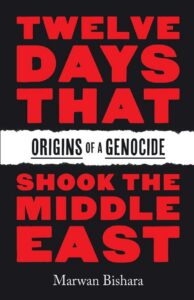
From Twelve Days That Shook the Middle East: Origins of a Genocide by Marwan Bishara. Copyright © 2026. Available from Haymarket Books.
