
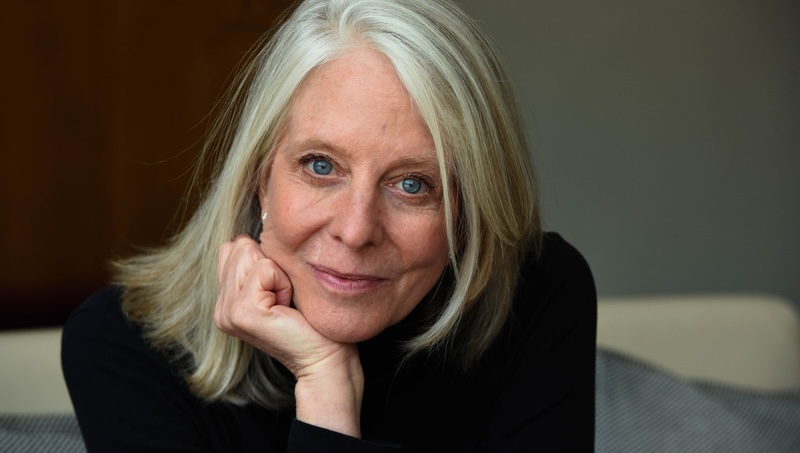
Elizabeth Zott, the feisty 1960s-era chemist in Bonnie Garmus’ mega-selling first novel Lessons in Chemistry, captivated readers with her early feminist point of view and transformative approach to hosting a TV cooking series. Batter Gray, an aspiring poet from Yuba City, California who finds himself caught up in a dynastic family drama in the 1980s New York City poetry world, is a surprising, equally engaging follow-up.
What inspired you to write a new novel that revolves around poetry? I asked Garmus.
“When I was fourteen, I had an English teacher who used to read a poem to us every day. He knew how to make the words come alive—not with theatrics or exaggeration—but with careful meter and tone, and he only ever read us work he thought mattered. That’s how we ended up hearing the voices of Nikki Giovanni, Langston Hughes, W.H. Auden, Yeats, and more. As the year drew to a close, he made us promise we would continue to read a poem a day for the rest of our lives, assuring us it was best way to keep our hearts and minds open. We all agreed. But then came summer vacation and that promise went right out the window.
“It wasn’t until decades later, when I heard his favorite Nikki Giovanni piece being read on the radio, that I remembered that promise. Not feeling like I’d done a very good job keeping my heart and mind open—work was challenging—I started reading a poem a day. Then I subscribed to the Poetry Foundation’s email list.
“Oddly enough, something changed in me. That’s about the time I started imagining a story about someone who, like my teacher, instinctively knew which poems were good and which weren’t (because who does? How can you tell?) But I thought my character would have to be young, unsuccessful, idealistic, and would somehow become the deciding factor in the battle between originality and conformity. These days I print out the poems I love and tack them to my wall. It kind of looks like fluttery wallpaper, especially when the window’s open.”
*
Jane Ciabattari: Was Peck & Peck always the title (with the ampersand)?
Bonnie Garmus: I tried several last names but settled on Peck because of its multiple and conflicting meanings. To peck at something means to hurt it, but a peck can also be a kiss. Families and companies often have pecking orders which aren’t always fair or wise but persist anyway. When we feel peckish, we’re in want of something elusive. For me, the name Peck not only encompassed the conflicts in the book (between twin brothers, capitalism and social good, originality and conformity) but also captured the constant ephemeral battle of proving how and why art matters.
JC: Batter has a loving father, an idealistic historian at a local college, and a mother, a professional type designer, who shapes his actions with stories about his namesake a forthright and courageous dog named Batter, and her assessments of his moves. How important were these parents in the evolution of Batter as a character?
BG: Like all parents, John and Rainey Gray want their son to be financially secure. They’re both in the humanities, they both know it doesn’t pay, they both really want Batter to be something else. But their desires for their son are at odds with how much they both love their work. The father has made some bad decisions in the past; he can’t outrun them. Rainey suffers from the death of Batter’s brother, but instead of telling her son what happened, she fills his young head with apocryphal stories of her heroic dog who never, despite a bad leg, let anything stop him. What’s ordinary can become extraordinary, she insists. All you need is nerve.
Eventually you’ll realize succeeding on someone else’s timeline may not be for you and that’s fine. Your future self will always be just up ahead, waving, waiting for you to catch up.
But finding one’s nerve means fighting the everyday vagaries of low self-esteem, depression, self-deception, insecurity, loss, never-ending grief, and narcissists. You can be Batman, she assures him, or you can be Alfred. They both matter the same. And although it’s Rainey’s words that ultimately shape Batter, it is his father’s confession that pushes him to do the one thing so many of us what to do, but avoid. Take action.
JC: Also notable are Batter’s “blind spots” when it comes to the consequences of his actions and the people around him. He jumps to conclusions, acts impulsively, and yet stays engaging. Is this part of his essential personality? His age (he’s twenty-five). His future self?
BG: Batter Gray is young, impressionable, impulsive, naïve—in many ways, he’s an everyman. He craves success, is embarrassed by his failures, is undeniably average, has not found love, is limited by a lack of money, has no idea how to get what he wants—and partly that’s because he’s not sure what he wants. A lot of us experience the worry that comes with not knowing who we are or how we’ll get by.
Part of his journey is the slow walk toward self-acceptance. But the walk is filled with potholes and he makes a lot of mistakes. He has to embrace the idea that choosing a major in college is not a path, it’s only a start. Education may have little to do with a certain subject, but rather who you met and how they influenced you. And eventually you’ll realize succeeding on someone else’s timeline may not be for you and that’s fine. Your future self will always be just up ahead, waving, waiting for you to catch up.
JC: The Pecks are an eccentric family who founded an iconic poetry quarterly, Peck & Peck, carried forth by generations of twins. The current twins, Declonius and Salton, are feuding opposites, both of whom find ways to lure Batter into their schemes. What sort of research went into this quirky family tree, including the sets of twins? And their interconnections with the other people Batter meets?
BG: Lots of us assume twins enjoy an extra-close sibling relationship, but after interviewing several twin sets (fraternal and identical), chatting with a twin therapist, and consulting a few behavioral twin studies, I was surprised to learn that twins have a problem the rest of us don’t—a strong need to be recognized as individuals. Because of it, twin relationships can be very contentious. It reminded me of the couplet; how they, too are always expected to be harmonious—to rhyme. But what if they don’t? Conflict is everywhere in our lives. How do we deal with it? And how does it affect our other relationships? The funny thing about couplets that don’t rhyme? They still work. Yeats’s “Crazy Jane Talks with the Bishop” is a great example. And what we learn from this is that things don’t have to agree; they simply have to respect each other. That’s where the “gray” comes in. Things really aren’t black and white.
JC: How did you come up with the many mottos of Peck & Peck, like
Find originality.
Reward creativity.
Burn the rest.
BG: I’m a copywriter and we love imperatives! I love writing things that grab attention.
JC: How did you visualize the elegant five-story building with an aviary where Peck & Peck is headquartered, “standing at the crux of a three-way intersection” in Manhattan. The building is as idiosyncratic as the founding family. “With its slender, triangular shape, its odd plantings, its overly tall French doors, its twin glass domes, the one in back emerging like a cake that had outperformed the baker’s wildest expectations, it was one of the strangest—and most beautiful—buildings I had ever seen,” Batter muses upon seeing it for the first time. Is there a model for this building?
Things don’t have to agree; they simply have to respect each other. That’s where the “gray” comes in. Things really aren’t black and white.
BG: No. The building just comes from my imagination. I loved sitting at my desk and envisioning the place. Sometimes I’d get up and walk out in the fields out where I live and suddenly see entire rooms and have to run back and write it all down. I remember one time, during winter, when my boots kept getting stuck in the mud and I wasn’t making fast enough progress home, I was so worried I’d lose the idea for the Aviary, I stopped and sketched the entire room with a stick, then used pebbles and dried out corn kernels to delineate certain aspects of the room. The birds were flying overhead, watching me work. I remember thinking how bizarre is it that we put birds in cages. People, too.
JC: Did you have fun working with the idea of typefaces throughout? Batter’s awareness from childhood on is unusual, for sure. How did you research this element of the novel?
BG: I loved including the element of typography. It was a little like me putting rowing in Lessons in Chemistry—it was the one thing I knew.
I attended the Colorado Institute of Art, and it turns out if you go to art school, they pretty much assume you can draw. I couldn’t. I’d enrolled in their graphic and advertising design degree program to learn layout, but they made everyone take life drawing and painting and those classes became the nightmare that would not end. But I loved typography. I loved learning about typeface families, tracing all the glyphs and curves, hand-kerning headlines, researching the history of typography. By the time I graduated two years later, I knew over a hundred typefaces by sight. I love Rainey’s line about the importance of typography. “Ever try reading something without a typeface? Good luck.”
JC: Are Phone Book Parties a real thing? What a cool idea!
BG: They aren’t, but I wish they were. I love the idea of a hundred strangers from all walks of life gathering in an extraordinary private place to sip champagne and have wisdom read aloud. I knew the invitation’s extravagance would draw them in, not poetry—because really, who does adore poetry? But by the end of the evening, they would be transformed by the experience.
JC: I’m curious about writers whose work you found helpful in building this universe. And how your family members—husband David and daughters Sophie and Zoë—have helped you along the way.
BG: Every book resting on a shelf stands as a testament to the effort that went into its creation, so I owe a debt to every author who ever lived. But crafting this particular world was more about my own desire to escape the one I inhabit. If there’s anything I despise, it’s traveling a long distance only to discover a Starbucks on the corner. So I built the universe inside my own imagination. All I needed to do was put it into words. Yet the idea of a remarkable building mattered from the start, mainly because rampant conformity threatens to overwhelm culture. Brands, AI, and fascism push people toward sameness. Amid that pressure rise structures like the Sagrada Família, the Guggenheim, the Dancing House, and the Harbin Opera House—original forms, not copies. They’re a form of living poetry, proof that fresh ideas exist. That’s the essence Peck & Peck embodies: novelty, originality, the extraordinary.
As for my family, they didn’t read the manuscript until I’d completed the first full draft (and there were many versions). Still, they supported me every step of the way. Sometimes I’d drop in a random detail like “it’s set in New York in the eighties,” and they’d press me on that choice, prompting me to justify my reasoning. Other times I’d share a paragraph and receive feedback on tone and dialogue. They’re all readers and not shy about offering opinions. I value what they bring to the table.
JC: What are you working on now/next?
BG: I have several notions for a new project, but I’m not certain which will win out in the end. The characters themselves will tell me what to do.
______________________________
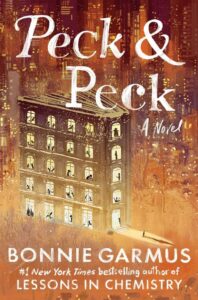
Peck & Peck by Bonnie Garmus is available from Scribner, an imprint of Simon & Schuster.
