
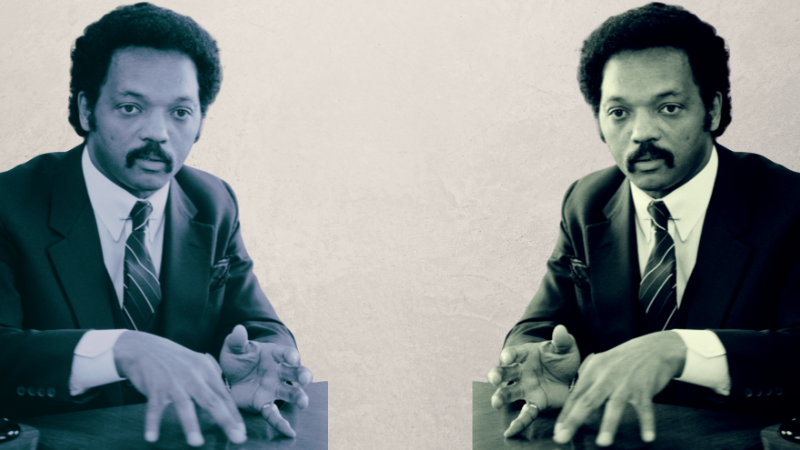
There comes a moment in every young person’s life when they meet someone who convinces them that the world can shift—that they themselves can change—and nothing afterward looks the same. For me, that turning point arrived through my mother.
I was twelve when my mother brought me to Reverend William Augustus Jones, the eminent pastor of Bethany Baptist Church in Brooklyn. Reverend Jones stood among the greatest figures of the Black church in New York—a prophetic voice, a man of scripture and struggle. My mother saw in me a potential she wanted shaped by serious men. Reverend Jones saw it, too. And so, he did what resolute men of faith do when they detect a spark: he handed it on. He introduced me to Reverend Jesse Louis Jackson Sr.
I was just a boy. Jesse Jackson already moved with the force of a formidable presence.
He was young by the standards of movement leadership, yet he carried himself with a gravitas that felt centuries old, as if he had been forged in a furnace the rest of us hadn’t yet approached. When he spoke, you didn’t merely hear words. You sensed history’s architecture bending in response. I remember standing in that room thinking: This is what a leader sounds like. This is what it looks like when a man has decided, without hesitation or apology, that his people’s liberation is worth everything he possesses.
Jesse had already shown me what it looked like to stand where you were not invited, to refuse the limits others set for you.
I became the youth director of Operation Breadbasket in New York soon after. Jesse had built Operation Breadbasket as the economic arm of Dr. Martin Luther King’s Southern Christian Leadership Conference (SCLC). Operation Breadbasket was a campaign to marshal the organized moral weight of the Black community to demand jobs, demand dignity, demand that American commerce reckon with the people it had spent generations exploiting. As a teenager running the youth division in New York, I was learning in the most serious school I could have attended. Jesse Jackson was the professor, and the streets of America were the classroom.
What I did not fully appreciate at the time—though I came to understand it deeply as I grew older—was how much Jesse’s effectiveness flowed from his grounding in the Black church. He was not simply a politician who occasionally used religious language. He was a preacher who understood that the prophetic tradition of the Black church was itself a form of political power, perhaps the most enduring political force Black Americans have ever wielded. The church had been our refuge and our launching pad, our sanctuary and our strategy room. Jesse never allowed those two realities to be separated. When he spoke from a pulpit or a podium, there was no seam between the sacred and the civic. They were one fabric, and he wore it unreservedly and without confusion.
That fusion of faith and action—that insistence that the gospel carried social, economic, and political consequences that you were bound to pursue in the real world—is something I carry with me every single day. Every Saturday morning at National Action Network (NAN), when the members come, raise their voices, and then discuss the work ahead, I am drawing from a well Jesse helped dig.
When Jesse later established Operation PUSH in Chicago, his Saturday-morning rallies became something historic. A sanctuary full of working people, activists, clergy, and young people who needed somewhere to channel their energy—gathered weekly to hold power accountable and lift one another up. When I later founded NAN, I patterned our own Saturday morning action rallies in Harlem directly after what Jesse did in Chicago. I make no apologies for that. You learn from the best, and you build on what they built. That is not imitation; that is lineage. I stand in the direct line that runs from Dr. King to Jesse Jackson to the work we do at NAN today, and I have never once been embarrassed to acknowledge it. That lineage is not a burden. It is an honor.
Jesse understood that, too. When he visited Harlem and stood inside our headquarters, he scanned what we had built—the staff, the history etched on those walls, the community that had grown around that building—and he named it himself. He called it “The House of Justice.” That name endured, because that is precisely what Jesse Jackson spent his entire life attempting to construct: not monuments, not self-congratulatory legacies, but actual houses of justice—places where ordinary people could walk in off the street and find someone willing to fight for them.
What some people forget—especially those who encountered Jesse only on television, only in the grand arena of presidential politics—is how practical he was. “Keep hope alive” wasn’t some slogan concocted in a consultant’s office—it was a theology, a survival strategy, a concrete instruction to people who had every reason to give up. Jesse meant it. He lived it.
Yet the preaching was always in service of the program. This is what I learned as a young man watching him work: the sermon and the strategy had to be one. You could not inspire people on Sunday and send them off without a plan for Monday. Operation Breadbasket understood this. PUSH understood this. His two presidential campaigns, in 1984 and 1988, understood this. When Jesse stood before those Democratic National Conventions and spoke of the suffering of farmers in Iowa, steelworkers in Gary, Indiana, sharecroppers in Mississippi, and young Black men in Chicago in the same breath, he was not engaging in rhetoric. He was building a coalition. He was insisting, long before it became fashionable, that the poor and working people of every color in this country shared more in common with each other than with the powerful interests that pitted them against one another.
I watched him challenge the Democratic establishment when it wasn’t comfortable to do so. I watched him go to Syria in 1983 to secure the release of Lieutenant Robert Goodman—a Black naval aviator shot down over Lebanese territory—when the Reagan administration had essentially written the man off. Jesse returned with Lieutenant Goodman. He did not ask for permission. He did not wait for the diplomatic machinery to move at its own slow pace. He went, because that is who Jesse Jackson was: a man who understood that moral authority, wielded with courage, could accomplish what institutional power would not even bother to attempt.
I think about that mission often. I think about what it meant to a young Al Sharpton, watching a Black preacher from Greenville, South Carolina—a man born outside of wedlock, who had known poverty and humiliation, who had been shaped by the church and the movement and his own relentless hunger to matter—enter one of the most tangled geopolitical situations in the world and walk away with an American serviceman in hand. It told me something about the power of moral seriousness. It told me that race need not be a ceiling. It told me that if you carry yourself with enough conviction, if your cause is righteous and your preparation thorough, you could sit at any table, walk through any door.
Jesse Jackson taught me that the measure of a leader is not the offices he holds but the doors he opens for others.
Jesse gave a whole generation of us that belief.
He is why I ran for office. He is why I started the National Action Network. He is why, when people told me that a Black activist from Brooklyn had no business being on a presidential debate stage in 2004, I stood there anyway. Because Jesse had already shown me how to stand somewhere you were not invited, how to reject the limits others set for you, and how to expand what everyone who followed could imagine.
But I want to say something about the man behind the movement, because history sometimes reduces people to their greatest moments and forgets what made them human. Jesse Jackson was funny. He could read a room and arrive at the exact line that would ease the tension and bring a crowd together in laughter before returning them to seriousness. He was warm in private, in ways the public Jesse—the preacher on the stage, the opponent on the picket line—did not always reveal. He was a man who asked about your family, who remembered details about your life you had mentioned once, who understood that relationships are the infrastructure of movements. You cannot sustain a lifelong struggle without people around you who genuinely love you and whom you genuinely love in return. Jesse had that. He cultivated it. He understood that the long work of justice is not a solo performance but a shared vocation, and he treated the people in his circle with that understanding.
I also want to say something about his resilience, because Jesse Jackson faced criticism—some fair, some wildly unfair—through every decade of his public life. He was attacked from the right for being too radical and from certain quarters on the left for not being radical enough. He was scrutinized in ways that white politicians of comparable stature were not scrutinized. And through all of it, he kept going. He did not retreat into bitterness. He did not let the weight of others’ opposition steer him away from the work. That’s its own form of courage, quieter perhaps than the bravery required to enter a foreign capital or to stand on a picket line, but no less real.
This book traces the arc of one of the most consequential careers in American public life. You will hear Jesse in many voices here: the preacher and the politician; the strategist and the dreamer; the man who ran for president twice and helped move the nation in the process; the elder statesman who never stopped showing up. What I hope you take from these pages, beyond the history and the analysis, is the character of the man. The humor. The tenderness. The iron beneath the eloquence.
Jesse Jackson taught me that the measure of a leader is not the offices he holds but the doors he opens for others. By that standard, there are few figures in American history who stand taller.
He is gone now, and the grief is real. But so is the inheritance. And so is the obligation—the duty to honor what he built by refusing to let it go dormant, by continuing to speak when speaking costs something, by keeping a presence in places where power would rather we stay away. That is what Jesse would want from those he leaves behind. Not eulogies at the grave, but lives that carry the work forward. Not nostalgia for what he did, but action in the spirit of why he did it.
Keep hope alive. He meant that for all of us.
______________________________
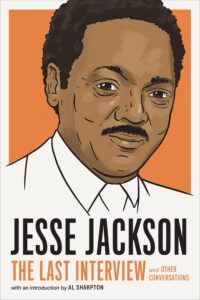
From Jesse Jackson: The Last Interview and Other Conversations. Introduction © 2026 by Al Sharpton. Published by Melville House Publishing.
