
By the end of the Middle Ages, a broadly accepted truth circulated across Europe: women had been seduced by Satan and were empowered to wield malevolent magic in his service. A large number of treatise writers began insisting that anyone who doubts the diabolical empowerment of women as witches is deluded and dangerous. Witches were described as allied with the devil, without doubt; in their dealings with him, they were imagined to wield all kinds of mischief and sorcery in his stead and on his behalf. Because of their alleged collaboration with Satan, these female witches were deemed worthy of death, even if they possessed no autonomous power of their own.
William Perkins, a prominent voice in late sixteenth‑century England’s witch-hunting fervor, argued that any miraculous power a witch or her objects appeared to have was merely borrowed from Satan. Much of Perkins’s writing simply catalogs the nature and force of Satan; the monstrosity of the wicked women of the sixteenth and seventeenth centuries is portrayed as borrowed, precarious, and attributable solely to the devil. Witches lack any intrinsic power. Again, this is Christianity working itself out in the portrayal of female monstrosity. The ancientPersisting entities such as Tiamat, Lamashtu, Lamia, the Furies, Medea, the Bacchae, Erichtho: these figures were all independently potent beings that belonged to themselves. Now, with the rise of the witch-era and its deadly counterpart—the witch-hunt—there were no longer any autonomous Monstrous Women, only vessels for the supervening will of Satan.
At the root of witch persecution was the notion that witches’ sexuality was the thing most to be feared about them, the thing most urgently to be tested, chastened, and destroyed.
As Jean Bodin argues in his enormously influential 1580 treatise, The Demon-Mania of Witches, “A witch is someone who knowingly tries to accomplish something by diabolical means.” All that was required was an agreement with Satan, granting her access to his power and the ability to employ it against the unsuspecting populace. Lamia-status had become something one could simply adopt, complete with its infant-fatal violences. Indeed, Bodin notes that one of the most common offenses of witches was to murder their own children before baptism. They were also infamous for killing the infants and children of other women, in order to drink their blood and devour their flesh. A witch is diabolical and evil, and must be slain, and yet she possesses no genuine power of her own, only accomplishing things through infernal intervention. Evil yet curiously powerless: a neat duality to invoke when seeking to wipe out a broad swath of humanity.
Once witch-fever gripped Europe in the sixteenth century, the state rapidly developed increasingly precise and brutal mechanisms for extracting confessions from accused women. The women under accusation were routinely stripped bare and shaved. Inquisitors sometimes used rape as a way to ascertain virginity—if she was proven to be a virgin, it could be held as proof of innocence; yet, once the act had occurred, it would become markedly harder for a woman to claim or maintain virginity, or to prove it. The accused endured grotesque tortures beyond this as well: being pierced with needles or seated on iron chairs heated by fires. The tortures were frequently overtly sexual, either explicitly or implicitly, because the central aim of witch persecution was the fear of female sexuality—the thing most pressing to be controlled, disciplined, and extinguished.
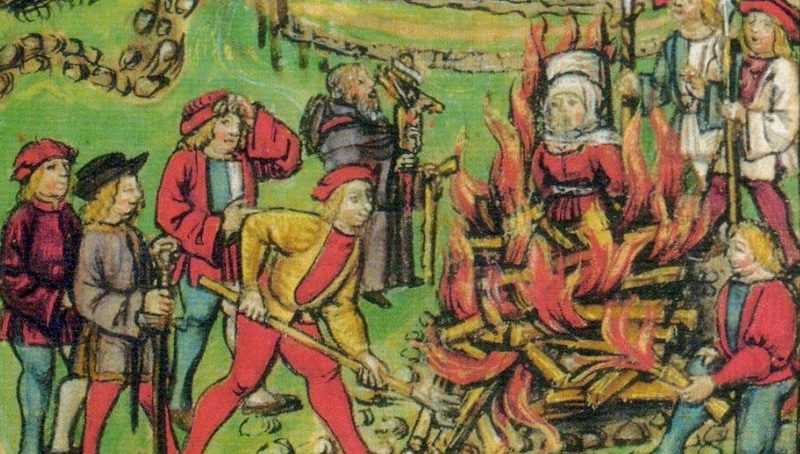
This appalling dehumanization did not stop with the accused alone. Witches were publicly burned at the stake, the explicit purpose being to deter other women from embodying the same “evil.” The daughters of those executed were sometimes forced to witness the pyre, being whipped by townspeople while their mothers perished in agony. Consider what that moment would feel like—their mother’s screams, the crowd’s jeers, the public humiliation—an experience so cruel it is almost unbearable to conceive. The daughter would almost certainly be left with a traumatic sense of exclusion from the community, obliged to distance herself from her mother’s memory—if not to declare, publicly, that her mother had indeed deserved such a fate. If the daughter refused, how could she survive the social and psychological upheaval of living among people who had violently punished her own mother? The likelihood was that she would be forced to declare that her mother had been guilty and deserved death, which would require her to accept a reality in which women could be tortured to death for being what they were. It is hard to imagine surviving such a psychic wound.
If we assume that the vast majority of executed witches were women of reproductive age or older, and that a substantial number of those executed had at least one daughter, we are looking at a scale of social trauma affecting countless young girls—and this is in addition to the immediate physical terror inflicted on the accused. Hundreds of thousands of young girls were likely compelled to decide that women—even their own mothers—deserved to be tortured in public for the sake of something as minor as an unruly expression of sexuality, or perhaps because neighbors’ miscarriages or stillbirths had occurred. The church and the state employed the public execution of suspected witches as a tool to spread fear and trauma among vulnerable girls at moments when they were most likely to lose their mothers. Witch fever, at this point in history, had become a means of brutally regulating and disciplining female conduct across generations.
Accusations of witchcraft have always centered on demonizing female reproductive power, because controlling reproduction is a way to regulate the patriarchal, linear transfer of property through generations. As Silvia Federici has argued, the systematic persecution of witches is deeply tied to the consolidation of private property in the same era.
If one surveys England in the sixteenth century and concentrates on regions where enclosed land—property taken into private hands by a single owner—predominated, one finds a strong correlation with witch prosecution. In contrast, in places where enclosure was less common, persecution was nearly absent. To dominate land, you must possess unquestioned knowledge of inheritance lines. No bastards in households, no sterile marriages, no promiscuous women. To seize control of land, you must control the wombs of women—or, at the very least, you must demonize and eradicate women who carry them, as well as those who would exercise reproductive agency in ways that patriarchy disapproves of.
Witch fever, by this point in history, had become a mechanism for brutally regulating and disciplining female behavior, and doing so intergenerationally.
The persecution of witches accelerated in step with the growing privatization of property in the sixteenth century. In fact, the earliest law making witchcraft punishable by death appeared in 1532: the Carolina, an imperial Spanish code. England followed suit somewhat later, but by 1604 a woman could be put to death for witchcraft in England even without solid evidence that she caused harm or damage. Scotland, the Netherlands, France, and Switzerland also made witchcraft a capital offense around 1550. Across the sixteenth and seventeenth centuries, hundreds of thousands of women were tried, tortured, and executed for witchcraft. A sizable portion of these women were midwives, or relied on midwives for service. Some were simply deemed too provocative, too loud, or too capable of unsettling male anxieties. Neighbors blamed miscarriages or stillbirths, or other misfortunes, on the alleged maleficence of witches.
Despite the raging hysteria of witch fever, there were counter-narratives, mostly in the form of treatises attempting to awaken European publics to the fact that women were not merely gateways for diabolic meddling. One of the best-known skeptical works of the sixteenth century was Reginald Scot’s Discoverie of Witchcraft (1584), which forcefully denies the existence of witches. Scot maintains that contract-making with the devil is a complete fiction. Witches, he asserts, do not exist and therefore cannot—or should not—be prosecuted for witchcraft. He even contends that those who persecute and prosecute witches are themselves corrupt, exploiting elderly, despondent, and superstitious people—chiefly women.
In particular, he notes that “many poor, olde women” are persecuted disproportionately, and without just cause. He calls the Malleus Maleficarum “fables” and Jean Bodin’s sixteenth‑century Demon-Mania “Bodin’s babbles.” He has read the same texts as others, yet he refuses to believe that the vilification of women as predatory, hypersexual, infant-killing, bloodsucking, loud-mouthed monsters is warranted. In his view, it is a fiction, and one that clashes with sincere Christian faith. For him, the devil simply does not possess such invincibly strong power. And women are not so easily lured away from virtue.
This treatise, The Discoverie of Witches, enjoyed widespread popularity in its era. In fact, it influenced some of the most significant seventeenth‑century writers on witches. Most notably, it left its mark on William Shakespeare, who read the Discoverie before composing his famous witch play, Macbeth in 1606. Yet, Macbeth stands as one of the least skeptical works about witches. Rather than challenging the idea of witchcraft, Shakespeare’s play assumes the existence of witches and portrays them as exploiting human frailty and vulnerability. To understand how witch fever spread through the remainder of the seventeenth century, it is instructive to move beyond the archival documents and into drama—a medium with uniquely wide, public reach during this era.
______________________________

From Monstrous Bitch: A History of Terrifying Women by Eleanor Johnson. Copyright © 2026. Available from Princeton University Press.
