
During the summer of 2021, as the grip of the Covid-19 crisis began to ease, my teenage son and I headed to Italy. The travel bans had just been eased a few days earlier, and the streets of Rome were nearly bereft of visitors. It felt wonderful.
We drifted through the city, pausing on the Spanish Steps as a gentle evening breeze cooled us, then made our way to the Trevi Fountain and tempting the luck by touching its waters. Dining was informal, seated at sidewalk-side tables tucked along aged thoroughfares, savoring bowls of pasta. On a blazing, sunlit afternoon, we joined the queue to the Colosseum and entered with ease. Our visit then took us to the Vatican, where we gazed upward at the Sistine Chapel’s ceiling with reverent attention.
I’d been to the Vatican before, but as we wandered through its halls, almost deserted, I felt as if I were encountering it anew. It shivered with wealth, the fount of salvation overflowing with material magnificence. No fur-trimmed robe was too lavish, and no dish too sumptuous, for the clergy of old. In that instant, strolling from chamber to chamber lined with marble, silk, and silver, all drawn from the toil of unlettered laborers in distant fields and from seaborne crafts, the motivations behind the Protestant Reformation became starkly evident to me. My son, who had studied social sciences that year, and I discussed topics such as the French Revolution, Karl Marx, and the perpetual struggle between those who hold power and those who are powerless, and how that conflict persists.
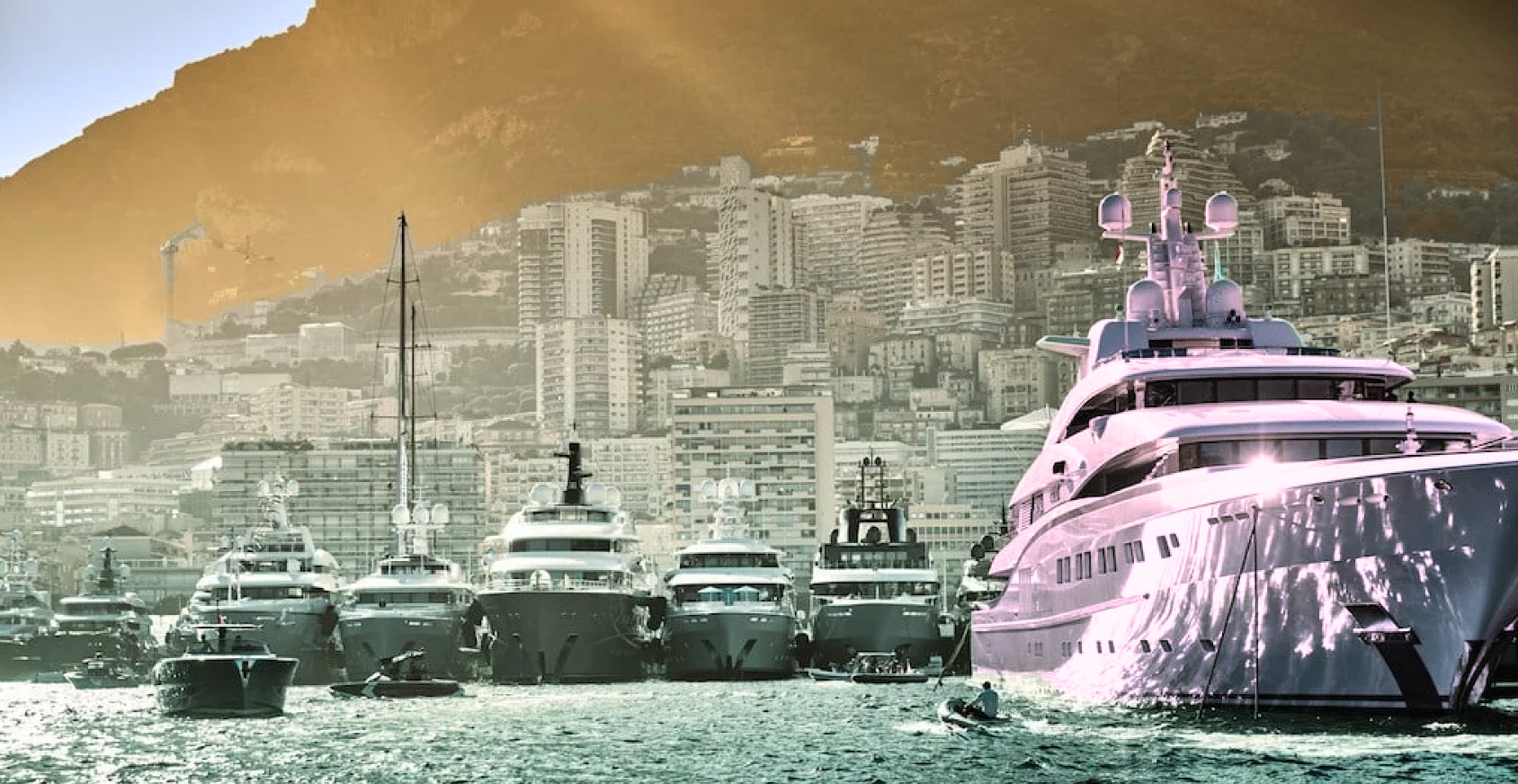
There, behind the casino in the harbor, were the superyachts.
Behind the harbor’s casino lay the superyachts.
We rented a compact Fiat 500, painted in a rich, verdant shade. It had two front seats and two small rear spots for baggage. Our route carried us from Rome to the Amalfi Coast, onward to Venice and the Dolomites. After some days among the peaks, we rolled down to Milan and enjoyed a brief Ferrari ride of about a quarter-hour. Our lodging varied from rural Airbnb dwellings to a kindly elderly woman who, noting that it was a father and son traveling, offered us complimentary lodging in her charming farmhouse.
Toward the trip’s end we reached Monaco. On the quay before a casino, we observed an elderly man, perhaps in his seventies, clad in a track suit, step stiffly from a gleaming Lamborghini beside a strikingly young blonde woman, almost his granddaughter in age.
Ten in the morning, the man flung his keys to a uniformed valet, the woman gripped his arm with a possessive familiarity, and the pair moved up toward the casino’s entrance.
Lean and tall yet with a noticeable potbelly beneath the track suit, he did not resemble a corporate titan. He seemed inconspicuous, giving off an air of indifference and fatigue, as though each day followed the same inert pattern with no clear purpose.
Behind the harbor’s casino lay the superyachts. Some rested at moorings within the sheltered marina, others drifted at anchor. The fleet mostly gleamed in white, ostentatious in the usual fashion, with tinted privacy glass, chrome railings, and many decks. A handful stood out as jarringly futuristic, like set pieces from a fantasy, almost surreal. The majority appeared uninhabited, as if winterized homes; yet a few bore signs of occupancy—crewmembers at the rails, tending to the hulls as though preparing to depart. I observed them for a while, pondering who they were, what they made of their labor, and from that reflections emerged the seed of my novel The Red Dress.
“Many books start this way, I suspect, with a single moment, and for me, this time, it was the image of a middle-aged man, in an officer’s uniform, casually spraying the deck of a superyacht with a hose. He became my narrator, an imaginary captain, a well-paid professional servant of empty extravagance. I named him Nick, after Nick Carraway in The Great Gatsby.”
Like many, I sought a respite from the pandemic that summer. I had served on the front lines of healthcare throughout the crisis, and Italy offered a much-needed break. As with other healthcare workers, I faced daily exposure to the virus, often with dangerously insufficient protective gear. An N95 mask is inexpensive—less than a coffee at a shop—yet the US government failed to supply them and refrained from compelling domestic production by firms, on grounds of cost. Consequently we wore disposable N95s for extended periods, keeping them in paper bags between uses as though they were meals, until the elastic bands wore out.
Patients understandably hesitated to seek care, and many shifts were unusually calm and silent. A physician assistant I worked alongside, a veteran of the Iraq War, compared the ER’s ambience to patrolling Baghdad when streets were empty and nerves on high alert. His description remains with me.
Never in my life have I felt more disposable, or more like a name on a schedule.
The ICUs were hushed as rows of patients dying on ventilators didn’t make noise. There is only the slow hiss and sigh of the machines, tucked safely out of sight, as social media filled with resistance to mask mandates, to empathy and authority, to the power of the state, and the chorus of anti-vaxxers grew. Meanwhile, the administration couldn’t distance itself far enough. It soon corrupted the CDC with propaganda, and abandoned the states, along with the hospitals within them, to make their plans alone. These years later, the origin of Covid-19 remains unclear, yet more Americans died of Covid-19 than in all of our wars combined.
The gloves of structural and institutional power came off fully during the pandemic, and one of its central lessons was that we were not, in fact, in it together. Under pressure, society did not unify before a collective threat. It fractured and divided. Non-essential workers—executives, administrators, management of all kinds—disappeared into Zoom en masse across the country.
But essential workers—in meatpacking plants, in hospitals, in nursing homes, in bus stations, in grocery stores, in Amazon sorting facilities, in restaurants cooking meals-to-go, on farms, and on fishing boats—kept right on working essentially unprotected. The many deaths among them and their families passed unrecognized, but if they spoke out in resistance, they were fired, and the message spread fast. If you want to keep food on the table, keep your mouth shut, go to work, and hope for the best.
Never in my life have I felt more disposable, or more like a name on a schedule. I, too, was an essential worker trapped in the amber of the machine, unable to truly speak my mind, and knowing it would change nothing if I did. I’ve understood this all along, but Covid-19 was a flashbulb anyway, illuminating our hierarchies and divisions in stark relief.
Medicine, of course, serves the sick and the injured. But it also increasingly serves corporate power, and the balance sheet, and at the height of the worst pandemic in a hundred years, when hospital beds in the state of New Mexico were in critically short supply, Lovelace Health System, part of a national for-profit corporation, closed an entire wing of their hospital and laid off dozens of nurses at the direction of faceless executives working from home. The State of New Mexico protested to no avail. The executives, for their part, were serving still more distant masters—shareholders, owners, and the CEO in his private jet.
John Updike once wrote: The essence of the superrich is absence. They like to demonstrate they can afford to be elsewhere. It’s a resonant line, and an accurate one. But it also occurred to me, contemplating the arthritic passage of what I presumed to be an oligarch up the brown stone steps of the casino with his temporary child bride, that the individuals themselves, whether polishing the rails or reclining in the master suite, are in an important sense similarly interchangeable and replaceable, serving larger forces that none of them fully understand.
We got on the plane and flew home. My name was on the schedule again, and school was about to begin.
Fiction at its best asks us to look closely, and to ask both ourselves and others real questions. If there is lightness and humor along the way, so much the better, but the purpose of literary fiction is ultimately serious. It asks us to consider our own lives and complicities, and to step beyond ourselves into other shoes. It seeks to explore the grey as much as the black and white, and the middle as much as the extremes of life. It reminds us that no amount of detachment, ironic or otherwise, will protect us in the end. Perhaps above all it asks us to see clearly, and challenges us to lead more examined lives.
These days, the headlines all point to difficult times ahead. The cacophony is loud, the opinions many, the forces great, and the collective threat real. Rarely has examination been more important. But so far, for most of us, the effects are insidious. They are atmospheric and implied, like storms in the distance, and the sense that rain is about to fall. Meanwhile, everyone keeps going to work with their heads down, and the ordinary days continue.
After leaving Monaco, we returned our elegant little car at the Rome airport very early in the morning and took the shuttlebus to the terminal. The terminal was crowded as overnight flights arrived: tourists were coming back. What first had been a trickle was now a flood, as the lines at the Colosseum quickly formed again.
We had been gone for three weeks, privileged travelers on vacation, exactly like the others in the morning crowd. But then it was over, and the real world asserted itself once more. We got on the plane and flew home. My name was on the schedule again, and school was about to begin.
A few weeks after arriving home, I began The Red Dress—a gesture, I suppose, an imperfect attempt, however small, to examine this time, when history is about to change. It’s the story of a flawed and solitary father’s love for his child, his desire to protect the promise of her future, and to gather what small forces of resistance he can against the faceless, inhuman, profoundly distorting powers of the coming world, where so little will be known with certainty, and nobody understands where we’re going.
__________________________________
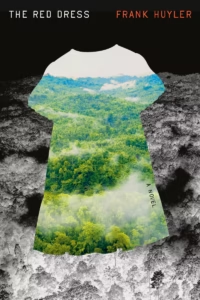
Frank Huyler’s The Red Dress is available from Bellevue Literary Press.
