
Southern California’s enduring sunshine seldom pierced the ground-floor cell of the Los Angeles county jail. On the sunniest days a damp hush would enshroud the adobe chamber and its inhabitants. And this day was among the bleakest. January 1856 brought icy air and a fresh group of inmates to the jail: women and children, now pressed close on the earthen floor of their prison home.
If they were fortunate, the jailer might provide a few spare blankets to chase away the chill and a handful of candles to light the hollow room. The judge’s pity for those imprisoned here offered little consolation to a group with scant trust in any legal authority. The oldest among them, a woman named Biddy, perhaps offered a word of reassurance now and then. After all, she had endured far worse in nearly four decades of bondage. Yet even for her, hope was hard to summon in that dim place.
These prisoners—all of them Black, most of them minors, including Biddy’s three daughters—were among the first inmates of what would become the nation’s largest prison system. They were not detained for breaking laws or facing charges. Rather, they were there to ignite a historic struggle for liberty.
It wasn’t bodily strength alone, or even primarily, that sustained Biddy and her family. It was her resilience, her courage, her kindness, her faith.
Biddy was no stranger to irony. Not only was she pursuing a freedom suit from a jail cell, she had spent the previous five years in bondage in California—a slave in a free state. She belonged to a man named Robert Smith, who had moved Biddy and her daughters to California in 1851. Although California’s 1849 constitution had technically abolished slavery, no power confronted Smith about his human property. He continued to profit from their labor on his ranch, in his household, and even while delivering his neighbor’s children. Smith’s Black workforce grew to fourteen people, making him the largest slaveholder anywhere on the Pacific Coast.
Only when Smith attempted to leave California with his caravan of enslaved workers in early 1856 did legal authorities finally intervene. Just before the wagon company’s planned departure for Texas, a sheriff’s posse halted them, detained the enslaved people, and ordered Smith to appear before the First District Court of Los Angeles. The district judge confined Biddy and most of the Black children in the county jail, ostensibly for their own protection from their unscrupulous enslaver. Thus began Biddy’s long winter nights in prison as she awaited her family’s fate.
Smith’s case rested on a pernicious fiction. He claimed to exercise “no greater control than his own children” over Biddy and the others. In truth, they had followed him “with their own consent.” Their migration to California, he insisted, was voluntary, as was the planned trip to Texas. His argument would have seemed farcical were it not for the fact that Black Americans were barred from testifying against white people in California’s courts and therefore unable to contradict Smith’s account. With the law on his side, Smith expected that Biddy and the others would be forced to accompany him once again—from the cusp of freedom into the maw of slavery.
*
To Smith, Biddy was merely a piece of property. But to those who knew her, she was a mother, a midwife, a migrant, and a survivor. In time she would become an entrepreneur, a philanthropist, a religious leader, a matriarch, and a city-builder.
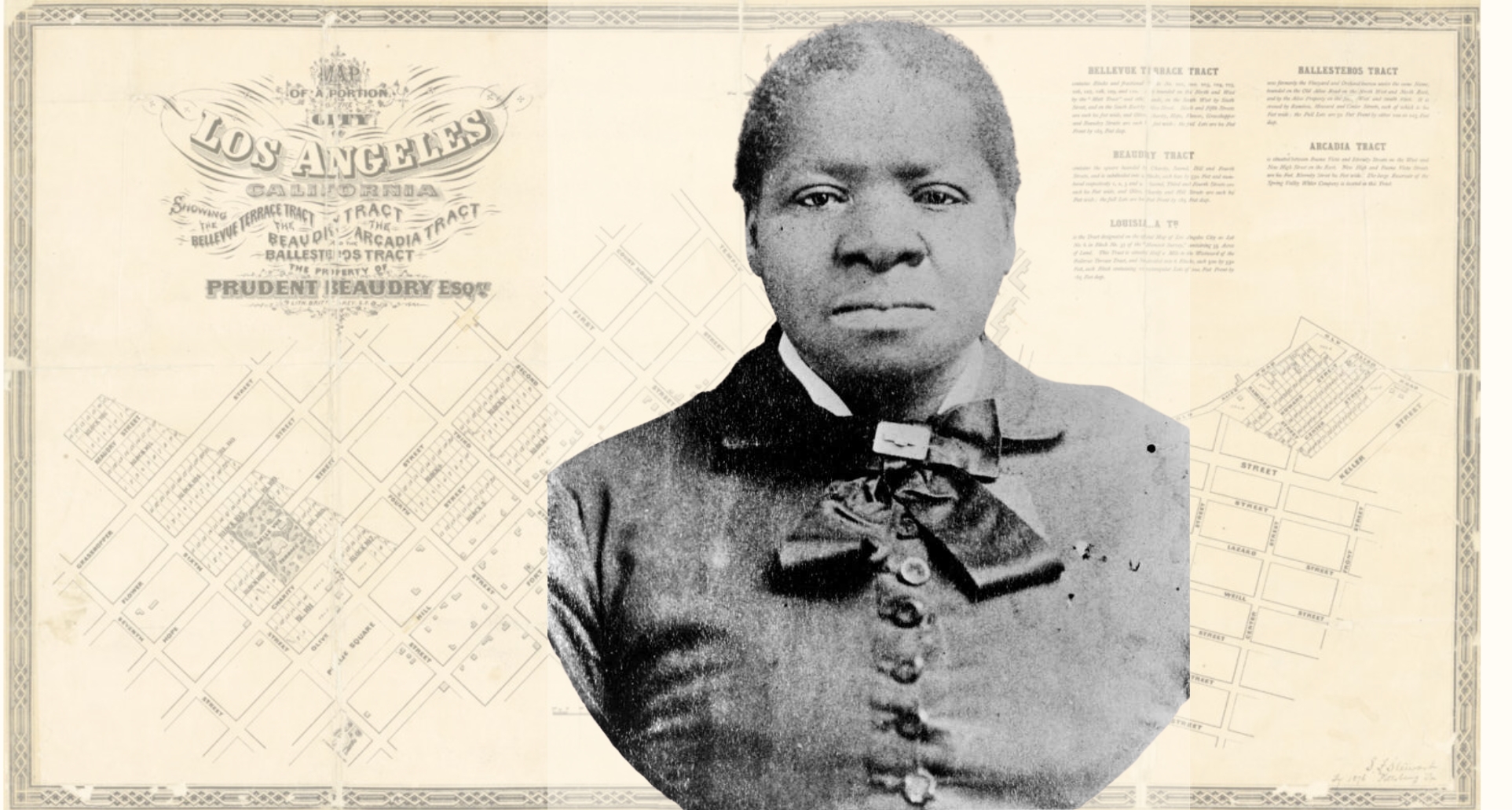
Biddy’s many roles are captured in her sole surviving photograph (as seen on the book’s cover). Taken roughly twenty years after her prison ordeal, the image reveals a still formidable figure, a woman unbroken by countless trials, staring straight into the camera. Even in her old age (by the standards of her era), she radiates a vitality that shines through the faded ambrotype. A prominent Black writer would later eulogize her as a woman of remarkable physical strength. Yet it wasn’t bodily prowess alone, or even primarily, that sustained Biddy and her family. It was her resilience, her courage, her kindness, her faith.
She would need all those qualities and more. The path that brought her to the Los Angeles courthouse wound through roughly three thousand miles of American terrain, from Georgia through Mississippi and Utah to California, marking one of the longest coerced migrations in U.S. history. Biddy traversed most of the journey on foot—the equivalent of about six million steps—driving livestock at the rear of her owner’s wagon train and pushing her way through a moving screen of dust raised by the caravan. Along the way she passed crude wooden crosses planted in the land, stark reminders that disease and disaster constantly stalked the route. Yet through it all, she managed to keep her family alive and intact.
Biddy’s tale does not conclude in a Los Angeles jail or along the route back to Texas bondage. In fact, those long nights in the county jail signaled the start of a new journey—a path that finally diverged from slavery. Robert Smith leveraged every advantage that his whiteness and wealth afforded him, yet he was ultimately outmaneuvered by the Black women whom he claimed as property. Their courtroom victory in January 1856 produced one of the largest emancipations in United States history, and certainly the most expansive anyplace west of Texas. Biddy, her three daughters, and ten other women and children were, as the California district judge stated, “free forever.”
There were no shortcuts to success on Biddy Mason’s long road. Her voyage was Odyssean in scale, a survival saga that spanned a continent.
But what would “freedom” really mean? Biddy’s new home proved unwelcoming, even perilous, for people of color. Antebellum Los Angeles had a well-honed reputation for violence and mob rule, with a murder rate fifty times higher than New York City. The Southern migrants who formed the majority of the city’s native population still treated those like Biddy as property, not people. When the Civil War reached the Pacific Coast, many of these Southerners rushed toward the Confederacy. And in the Reconstruction era that followed, they led a vehement anti-Black political backlash that drew praise from rebels and reactionaries across the country. Los Angeles, in many respects, stood as the western outpost of the rebel South.
Undeterred by these barriers, Biddy embarked on a patient, almost improbable ascent up the social ladder of her adopted city. She adopted the Mason surname and established a nursing practice that served residents citywide without regard to wealth, status, or race. The earnings from healing enabled her to invest in West Coast real estate. And the profits from real estate funded a wide array of philanthropic efforts that further aided Los Angeles. Even the volatile nineteenth-century economy of Los Angeles, swinging between booms and busts, did not derail Mason’s financial plans.
The land she developed in downtown Los Angeles formed a core part of what later became known as the “Wall Street of the West.” By 1890 she stood among the wealthiest Black women west of the Mississippi. Estimates put her net worth at as much as $100,000 (nearly $4 million in today’s money). That fortune would continue to flourish after Mason’s death, sowing the seeds for a Black family dynasty in Los Angeles.
Even more lasting than her wealth was her faith. To truly grasp Mason and her transformative influence requires an understanding of her Christian beliefs, which sustained her through slavery and continued to guide her in freedom. As soon as she could, she helped establish Los Angeles’s first Black church, and she funded many of the church’s early, uncertain activities. Today First African Methodist Episcopal Church of Los Angeles counts nearly twenty thousand members. Her faith also inspired decades of philanthropy, a broad “gospel of giving.”
At the core of her ethic was a radical conviction: all who were in need deserved care. Her charitable works extended far beyond her own community to Indigenous inmates, Chinese immigrants, and white laborers, along with countless other Angelenos. A biographer, writing many years after Mason’s death, observed, “The name of Biddy Mason is reverenced in the City of Los Angeles where her kindness to the poor is fresh in the minds of the public.”
Mason’s triumph was exceptional, but it did not occur in isolation. The Boundless Biddy Mason is at once the biography of an individual, of a community, and of a city in its infancy. The enslaved women and children who crowded into the county jail in January 1856 became the free people who reshaped Los Angeles in the decades that followed. They founded many of the first Black institutions in Southern California and formed the residential core of the city’s enduring African American community. Los Angeles would become a beacon for Black refugees escaping Jim Crow in the South, who sought the opportunities Mason and her neighbors had made possible. By the early twentieth century, LA boasted the highest rate of Black homeownership of any major city in the nation.
There were no shortcuts to success on Biddy Mason’s long road. Her journey was Odyssean in scope, a survival story on a continental scale. From Georgia to California. From slavery to freedom. From poverty to fortune. From dislocation to belonging.
______________________________
From The Boundless Biddy Mason: An Odyssey from Slavery to Freedom Across the American West by Kevin Waite. Copyright © 2026. Available from University of California Press.
