
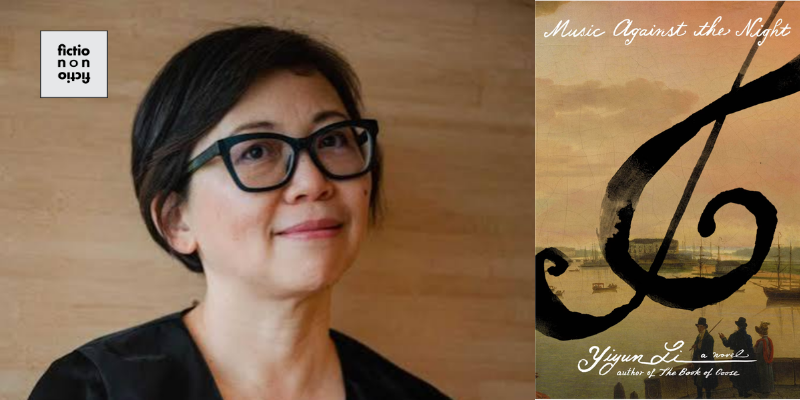
Acclaimed author Yiyun Li returns to the program to discuss her forthcoming novel, Music Against the Night, joined by co-hosts V.V. Ganeshananthan and Whitney Terrell. Li details how the idea of fictionalizing the lives of the married musicians John Field and Adelaide Percheron first captivated her, and she reflects on the boundaries, obstacles, and possibilities that arise when researching history for fiction. She explores the influence of grandparents on her characters, and how elder mentors can mold an artist’s personal and professional development. Li also explains how she arranged two expansive life stories within a single book, and how her protagonists reveal the inequalities in opportunity that can exist among equally gifted peers. She contemplates how her characters define notions of failure and success, and how those definitions steer John and Adelaide, neither of whom attain enduring fame. The episode features a reading from Music Against the Night.
To hear the full episode, subscribe through iTunes, Google Play, Stitcher, Spotify, or your preferred podcast app (be sure to include the slashes when searching). You can also listen by streaming from the player below. Video versions of our interviews are available on the Fiction/Non/Fiction Instagram account, the Fiction/Non/Fiction YouTube Channel, and our show website: https://www.fnfpodcast.net/ This podcast is produced by V.V. Ganeshananthan, Whitney Terrell, Emily Farris, and Sydney Perkins.
Yiyun Li
Music Against the Night • Encountering the Past in “Music Against the Night” | The New Yorker • Things in Nature Merely Grow • The Book of Goose • Wednesday’s Child • Must I Go • Where Reasons End • Kinder Than Solitude • Gold Boy, Emerald Girl • The Vagrants • A Thousand Years of Good Prayers • Dear Friend, from My Life I Write to You in Your Life
Others
A Life and Times: Fryderyk Chopin | Dr Alan Walker • A Confession and Other Religious Writings | Leo Tolstoy • Fiction/Non/Fiction Season 5, Episode 42: Yiyun Li on Complicated Friendships Real and Imagined
EXCERPT FROM A CONVERSATION WITH YIYUN LI
V. V. Ganeshananthan: Regarding the research you’ve done, John Field is a real figure. Adelaide Percheron, also known as Percherette, is real too. What drew you toward these historical personalities? Tolstoy was one touchstone for you. When did you decide these were the people you wanted to write about?
Yiyun Li: I spent quite a bit of time reflecting on how this came to be. I first encountered John Field through Tolstoy’s autobiography; Field served as the music master to Tolstoy’s mother. While reading the biography, I came across John Field under an Anglicized name I hadn’t known. Field isn’t well known outside of Ireland, so I did some digging and read a slim biography, much of which consisted of musical scores. What struck me was that Percherette, in the biography, appears only a few times—perhaps no more than five passages. She is an important artist, yet she’s barely mentioned. That gap suggested to me that Percherette could anchor a novel. The idea that John Field and Percherette might make for a compelling pair of protagonists was the seed. And since one volume wouldn’t suffice to hold it all, we thought, why not three novels?
Whitney Terrell: So you’ve decided on that plan. Has work already begun on the other books?
YL: Yes, I’m midway through the second novel. In this first book we glimpse their marriage briefly and we witness their deaths, but the bulk of the narrative centers on their childhood and youth. It follows a very traditional arc: childhood, youth, adulthood. So I borrowed that structure and conceived three novels—childhood, youth, adulthood, culminating in death.
WT: This novel mostly follows their youths running parallel before their meeting. Do you see it as part of a larger project?
YL: Precisely. The focus is on their upbringing and their evolution into musicians, before their marriage and artistic pursuits truly begin. The book is about how they become themselves.
WT: There’s considerably more information available about John Field than about Adelaide. How did you uncover details about her?
YL: There isn’t much to find about her. Everything about Percherette exists in my imagination.
WT: That’s the best part, isn’t it?
YL: It’s all invented for this person. It’s quite striking. In Field’s biography there’s only one line describing her as a “flirtatious young woman.” A contemporary observer quips that if you place a top hat on a stick, that’s enough to provoke flirtation in this girl. It struck me as a vivid portrait of a young woman. But for me, it’s simply because there isn’t any other information. Imagining the arc of her life—from Pondicherry to Moscow—feels like an epic novel in itself. Percherette’s counterparts resemble the Austen heroines who inhabit their own world, seldom venturing beyond it. They travel for occasional visits, perhaps to Bath or London, within a familiar social universe. Percherette’s reality, by contrast, is expansive and foreign to most women of her era, and that breadth feels sufficient to sustain a novel.
VVG: When you think about research—and correct me if I’m mistaken—you’ve spoken about calibrating it so it doesn’t overwhelm the narrative. Research can be time-consuming. I’ve even heard a student quote you as saying something like, “If you want to write three novels about the piano, you have to learn the piano.” This book reads as if it’s steeped in precise musical knowledge, down to the way a hand might favor a particular finger. So you studied piano for three years, but you didn’t undertake a literal, century-spanning journey from Pondicherry to Moscow. Where do you draw the line?
YL: That’s a fair question, and I’m fairly sure your students heard me incorrectly. I’m fairly certain I was echoing something Edward P. Jones once said. He described his approach to The Known World: he checked out a lot of sources but ended up not reading most of them because he trusted that his mind could retain the essential details. He warned against getting the history wrong in even a small way; if that happened, readers would call you out. He suggested that sometimes it’s better to invent the specifics. I might have quoted him.
WT: I’ve heard him express that idea as well.
YL: I do a substantial amount of research, but learning to play piano is itself a substantial commitment. Where to draw the line? Even if I visited Pondicherry today, I wouldn’t see Pondicherry as it appeared to Percherette. Travel has changed; we fly now instead of voyage by sea. I find it helpful to read travelogues written by Percherette’s contemporaries—English travelers who journeyed from England to India around 1800–1801—to glimpse events through local eyes of the period. When I research, I don’t typically read later analyses by contemporaries, since those are already distilled. I seek obscure, little-read sources. For example, one musician boasts about tuning more bells in his church than anyone else; you read those fragments to glimpse how music mattered to people of that era. That’s my method. And yes, I do a great deal of digging to ensure accuracy and fill in gaps where possible.
Transcribed by Otter.ai. Condensed and edited by Emily Farris. Photograph of Yiyun Li by Hannah Yoon.
