
Chances are we already possess the century’s definitive artist film in Ira Sachs’s Peter Hujar’s Day. This idiosyncratic biopic makes astute choices, capturing the day-to-day texture of a working life in a fleeting moment, with its gossip, financial anxieties, and ongoing projects that either fade, crest, or inch forward. Hujar is uncertain about what lies ahead, curious about where his talent and ambitions might lead, embedded in a community that may or may not support his path.
The future presses in because the audience understands what the film’s present characters do not: that the friends and peers we hear about will soon be devastated by AIDS; that Hujar’s standing will accumulate over decades; and that his photographs will open new dimensions once time has shaped them into a document of a city and sensibility that our moment of intense gentrification, stark economic disparity, and anti-immigrant state power cannot easily imagine. Yet the movie manages to convey all of this, astonishingly, within the fading glow of Linda Rosenkrantz’s apartment, where a tape recorder preserves nuances that matter immensely to the sensitive pair. Creative effort, in the span of a few hours, reveals its many faces—ardent and alluring, transient and playful, stubborn and luminous.
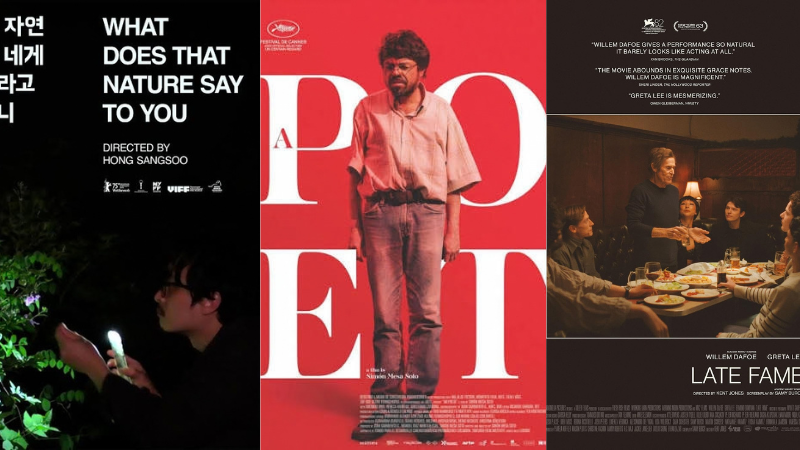
Anticipating perhaps a letdown, I approached three recent films about poets with a mixture of eagerness and caution: What Does That Nature Say to You, A Poet, and Late Fame. I wondered what this sudden surge of attention might signify and what each story would get right or miss entirely. The world’s cynicism still astonishes, as who would have imagined the enthusiasm with which we’re urged to discard writing and declare it obsolete. Poets and their works provide convenient foil for testing whether resistance to this current is worthwhile. Yet movies rely on familiar structures, so the protagonists—almost exclusively male—seek connection. Along the way, they recite their poems, none of which are truly extraordinary. Alcohol flows, rivalries intensify, and humiliations accumulate—a handful become transformative, while others vanish like a remedy that never really works. The sequence in which I watched the films drew progressively closer to my own life.
New York’s public life, in this particular season, is sterile and uncompelling, while the streets of its past are so freighted with nostalgia they can feel exhausted and wrung dry.
The first of the trio is Hong Sangsoo’s What Does That Nature Say to You, a South Korean director whose film opens inside a car parked at the foot of a driveway. Donghwa (Ha Seongguk) drops off his girlfriend, Kim Junhee (Kang Soyi). After three years together, he grows curious about her family and the country home she’s described, and he asks if he might join them inside for a visit. She agrees, albeit reluctantly, and they are promptly greeted by her father. He admires Donghwa’s vintage car and proceeds to escort him to admire the hillside gardens he’s created as a labor of love to please his late mother, whose death he mourns through these living sculptures.
Donghwa is a poet. At thirty-five, he earns a modest living filming weddings, though his father—the family’s lawyer—is wealthy and well known by Junhee’s relatives. The mother and sister seem welcoming and invite him further in. Notably, the mother is also a poet, with her verses framed and hung on the walls. Donghwa, deferential and earnest, praises her lines. The family quizzes him, initially with courtesy, about his vocation, poetry, his father, and, with mounting pressure, whether owning and driving such a venerable car is wise. Donghwa mostly deflects, though over the course of the day he makes no secret of his ascetic beliefs and his deep affection for nature and the mind’s life.
By dinner, the drinks flow—soju and whiskey—and the mood hardens. Junhee’s sister confronts Donghwa about the folly of refusing his father’s money. Urged to recite a poem, he offers a brief piece that lands poorly. Finally, sloshed beyond reason, the young writer erupts in fury and then collapses. The parents retreat to a small outbuilding on their hillside to lash him again. What’s maddening is that they are themselves nearly artists, and the rift between the expression they feel entitled to and what they can tolerate in the younger generation resonates in culturally specific ways while also feeling universally recognizable. The next morning, Donghwa and Junhee exchange pledges they probably won’t keep; he drives off, and the closing shot finds him broken down along the roadside, calling for roadside assistance.
Does the film, by casting the poet as a stranded figure, validate the family’s pragmatic yet vain worldview? Or is this another trial meant to test Donghwa’s idealism and resilience, the price of gazing at trees and sky in a heightened state? We aren’t sure whether he’s a serious talent, or whether he’s truly prepared to persevere and, if so, in what milieu his poems might circulate. Earlier, before the disastrous dinner, he had accompanied Junhee and her sister to a site with stone pagodas erected for the departed. He notes that while the honorees’ names fade, the statues endure, inviting visitors to contemplate their presence.
If the film functions as a parable about art, it remains a time-honored yet solitary one. I thought of Proust’s reverie about a nameless stone carver who left an enduring mark at Chartres cathedral. Donghwa’s sincere preference for form over individuality at least reassures us that he isn’t the pretentious impostor the family suspects him of being. Hong may sense that he himself is perceived in the same light by a public perhaps skeptical or irritated by his unwavering commitment to a craft that seems stubbornly isolated from the spectacle favored by the industry.
A Poet (Un Poeta), the second feature from Colombian filmmaker Simón Mesa Soto, presents another idealist, yet one who embodies the notion that such a stance is not only fragile but also a mask for myopia and fear. Oscar Restrepo (Ubeimar Rios) is middle aged, living with his mother. He occasionally drinks to the point of collapse, reciting lines by his idol José Asunción Silva to the nocturnal streets of Medellín. Invited to speak at the literary center where he hangs out, he attempts a talk on the suffering of poets but is prompted by the director to simply read his own work. Oscar’s latest volume won a prize long ago, and now he confronts inertia as his sister and her husband urge him to find a job as a high school philosophy teacher. His daughter, estranged, regards him as a disappointment.
Oscar is intense and peculiar, and at first his class warms to him. One student, Yurlady (Rebeca Andrade), writes verse, and Oscar glimpses something in her. We hear a few of her poems, and they’re modest but luminous, reminiscent of the way a young Adam Driver’s character in Paterson is portrayed—though the comparison to Whitman or Williams is a stretch. It takes some persuading, but Oscar convinces Yurlady to enroll in a creative writing workshop at the center. There she encounters Oscar’s rival Efrain, a poet who has become a successful novelist, whom Oscar views as a sellout. In fact, Efrain pushes Yurlady to write more about her impoverished upbringing and her racial identity, so that the center’s wealthy, white benefactors will be satisfied with what they demand. She agrees, performs at the gala, becomes overwhelmed, and passes out. Oscar drives her home, and, paralyzed by the circumstances, leaves her at her family’s doorstep, unconscious.
The poets don’t need the movies as much as the movies need characters who still have something unruly to lay on the line.
The family suspects that Yurlady has been assaulted by her mentor and accuses both Oscar and the center. A scene in which the center’s director and the novelist visit the family, attempting to minimize concerns and placate themselves, unfolds like a documentary sketch. The rest of the narrative revolves around Oscar trying to repair his relationship with his daughter, who starts to mend fences until she learns of the accusations against him. Yurlady ultimately becomes the mediator, writing to the daughter that her father is decent and did not harm her. The plot twist and its upbeat ending may be necessary for the screenplay’s arc. The film implies that poetry recedes behind the urgency of personal growth, or, within the film’s own logic, that art itself hardly matters and serves mainly as a pretext for people who avoid responsibility.
Ed Saxberger (Willem Dafoe), the hero of Late Fame, has already made peace with all that. He matured in parallel with the poets whose faces appear in the opening shots of the film: Ted Berrigan, Anne Waldman, Bernadette Mayer. Then he stopped writing and took a job at the post office for forty years. After his shift, he drinks and shoots pool with his working-class friends. One night, a recent college graduate named Meyers shows up, a devoted admirer, and persuades Saxberger to join a late-night gathering of young aesthetes. They are exhilarated by the prospect of rediscovering him and seek to borrow his gravitas for their own uplift.
They’re faintly ridiculous. They declaim against the stifling effects of technology, all the while sneaking glances at their phones. They praise the poet’s life, yet Meyers’s own life reveals a conspicuously lavish loft funded by his wealthy parents. He can and does apologize for it, which makes the situation more discomforting. Saxberger finally commits when Gloria (Greta Lee), the group’s self-proclaimed muse, arrives to flatter him. He grows eager to be part of the project, and the prospect of reigniting his reputation makes him wince as his ego inflates. The ensemble schedules their debut reading, and Meyers insists that Saxberger supply a new poem. To spark his own imagination, he plays back recordings of poets he admires—Williams, HD, Snyder, and Schuyler. If nothing else, the film at least gives us the pleasure of hearing Schuyler, with a rough rasp on tape, reciting “Salute” in a 2026 cinema. “Past is past, and if one remembers what one meant to do and never did, is not to have thought to do enough…”
Saxberger cannot conjure a new composition. Visual storytelling tends to favor painting and photography, and even accomplished filmmakers have chased the image of a writer in motion. Yet Kent Jones, the director, is another artist who seems terrified by the image of a passive writer at a desk, so he crafts a frenetic, rambling tour of Greenwich Village, punctuated by a voiceover that has Saxberger murmuring the same line repeatedly: “seasons collide.” The intention of collision or collage might have served as a legitimate poetics for the character, but the opposite occurs for him and for us: New York’s public sphere in this moment feels dull, while the nostalgia for the city’s past can feel drained and exhausted.
In the end, everything collapses quickly: Gloria withdraws, the poetry reading remains largely a farce. Yet in the midst of the fiasco, Saxberger reads not a new piece but a poem from his long-lost volume. It’s markedly better than anything else we hear, yet it doesn’t reach the level of his own models either. What it is, is a “New York School” poem, one that names real people and situates them in a precise place and time. That approach is sometimes seen as antiquated—I won’t pretend I understand why, because people keep doing it, and it’s consistently humanizing—yet its quiet power is revealed in that moment, as the poem transports Saxberger back to the authentic past of its creation, and he smiles, finally finding the meaningful circle he didn’t know he was seeking, not in fame but in art.
So close. The references are impeccable. But while I can’t speak to Seoul or Medellín, I know most poets don’t live in such a way in New York—exiled from a crystallized peak of past genius, as romantic or revolutionary as that may have once seemed (Peter Hujar’s Day treated it as both radiant and ordinary). The poetry scene in the city is diverse and energetic, with cohorts reading, listening, and publishing among themselves. They protest, celebrate, and parent together, while debating aesthetics, identity, ideology, and class. Many are serious scholars, tracing lines that academia often neglect, pursuing lineage and legacy—it’s unlikely there would be a Saxberger who had never encountered someone like Eileen Myles or Anne Waldman reading at the Poetry Project on New Year’s Day. Late Fame faithfully adapts the late-19th-century Austrian novella by Arthur Schnitzler, which itself has seen a recent revival, but the transfer to the present only takes the project so far. If the film acknowledged that Anselm Berrigan or erica kaufman or Simone White might appear at any moment, the plot would instantly collapse.
Is the gaze on poets nostalgic, or a little cruel, a reflection on people who can barely monetize their art yet carry a stubborn insistence on something larger than profit? The last generation of artists who wrestle with money, who carry a keen, practical concern for old books and what they hold, who perhaps embody the directors’ own discontent with the road of devotion and the specter of artistic failure, seems doomed to be treated roughly. The nuances of their world and the conversations within it may resist full filmic capture, or at least resist it in any definitive way. And yet that may be precisely where the poets’ truth lies: the films don’t need them as much as the poets still need figures who have stubborn, unruly truths to speak into the world.
______________________________
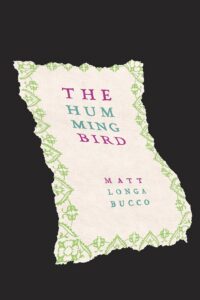
The Hummingbird by Matt Longabucco is available from Nightboat Books.
