
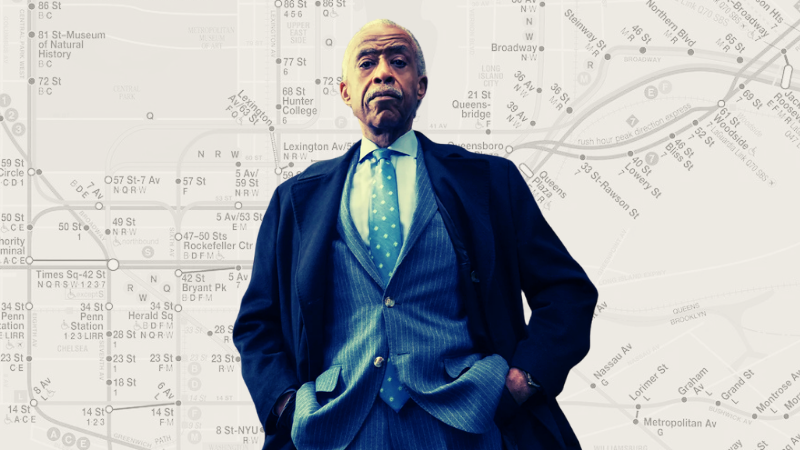
The Reverend Al Sharpton was in the heart of downtown when a text arrived. One of his staffers at the National Action Network shared a link about a story making the rounds online. A young Black man had died from a chokehold on a subway car. Sharpton picked up the phone that day and rang his Harlem headquarters, instructing Malcolm Byrd, his lieutenant within the organization, to verify the report and, if it proved true, to learn more about the family and to convey Sharpton’s outrage to them. He urged: call the precinct. Call the district attorney, a longtime ally in a city full of allies. Make it known to everyone involved: whatever the Reverend could do, he would.
For Jordan Neely’s family, receiving a call from the Reverend Al Sharpton’s circle carried great significance. It raised the hope that Jordan’s death might transform into something meaningful, something that could be printed on a million T‑shirts and signs, something more than a private tragedy—a lasting symbol. The family was grateful, yet also stunned into silence by the moment.
A few days later, Sharpton’s team got a call from a lawyer named Lennon Edwards. He represented relatives of Neely. In a city built on networks, Edwards happened to be related to someone connected to one of the Reverend’s television ventures—the Reverend operating, as he did, across cable news, social media, the pulpit, the streets, backchannel advising, and the conference circuit. Sharpton recalled that he had watched Edwards’ show for years, going back to the days when the urban vigilante Bernhard Goetz shot four Black men in a subway car in 1984 and claimed they were attempting to rob him. Sharpton remembered offering Edwards and his law partner, Donte Mills, some guidance.
Again and again, Black people were dehumanized. Again and again, their dehumanization was inverted and recast as a story of the threat of disorder that they posed.
The media was poised to frame a narrative of Neely as someone having a mental breakdown, as threatening, as dangerous, as an animal. These labels would come to define him. The Reverend told the lawyers that if they wanted a real shot at justice, they had to prevent that narrative from becoming permanent. If you lose the narrative, you lose the chance for justice. The Reverend understood the playbook as well as he understood the sermons he never wrote down. It had played out in the era of slavery with fears of revolts; in Jim Crow with anxieties about Black men threatening white women; and in the 1990s’ panic about young “superpredators” prowling America’s urban wastelands. Time and again, Black people were dehumanized. Time and again, that dehumanization was inverted and recast as a story about the threat of disorder that they supposedly posed. And the ensuing fear of disorder was then exploited to justify still more dehumanization. Neely’s death risked becoming part of that rewrite.
Sharpton spoke with one of Jordan’s cousins, who explained that the start of the pursuit for justice for Jordan, whatever it entailed, was complicated by the family’s own divisions. Jordan and his father had had their share of disputes. People within the family held different viewpoints on the matter.
Sharpton tried to soothe that unease. “Hold on a moment, let me explain something to you,” he recalled saying. “I’ve never fought for a case that had a Norman Rockwell, Mayberry‑suburban family in it. If you want to talk about a dysfunctional family, I come from one: my father ran a corner store, moved to Queens, built a decent middle‑class home, and fathered a child with my stepsister. My mother and sister and I later found ourselves in the projects. For the first decade of my life I lived as a middle‑class Black kid in Queens, then I became a person in the projects on welfare, so I know both sides.”
“Your father knocked up your sister?” the cousin asked, as if the family drama weren’t inescapably relevant to the present case.
The point wasn’t the family’s internal coherence or chaos. What mattered was that this guy Penny had cornered Neely from behind and killed him. The Reverend didn’t know whether Penny was a white supremacist, but he did know this wasn’t self‑defense. It was vigilantism, pure and simple. And it needed to be addressed.
The Rev liked to think that, despite his nearly seventy years on the planet, he didn’t really belong to what he called “that old model, the old civil rights, Black church model.”
The Reverend spoke again with the lawyers. He didn’t want them to think that his involvement meant bringing along heavyweight attorneys who would overshadow them. He recalled telling Edwards and Mills that he never recommended lawyers. They might have seen him alongside a legal giant like Ben Crump on television, but that was because Crump called the Reverend, not the other way around. The lawyers’ positions remained secure. They could trust him. They could conduct business together—the business of justice.
In fact, the Rev said, they should come on his show. He’d hosted MSNBC for twelve years. People hadn’t expected him to endure beyond a few weeks. To some, it might have seemed like a departure from his spiritual and activist duties. But he liked to say that he went on television, wearing those three‑piece suits with his initials monogrammed on his tie, to continue what he was doing—not to stop doing it. It was all part of his multi‑platform campaign for justice. He could take a call from Neely’s family; give them advance notice of what the media might throw at them; speak on their behalf if asked; bring them on his TV program to promote their pursuit of justice; rally people into the streets if needed; broker private mediation among family members; prod officials who happened to be his friends about how to speak about the case or what actions to take. He could Rev it all up.
Sharpton’s horizontally integrated machinery for seeking justice could be formidable. Yet he recognized that a younger generation of activists, like Hawk Newsome, was growing impatient with the circles of influence he enjoyed and with the traditional, patient path to change. They were restless and angry, ready to abandon the preacher’s passivity and the timeworn ways of seeking freedom, skeptical of established blueprints for change, and tired of asking for progress. The Reverend hoped that, even at nearly seventy, he hadn’t fully detached himself from what he described as “that old model, the old civil rights, Black church model.” He sometimes claimed he descended from the James Brown tradition rather than the Martin Luther King Jr. tradition. “I come out of the urban swagger movement,” he would say. “Martin Luther King would’ve never worn my hairstyle or walked the way I do.”
Still, it was increasingly uncertain whether such self‑designations and Sharpton’s mix of insider and outsider activism would appease the Hawks, or whether the country’s fatigue with stasis would push people toward fresh strategies—often involving taking action into their own hands.
Nevertheless, the Reverend’s power, platforms, and networks still proved useful, as when the funeral issue arose. Sharpton warned the family that opportunists would appear—people who can’t even spell Jordan’s name who would start GoFundMe pages. He recalled telling Jordan’s cousin: “Whatever the funeral costs, tell me, and we’ll try to cover it.” The cousin was grateful, but Sharpton understood that the family did not actually need financial assistance.
But then Jordan’s father, Andre Zachery, called. He thanked the Reverend for getting involved. Sharpton agreed to deliver the eulogy. It would be an opportunity to shape the right narrative. Better that he frame the story than someone like Hawk Newsome—or the church old‑guard. They needed a venue. Jordan’s mother, who had been killed by her partner and stuffed into a duffel bag, had been laid to rest at Mount Neboh Baptist Church in Harlem. The senior pastor there, Johnnie Green, was a friend of the Reverend, and a member of the board of the Reverend’s National Action Network. He would host the funeral.
It crossed the Reverend’s mind that the last time Jordan had seen his mother might have been in the casket at the very church where his own casket would soon lie.
Shortly before the funeral, a snag emerged. The family was having trouble accessing the funds in the GoFundMe account, and the funeral director wanted payment.
The Rev felt that Neely could well become the George Floyd of the crisis of mental health, the George Floyd of the crisis of homelessness, the George Floyd of urban white vigilantism. But the case needed to be shaped, conveyed.
“We’ll pay it,” the Rev told a representative of the family. “Y’all don’t even have to pay us back. That’s what we do.” He noted that his involvement in a case tended to make it harder for certain politicians to demonize the dead. Mayor Adams had already said some highly questionable things about Jordan, about whether people like
The death of George Floyd didn’t become The Murder of George Floyd by itself. It took shaping. It took strategy. It took having friends. It took a family that could come together in spite of all the forces unleashed by tragedy that made unity so difficult. It took a carefully waged, two-pronged case that indicted the accused but also indicted a whole community for enabling the act—without absolving the actor.
The Rev felt that Neely could well become the George Floyd of the crisis of mental health, the George Floyd of the crisis of homelessness, the George Floyd of urban white vigilantism. But the case needed to be shaped, conveyed. It needed the Rev.
Not long after Neely’s death, Sharpton ruminated on his inside-outside strategy of nudging and chastising his friends, pulling and pushing them. “Many people felt that because of my relationships, I wouldn’t say anything,” he said. “And I decided that I’m not only going to say something, I was going out front. And I didn’t have to get in line.”
Speaking of Mayor Adams, he said: “I say it all the time to Eric’s staff, that Eric has got to show not only a new generation but a new direction. I’m not condemning them as of yet, let me be clear, but I am saying that Neely is going to be a real point of where he will be graded not only by the Black community but by the city. And the same thing with Alvin Bragg.”
“Yes, we have a new generation,” he went on. “Eric and I are in the same generation—he may be a few years younger than me—but Alvin’s younger than both of us. The question is, Do we have a new direction? We didn’t fight and go to jail and do the stuff we did when we were young,” the Rev said, “just to put some Blacks in high places.”
He had not judged Alvin Bragg as of yet, but he was going to be watching closely. He had not called him, even though he was a friend, because he did not want to compromise any case that might be brought. He would call later on if needed.
The office from which the Rev was speaking was at Fortieth Street and Seventh Avenue. Every day, as he walked from car to office and office to car, he saw people in great need: without homes, boxing demons, untended. Lately, in every one of them, he saw Neely.
__________________________________

From Man in the Mirror: Hope, Struggle, and Belonging in an American City. Used with the publisher’s permission, Knopf. Copyright © 2026 by Anand Giridharadas
