
My career as a writer—and life writ large—took a dramatic turn when I received a contract to write My Two Italies in 2011, my first book for general readers and a swerve from the more academic work I had done till then. I was initially planning to a write a cultural history of Italy, culminating in the turbulent Berlusconi era. Neither I nor my editor was sure exactly what form the book would take: the contract even listed the work as untitled. I had reams of material on Italy that I had gathered as a student, scholar, and teacher. But I was missing the engine that could move along this bulk of information. So I struggled. Weeks, months passed, and still I had no book, no narrative center. Then one day I went to the Bard library, punching the metaphysical clock once again for work on this unborn book, and as so often happens to me when I am in a comfortable space surrounded by books…I fell asleep. And dreamed.
I dreamt I was back in my childhood home, bursting into the house after a day at school, hoping for a buttered slab of my mother’s freshly baked bread or warm, crispy wine biscuits. Instead, a scent wafted up from the downstairs oven and rooted me in place, turning my appetite to nausea. She was making tripe. In two large black cauldrons, my mom was boiling cow stomach. Somehow, the dreadful aroma became a wakeup call, reminding me that I shouldn’t try to “write” this book; I should simply remember it, let the stories of my childhood narrate themselves and spill across the page. You could say that I smelled the sources for the book as much as I remembered them. The taste of a tiny madeleine in Proust’s In Search of Lost Time famously unleashes a flood of memory for the narrator; for me, the Prime Mover had been the humble tripe. To this day, I can’t pass a Tuscan tripe stand without wrinkling my nose and feeling a surge of literary gratitude.
In the suspended space of her stories, my mom ceased being the one thing that had defined her life since age seventeen and her first child: a mother.
My manuscript now possessed a center of gravity: I would reproduce the smells, sounds, and stories of my childhood, a nexus between Italy’s ancient culture, the ambitions of the American Dream, and a large family navigating Calabrian lore amid the secular freedoms of a self-focused consumer society. All I had to do was close my eyes and remember, just as that day in Bard’s Stevenson Library. But as every writer knows, a book cannot be written in isolation. Whether it’s a steadfast editor who inhabits your prose as deeply as you do, or a loving partner who keeps the children from shouting outside your study, you need a miniature village to sustain your work. I had more than enough material, and after that library epiphany I finally had a plan. What I needed was a muse.
This muse would not arise from some elusive ideal of youthful beauty like Dante’s Beatrice or Petrarch’s Laura, but from the nurturing presence of my eighty-something mother, Yolanda Luzzi, who had wrapped herself in mourning black for years after my father’s death in 1995. Now that I could smell the past, I needed to hear its voice. My mother provided that voice, not merely narrating events but performing them, animating what otherwise would have stayed as fragments of memory. Her performances unfolded either in the morning, as we shared coffee, or in the evening, at dinner in her yellow kitchen, or, in summer, at the backyard picnic table. This setting is the one I cherished most. It was thick with ghosts. I could sense my late father lurking by the cement steps where he had signed his name decades earlier, as if to record with sober certainty his arrival in the United States and the irrevocable loss of his homeland: P. L. Nato Acri 1923, Pasquale Luzzi, born in Acri, Calabria, 1923. The tree above our picnic table had sheltered my childhood forts and my mother’s tireless labor, where she hung clothes and dried rugs on its limbs.
Our summer dinners featured wedges of heirloom tomatoes from her garden, salted and dressed with olive oil, paired with slices of her homemade bread. There was, of course, an obligatory pasta dish—on fortunate evenings, hand-rolled fusilli she coaxed from a slender iron rod. My mother rarely drank wine: the old Calabrian gender codes permitted men to imbibe heavily while women were expected to decline, save for the occasional goccia, a mere drop on holidays and saints’ days. Yet, as she recounted tales from her homeland, Yolanda would sometimes agree to savor a glass of Calabrian red we made in my father’s honor.
Yolanda Luzzi understood the first cardinal rule of a great story: it has to be interesting to you first, if it’s going to hold the attention of your listeners and readers.
In the suspended space of her stories, my mom ceased being the one thing that had defined her life since age seventeen and her first child: a mother. As she told the story of how my father compelled her into marriage by confining her indoors when she was fourteen, making their village think he had acted with her and thereby stolen her honor, she became the frightened young girl whose childhood was taken from her in a single afternoon. When she described arriving in America in her twenties, alone, without husband and four children, tasked with establishing a home in a strange land, she became again the perplexed but determined immigrant ready to carve out a future. And when she spoke of losing her domineering husband after fifty years of arduous, devoted love, her eyes flashed with a blend of anger and sadness, the wish that their life together had been gentler and the ache of being separated from the person who had shared her soul.
Soon after my book appeared, I returned to my mom’s kitchen and, coffee in hand, recorded our conversation on video. When I asked why she had come to America, she replied, “Siamo venuti ca per campare più buono perchè c’era la fatiga,” “We came here to live better because there was work here.” The term she used for work, which in standard Italian would be lavoro, was fatigare, meaning to become fatigued, to exhaust oneself—an apt symbol of men like my father, for whom America meant endless manual toil and the sense of collapsing at the dinner table amidst cigarette smoke. When I pressed her on what she missed about Italy, she surprised me with a response in imperfect English: “To tell you the truth, I no miss it…my husband miss, not me.” “I missed my mother, my father,” she added, always in English. By the time of the interview, everyone from her childhood family had passed away, so she added, matter-of-factly, “I got no brothers, no sisters, what am I going to miss?”
What strikes me now, looking back at the video, is how bored and uncomfortable—sometimes irritated—my mother appears. And how starkly different those plainspoken replies are from the poetry she would summon when we sat at the picnic table, reanimating her past. I understand why. In that interview, my mom isn’t simply telling stories; she’s answering questions and cues that must have felt like an interrogation. Under the family oak, the storyteller in her could speak more freely and, even more, recast her own life’s narrative. My mom wasn’t inclined to commit things to paper—that was my terrain, and she was content to assist me. But make no mistake, those summer tales of Calabria’s loves and losses, of a family’s tentative first steps in a new world, were as much hers as they were mine. Yolanda Luzzi grasped the central rule of a great story: it must first captivate you if it is to captivate others. Thus she spoke at length, her words forming what would become her solitary creation and her masterpiece, the Book of Life.
______________________________
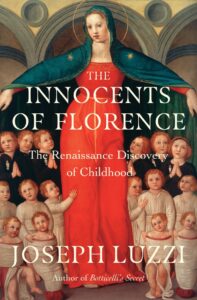
The Innocents of Florence: The Renaissance Discovery of Childhood by Joseph Luzzi is available from W.W. Norton & Company.
