
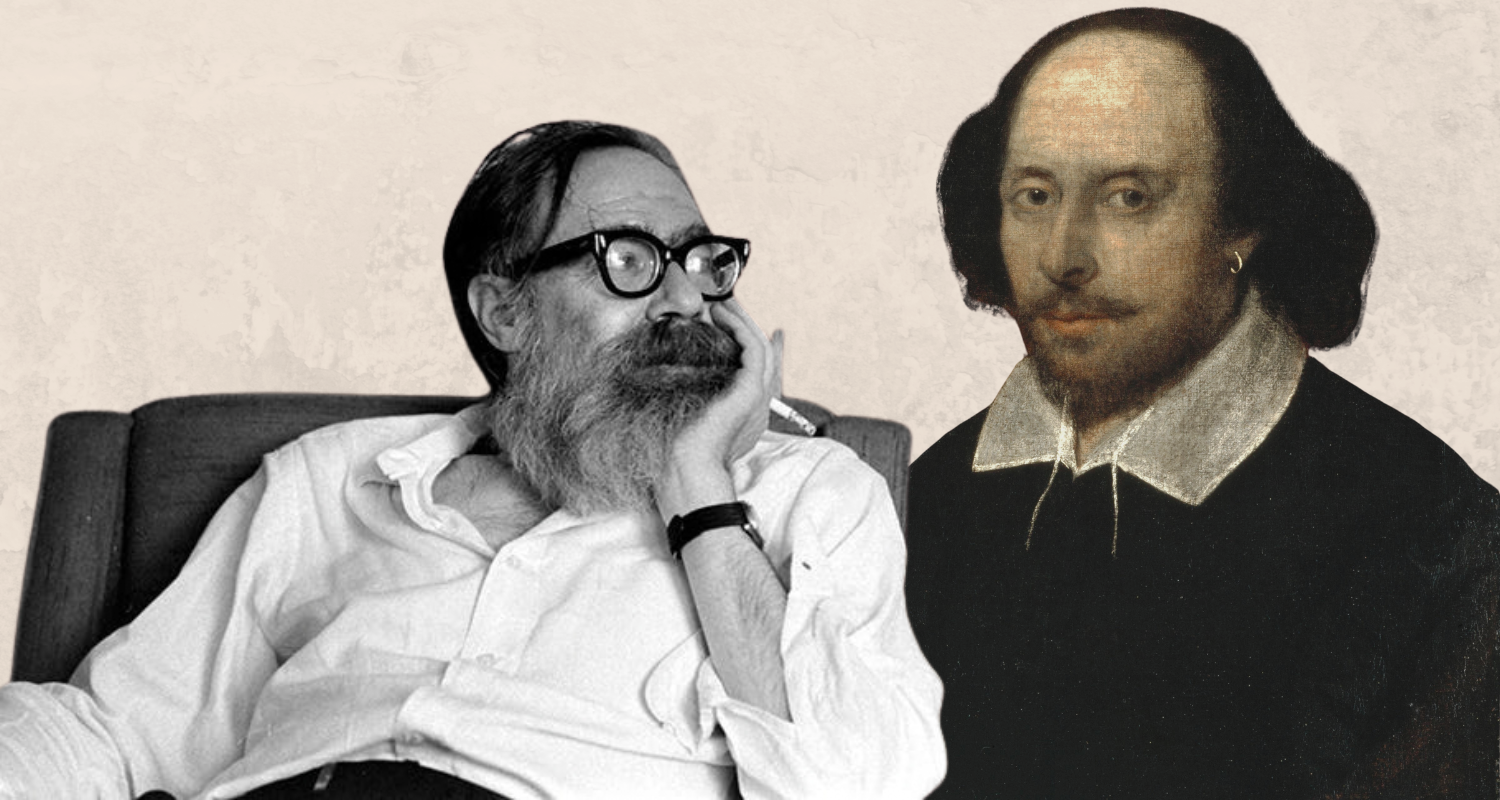
As John Berryman’s first marriage was unraveling, his attention turned to Shakespeare’s youth. It was the spring of 1951, and Berryman, then thirty-six, had not yet earned national recognition as a poet. Nevertheless, circumstances were improving. He had just received the Alfred Hodder Fellowship at Princeton University, a prize that provided both money and time to pursue multiple projects and to introduce himself and his work to a broader academic audience. While working on a play about the French revolutionary Mirabeau that he would not finish, he outlined another about treachery and carried on with a lengthy poem, Homage to Mistress Bradstreet, which would contribute to his growing reputation.
Yet the centerpiece of the fellowship, and the subject of the quartet of public lectures the fellowship required him to present, was a book he intended to write about Shakespeare. The success of these lectures carried significant weight, and his wife, Eileen, was keenly aware of the pressure her husband faced. The couple had moved back to the Princeton area after an unproductive three months at the University of Washington, where Eileen notes that John had repeatedly vowed to curb drinking and smoking but repeatedly failed. During those months, Berryman began studying Shakespeare with renewed, almost devotional focus. The first public lecture was scheduled for March 1951. Its title: “Shakespeare at Thirty.”
Berryman was a nervous public speaker, his hands betraying his jitters with tremors, and his shirts damp with perspiration. His choice of topic added to his anxiety. He had already produced a well-regarded biography of Stephen Crane, author of The Red Badge of Courage, but delivering a lecture on Shakespeare to a room full of Princeton faculty—many of whom questioned whether a man without a Ph.D. should tackle so revered a figure—was another matter entirely. Wearing a “grey flannel suit and shirt with button down collar,” Berryman approached the lectern and invited his audience to accompany him on a voyage of the imagination:
Imagine, with me, a time, a place, a man who has awakened, risen, washed, dressed, fed, and been congratulated, on a day in a late April long ago—perhaps April 22, 1594, a Monday—whether in London in some lodgings or at a friend’s or tavern, a small house in Stratford, a hundred miles by muddy roads to the northwest, or at Titchfield House a touch closer to the southwest, or elsewhere, but somewhere in England at the height of the northern Renaissance; a different world. He is thirty years old today, and the jolt from one decade to another is keenly felt by him alone in a single room, his intellectual and physical presence not yet visible to us, though we know his name.
Hardly a universal spectacle, this awakening is for Berryman a moment laden with personal recognition; he, too, had been a late bloomer of sorts, a “someone” growing into an influence after years in a more modest light. He, like Shakespeare, was an individual coming into his own, with a life that would soon be marked by both achievement and vulnerability.
Shakespeare had a long career…and for the first many of these years he little resembled the major canonical figure of English writing he becomes.
As the lecture drew to a close, Berryman noted that in 1594 “Shakespeare’s path has strangely cleared,” pointing to the deaths and retirements of his early playwright peers—John Lyly, Thomas Kyd, Christopher Marlowe—and suggesting that the next stage would lead into “the wilderness of dramatic literature, or garden, or palace, to be created in the six years coming:”
Richard II, 1 and 2 Henry IV, Henry V, King John, comedies of the Dream, the Merchant, the Shrew, Merry Wives, Much Ado, As You Like It, Twelfth Night, and Caesar; and beyond.
That catalog, remarkable in its breadth, points to a productive lull followed by a burst of creativity that would yield the great tragedies Hamlet, Othello, Macbeth, and King Lear, and later works such as Cymbeline, The Winter’s Tale, and The Tempest. Yet all of this lay beyond the precise moment in Shakespeare’s life captured by his thirtieth birthday. That particular story—the ascent to the pinnacle of his craft, the royal patronage, the comfortable life in Stratford, the later folio publication of his plays, and the enduring status of Shakespeare as a global cultural icon—was not yet knowable on that day; it was a narrative still to be told. And that is the story that would become widely known: Shakespeare’s rise, the flourishing of his troupe, the King’s patronage, a prosperous final phase, and the enduring prestige of his oeuvre—an achievement now perceived as beyond dispute.
To reckon Shakespeare’s contribution to knowledge is, of course, to reckon with all that he wrote. But Shakespeare’s career itself was unusually long, extending well beyond the span of many of his contemporaries, and for many of those early years he bore little resemblance to the canonical master he would become. He was, at that moment, a relatively obscure figure attempting to navigate his path.
The reality of Shakespeare’s April 1594 situation was far harsher than Berryman’s more celebratory portrait. London had been devastated by the plague since 1592, with plague mortality high enough to shutter the playhouses for twenty of the following twenty-two months. This outbreak was devastating in scale. At least fifteen thousand Londoners died in the ensuing twenty-four months, roughly ten percent of the city’s population. The fear of contagion posed a mortal threat to London’s nascent theater industry. When distancing measures restricted gatherings, those in the profession faced the loss of income and the peril of career collapse. For a young actor and dramatist with a young family, the plague could derail his entire vocation and force him to seek some alternative means of livelihood.
The plague’s greatest challenge was its unpredictability. The city’s wealthier residents often fled to the countryside, while the “middling sort,” to which Shakespeare belonged, stayed, supported by whatever aid they could procure at home. The poorest bore the brunt of the disease, crowded into cramped spaces where the contagion spread rapidly. London’s streets fell silent. Infected homes were marked, and entire families perished together, sometimes leaving bodies unburied for days. Thomas Dekker, a fellow dramatist, wrote of widows wringing their hands in grief and mothers swooning as their infants lay unresponsive in their arms. Such scenes were the stark reality of the moment. The volume of death meant that traditional burial rites were suspended, and mass graves outside the city walls became commonplace. The public understood little about contagion, but civic leaders sensed that closing venues could slow its spread. For Shakespeare, whose public theaters could hold thousands of spectators in close quarters, the closures represented not just hardship but a direct anxiety about survival. People learned to keep each other at a distance, and that fear would linger as long as the crisis persisted.
Biographers of Berryman, including Eileen, tend to describe the Shakespeare lectures as a turning point in his life. The first talk reportedly held his audience spellbound, and Princeton professors soon recognized him as a serious scholar with real command of his subject. Word of the event traveled across the Princeton campus and beyond, and his second lecture, a discussion of Macbeth, drew a capacity crowd. The four papers on Shakespeare helped establish Berryman’s reputation as a lecturer, and, more crucially, convinced him that he possessed real skill in public speaking. The experience also led to his appointment as the Elliston Chair of Poetry at the University of Cincinnati, where, for his inaugural address, he reprised the “Shakespeare at Thirty” lecture. Eileen notes that Berryman’s fame among Cincinnati’s literati rose rapidly; even she, who had once contemplated leaving him, found herself reassured by the turnaround. The couple then returned to Princeton, and other honors followed. A lecture on the potential of another poet-dramatist appears to have helped Berryman recognize his own.
What followed for Berryman is well trodden ground in literary biography. He would win the 1965 Pulitzer Prize for Poetry for 77 Dream Songs, drawing national and international attention as a major poetic voice of his generation. He would also be celebrated, in 1969, with both the National Book Award for Poetry and the Bollingen Prize for His Toy, His Dream, His Rest. Yet with success came its own pressures: a life marked by three marriages and struggles with substance abuse, a peripatetic existence moving among institutions, and a tragic end when he took his own life in January 1972, leaping from the Washington Avenue Bridge in Minneapolis, at fifty-seven.
Just over two decades earlier, Berryman had assessed Shakespeare’s prospects at thirty with cautious optimism about a future that seemed, in his view, to be clear of obstacles. He identified a path that opened beyond the moment, toward what lay ahead. He understood what Shakespeare would eventually achieve—an understanding we share—and he drew a line between what had come before and what was still to come. This capacity to see beyond the present is precisely what makes his meditation so compelling; it is a reminder that hindsight can illuminate, but it does not guarantee inevitability. To read retrospectively is to risk assuming that a certain outcome was always bound to unfold; life rarely conforms to such a neat logic.
Berryman knew what Shakespeare went on to achieve, as we do, and drew a line between that which went before and what was to come next.
Before the plague’s devastation in 1592, London’s theater scene was thriving, albeit in a setting that was still new, unsettled, and exposed to the fragility of the moment. The commercialization of theater in London began in earnest in 1576 with the opening of a dedicated playhouse, the Theatre, in Shoreditch, just north of the city. Other playing spaces quickly followed—the Curtain nearby in Shoreditch and the Rose across the River Thames in Southwark. It is crucial to stress how novel these permanent venues were. Although performance had long been part of English culture, the permanence of these theaters granted the enterprise a new legitimacy and cultural prestige.
If you had asked a Londoner in the summer of 1592 who the most famous dramatist of their day was, you would have named a number of writers who have since faded from memory: men such as Robert Wilson, John Lyly, Thomas Watson, Thomas Nashe, Anthony Munday, Robert Greene, Thomas Lodge, George Peele, and Thomas Kyd. You might recall Lyly’s witty comedies or Kyd’s chilling The Spanish Tragedy. You would hear about familiar plays such as The Three Ladies of London, Friar Bacon and Friar Bungay, and The Battle of Alcazar. Robert Greene stood out as a controversial figure, and the young Christopher Marlowe—whose success with Tamburlaine and Doctor Faustus had already won notice—also loomed large. If pressed on Shakespeare’s peers, one might mention someone named “Shakespeare,” a minor figure whose earlier contributions included fragments of hit histories and a controversial, sometimes violent, comedic piece set in Rome; a talent recognized by some, but not yet a leading light. A reader might recall the scorn of a pamphlet that mocked this “Shake-scene” as an “up-start crow.” Names like Ben Jonson or Thomas Middleton or John Webster would likely not have registered with many at the time.
The grand, book-length study Berryman had planned about Shakespeare never came to fruition. Yet the published lecture, “Shakespeare at Thirty,” remains a vivid and electrifying account of the best mid-twentieth-century criticism of Shakespeare’s early working life, filtered through Berryman’s own sensibilities as a poet observing a peer. His prose is scholarly and dense, and he insists on presenting an objective overview of the facts, even as his admiration for his subject often peeks through. He comments on the first-state Droeshout engraving in the 1623 First Folio: “There are faces that seem merely reserved. This one is almost ardent, though it maintains restraint. Proud without braggadocio, harmonious, formidable, yet in no way yielding up its subject.” He writes of Love’s Labour’s Lost that Shakespeare’s “playful, unflustered superiority” could irritate more dogmatic intellectuals, a remark that may have unsettled the members of Princeton’s venerable faculty.
Many elements of the outline that Berryman offers endure. Shakespeare was born in Stratford-upon-Avon, Warwickshire, in 1564. He wed Anne Hathaway in late 1582, at eighteen, and by the time he was in his twenties he had become involved in London’s theatrical world as an actor and playwright. By 1592, at twenty-eight, he had become so well known in dramatic circles that a cryptic reference to an “upstart crow” identified him in print. In 1593–94 his two narrative poems, Venus and Adonis and Lucrece, were published, and Shakespeare, as the dedicator, was first named in print as an author.
Sometime in 1594, most probably late in the year, he joined the Lord Chamberlain’s Men, the playing company, becoming their de facto house dramatist. These are the bare bones of the facts, plain and simple, but much remains to be filled in. Indeed, later generations of early modern scholarship would complicate and nuance Berryman’s brief portrait. Research into Shakespeare’s biography, social circles, and early modern Warwickshire and London contexts has since deepened our understanding of his early life and career, or at least the setting into which he was born, educated, married, and first launched his career. We are far better informed about when he wrote what, with whom he worked, and the companies and audiences with which his works may plausibly be associated. The subject is no longer something that fits into a single essay.
______________________________
From Shakespeare at Thirty by Rory Loughnane. Copyright © 2026. Available from Princeton University Press.
