
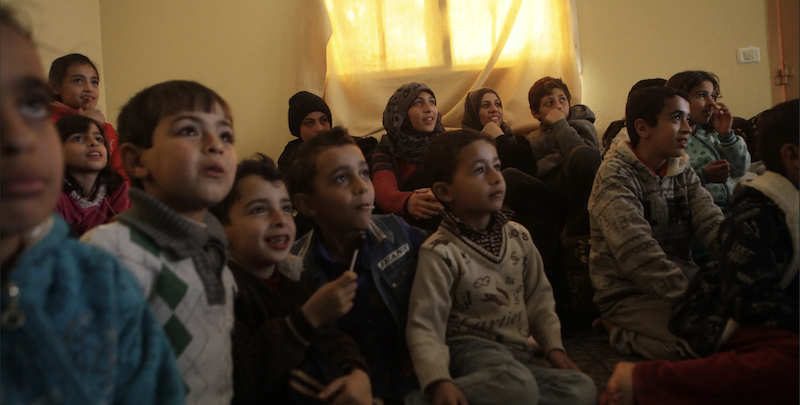
Even before the war, cinema was never really a part of everyday life in Gaza. Most movie theaters disappeared decades ago and the culture of cinemagoing has faded from the lives of the younger generations. But this war has taken far more from children than just the few remaining movie theaters. They have lost schools, libraries, parks, football pitches—all of the places where kids are supposed to be able to experience the world without fear.
Since the beginning of the genocide, the majority of Gaza’s cultural centers have been heavily damaged or destroyed entirely. Artistic and educational programs that once provided an outlet for young people have largely ground to a halt. Education has also been heavily disrupted. Most schools have been destroyed, while the ones that remain standing have been turned into shelters for displaced people. Hundreds of thousands of children have been out of school for almost three years. Against this backdrop, small initiatives have begun to bring back some semblance of normal life. One of them is Haws Cinema, the passion project of sisters Shaimaa and Safaa Dhabban.
“We started by removing the rubble that had blocked the path to the cinema. It took months, and we did it by hand because we couldn’t get heavy machinery.”
Big projects often begin with small ideas. The idea for Haws Cinema arose from an old family habit. Shaimaa says that she and her sister have always loved animated movies, and would sit down to watch them together every day after school when they were younger. With Gaza’s children living through an unprecedented period of isolation and terror, Shaimaa and Safaa wondered if that passion could be shared. “The idea was to take this experience to a bigger space,” she tells me. “We wanted to do something different and share our experience of cinema with the children of Gaza.”
The sisters’ backgrounds also shaped the project. Shaimaa graduated with a degree in information technology and had worked as a graphic designer before the war. Safaa studied English and translation in college, and had been translating films and television for fun since she was 16. She ran an online business selling Korean food. Now, she is raising twin daughters on her own, following the loss of her husband in the early days of the conflict. For the sisters, the project is both a labor of love and a way to generate a crucial income, but its main aim is to offer children a space that feels unlike their usual surroundings, a refuge from the roar of aircraft and the endless news of war.
“Our first task had nothing to do with a projector or sound system,” Safaa recalls. “We started by clearing the rubble that had blocked the path to the cinema. It took months, and we did it by hand because we couldn’t get heavy machinery.”
A small idea sometimes leads to a larger undertaking. The concept for Haws Cinema grew out of a family tradition. Shaimaa notes that she and her sister have always loved animated films and would sit down to watch them every day after school when they were younger. Facing Gaza’s children living through a moment of extreme isolation and fear, they wondered if that simple joy could be shared more broadly. “The plan was to extend this experience into a bigger space,&#rdquo; she explains. “We wanted to do something different and to share our cinema experience with Gaza’s children.”
Their professional paths also influenced the project. Shaimaa, with a background in information technology, had worked as a graphic designer before the war. Safaa, who studied English and translation, had been translating films and shows for fun since she was a teenager and had run an online business selling Korean cuisine. Today she is raising twin daughters, largely on her own, after her husband was killed in the conflict. For them, the venture is a mixture of devotion and a means to earn an essential income, yet its principal goal remains to offer children a space that feels removed from the daily nightmare—a space where they can briefly escape the thunder of war.
“Our first task had nothing to do with a projector or sound system,” Safaa recalls. “We started by clearing the rubble that had blocked the path to the cinema. It took months, and we did it by hand because we couldn’t get heavy machinery.”
Access to electricity proved to be a constant obstacle. They considered solar power but it was beyond their means. They switched to a generator, yet its supply often faltered. They eventually obtained a backup generator, but it required fuel, which had become scarce and costly. The region also suffers from limited internet connectivity since infrastructure was destroyed. “I stay up all night trying to download films,” Safaa says. “The internet keeps cutting out.”
For children who have survived one of the most brutal wars imaginable, choosing an appropriate film is of the utmost importance.
Preparing the screening room presented another hurdle. The sisters had to enclose the space with tarps, fabrics, and metal sheets to create a dim, cinema-like atmosphere. These basic materials are now extremely pricey because strict curbs on the entry of raw materials into Gaza restrict supplies. “We spent a lot of money preparing very simple things for the cinema,” Safaa notes. “It’s a continual strain on our resources and jeopardizes our ability to keep going.” Even after the venue opened, substantial difficulties persisted.
“The shelling hasn’t stopped,” Shaimaa says. “Each attack damages the space and the equipment.”
For children who have endured one of the most brutal wars imaginable, selecting the right film is crucial. The correct choice can help mitigate trauma, while the wrong one risks reactivating it.
“We make a point of choosing entertaining films that avoid violence,” Shaimaa says.
She notes that they screen every film in its entirety beforehand to ensure suitability. This may sound straightforward, but it reflects the project’s guiding principle. The aim isn’t merely to occupy children, but to bolster their emotional health. The sisters recognize that Gaza’s youngsters do not need more of what they have already endured. They need a glimpse of another world, even if that world exists only in imagination. After screenings, conversations about the films often continue—in person and online—with children and parents sending the sisters film recommendations via social media. Over time, a trip to Haws Cinema has become an interactive experience that blends entertainment with learning. During screenings, Shaimaa watches the youngsters closely, noting their expressions and reactions.
“When we see the effect a film has on their faces, we know that we have managed, even if only briefly, to lift the war from their imaginations.”
Safaa says that while many people have started attending screenings, Gaza’s economy is so dire that numerous families cannot afford even the cheapest tickets. Widespread unemployment and the collapse of household incomes make any extra expense a heavy burden. Deterioration in transportation infrastructure has also kept many children away. Despite all of this, the sisters remain convinced that spaces where children can play and unwind are as essential as any wartime necessity. Haws Cinema provides a rare chance for Gaza’s children. For many, televisions are out of reach because most homes have been destroyed. Even when a working set exists, there is frequently no power to run it.
Shaimaa recalls a solitary child who bought two tickets for a screening. When asked why, he replied: “One is for me, and the other is for my brother who was killed.”
The way the children react to the big screen speaks to what that loss truly means. Safaa recalls a boy who told her he wished he could take the cinema screen back to his tent so he could enjoy it for as long as possible. Then he realized that it wouldn’t work. “The tent is barely big enough for his family.”
Another girl told her: “I had a small phone that I used to watch videos and films, but the screen broke, and my father could not afford to repair it. I came to the cinema to watch the films I like.”
Shaimaa remembers a lone child who bought two tickets to a screening. When she asked him why, he said: “One is for me, and the other is for my brother who was killed. We used to watch movies together, and I don’t want to watch the film alone.”
The future that Shaimaa and Safaa imagine extends beyond keeping current screenings going. They aspire to establish a true cinema for Gaza’s children—a venue that could become a lasting facet of the city’s cultural life after the war, a place where youngsters can gather and escape the images of destruction that surround them.
“If a child has lost someone close to them,” says Shaimaa, “the least we can do is let them watch a movie in a cinema where they can’t hear the sounds of war. For a moment, a film can make them feel that life will go on.”
The true meaning of Haws Cinema becomes evident only when the film ends and the children return to their tents, shelters, and damaged homes. The war remains. Nothing beyond the cinema changes. But for about ninety minutes, they have shared a communal experience with other kids, laughed together, and followed a story that has nothing to do with the devastation surrounding them.
Haws cannot repair the reality these children face. It cannot rebuild a school, restore a home, or bring back a loved one. Yet it can grant them a few hours in which their lives are not dominated by war.
For Shaimaa and Safaa, that is enough to keep moving forward.
