
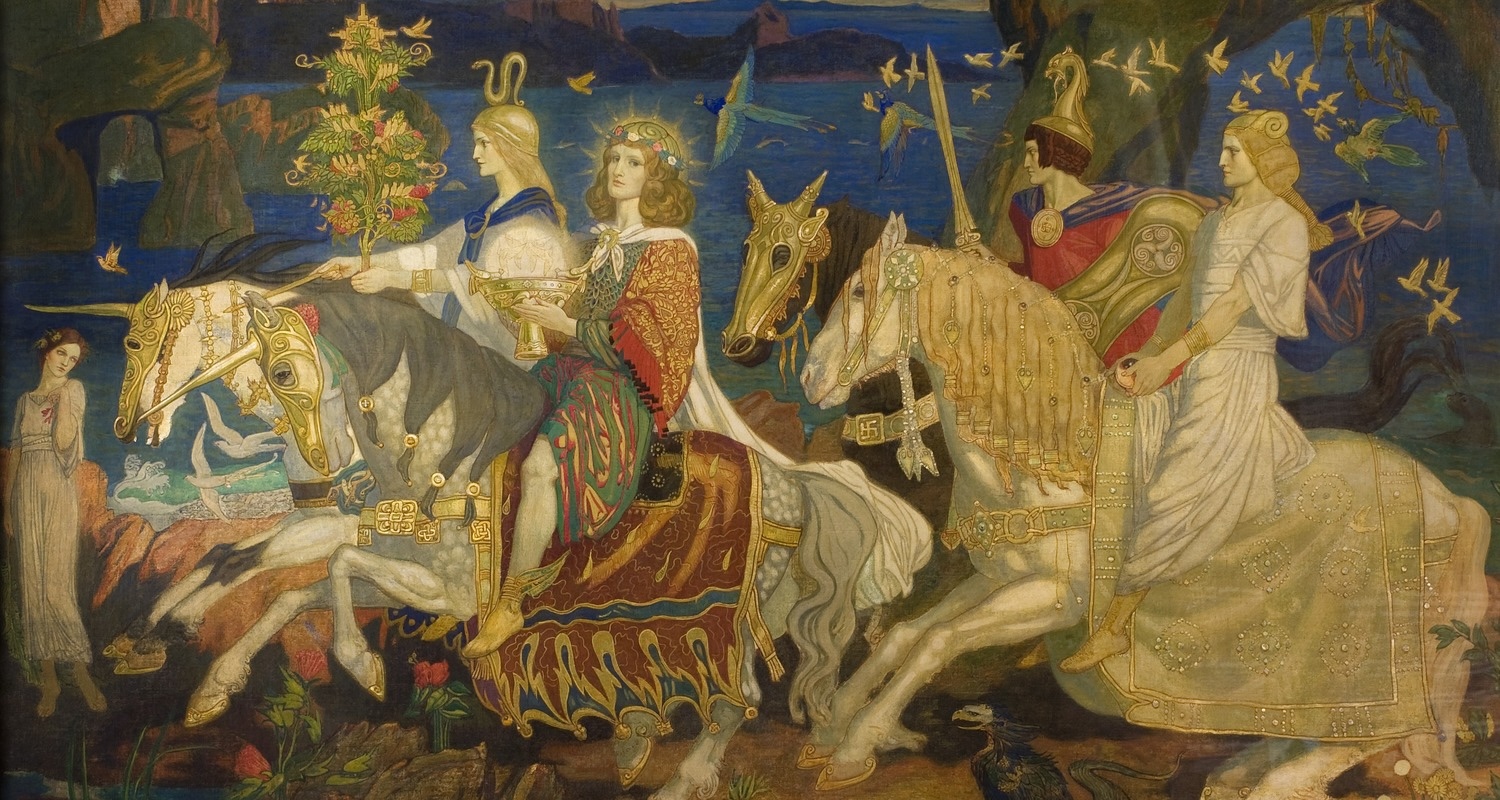
In mythic lore, the aes sidhe are celebrated for an almost unbelievable level of physical perfection—their hair, their forms, their outfits (to the point where one tale even claims flawless knees)—and as with the elves, that beauty frequently folds into a lure that’s more alluring than merely pretty. Among the male aes sidhe, it’s common for them to have affairs with mortal women: Lugh and another renowned aes sidhe, Manannan, both sire children with human women, and in Manannan’s case, he explicitly notes (to a group of complete strangers who perhaps felt they didn’t need to know) that this occurred through “vigorous sex.”
Female aes sidhe are equally capable of intense sexuality: even the Sovereignty of Ireland, a somewhat pale figure in The Phantom’s Vision, can be surprisingly assertive. In one tale, The Adventure of the Sons of Eochaid Mugmedon, five royal brothers encounter a hideous old woman by a well who tells them that to draw water they must kiss her. The first three refuse and gain nothing; the fourth complies, and she declares that his line will govern Ireland; the fifth, youngest brother, decides to go all in and has intercourse with her, at which point she transforms into a stunning woman and informs him that he shall be king—a sovereignty goddess trading kingship for sexual favors (and also displaying the aes sidhe’s capacity for shapeshifting).
Yet not every dalliance with these otherworldly women leads to a crown. As with the elves, yielding to temptation can invite peril. In one tale, Conn himself weds a woman of the aes sidhe named Becuma, and thanks to Becuma’s schemes, famine ravages all of Ireland: only after Conn sends Becuma away is the balance restored. By contrast, resisting the temptations of an aes sidhe woman could also invite danger: when the hero Cú Chulainn rejects the aes sidhe Morrigan in a narrative called The Cattle Raid of Cooley, she begins shapeshifting into various animals to try to entrap him or trip him up during combat.
The Otherworlds are just like the aes sidhe themselves, beautiful and beguiling and full of wondrous magic, but to be feared and avoided nonetheless.
Moreover, Morrigan signals another dimension of the aes sidhe that resonates with the elves, mares, and valkyries: female aes sidhe rarely conform to gender norms—they are dominant, choose their male lovers, and often drive the central plots of the tales (especially in the realm of the Otherworlds). Morrigan herself is a tremendously powerful figure, a figure who would have sat well among any band of valkyries: she is savage, blood-drenched, and in some legends she even foresees battles and deaths. It’s notable as well that the Sovereignty of Ireland in The Phantom’s Vision sometimes carries a prophetic edge, and Morrigan is occasionally depicted as three sisters rather than a single entity: had they taken up spinning, they might have been indistinguishable from valkyries, norns, and disir.
*
This does not imply that aes sidhe and the elves (and their related beings) originate from a common source, but their likenesses inevitably led to overlapping narratives (which in turn pulled them nearer together). In the Irish myth The Sickness of Cú Chulainn, for instance, the hero shoots down two beautiful white birds, unaware that they are aes sidhe in disguise. He falls asleep and then experiences a dream assault by two women—the birds in human form—who beat him with horsewhips until he is nearly dead. The resonance with the Icelandic myth of Vanlandi, where a mare’s death in a dream occurs at the urging of two women (and where horsewhips feature in Conn Chulainn’s dream violence), is immediately striking.
But there was a crucial boundary that kept the aes sidhe distinct from the elves in those early periods: they had a homeland, an Otherworld. While Lugh might have conjured his Otherworld from his own shadow, in most narratives mortal heroes are carried into the Otherworld by female aes sidhe, who, despite occasional references to some unseen king, appear to govern these realms, which tend to be populated largely by women. Moreover, these Otherworlds are anchored within real places—inside burial mounds.
*
The Mound of the Hostages does not look vast enough to house an entire Otherworld—it could perhaps hold a small Other-studio-flat. Yet the Otherworlds were often far grander than the mounds themselves—palaces the size of a city block, or even an entire island—and while entry was sometimes gained by stepping through the dark doorway beneath a mound, other times it involved crossing mists (as with Conn) or sailing across seas. Nevertheless, they were conceived as being tucked within the mounds themselves, real-world anchors for these strange, marvelous realms. Access to these realms was not universal; sometimes one needed an invitation, sometimes a voyage, and sometimes the timing had to be right: Samhain (November 1) was a day when the mounds were especially prone to open and the aes sidhe ventured abroad.
At first glance, it might seem that people would be queuing at the mounds every Samhain, for the Otherworlds appear as paradises of wonder. They are imagined as places of great delight: music, magically replenishing food, trees that flower and fruit together, heaps of treasure, crystals that rain from the sky, perpetual health and happiness. In one Otherworld, a wandering hero discovers a crystal pavilion filled with endless vats of inexhaustible food; in another there is nothing but truth—no aging, no decay, no sadness, no envy, no hatred, no arrogance. Free love flourishes in these Otherworlds: Otherworld women frequently lie with visiting mortal heroes, and inhabitants mingle with one another as well, described as lying with each other under bushes. These Otherworlds bear names that reflect their wonders—Mag Mell (the Plain of Delights); Tir na mBeó (the Land of the Living Ones); Tir na nÓg (the Land of the Young); Tir na nlngnad (the Land of Wonders).
Yet despite all their splendor, Conn was right to fear the Otherworlds. He might have returned unharmed, but one of his sons, Connlae, did not fare so well. The tale The Adventure of Connlae, like The Phantom’s Vision, is likely from the eighth century and describes how a beautiful aes sidhe woman approaches Connlae, confesses her love, and asks him to accompany her to her homeland—a realm inside a burial mound, a place “without death, nor want, nor sin,” where a “perpetual feast” awaits and where one could live forever in ageless, deathless joy. It isn’t explicitly stated why she wants Connlae to come, but he is described as handsome, and the implication is that she desires him as a lover. Conn overhears the exchange and pleads with the court druid to ward off this “treacherous attack” threatening to snatch his son away. The druid begins chanting, forcing the woman to depart, but as she leaves she throws Connlae a magic apple that reconstitutes itself after every bite. After this encounter, Connlae remains alive but sustains himself only on the magic fruit, living for a month without other sustenance.
…Longing then seized Connlae for the appearance of the woman that he had seen.
And when that month ends, the woman returns, this time aboard a splendid crystal boat, again inviting him to join her (and adding a detail about her homeland: a world populated entirely by women). Connlae agrees to go, though he confesses some hesitation, saying:
It is not easy for me, besides I love my people. Yet longing for the woman has seized me.
And so he boards the woman’s crystal vessel, his grieving kin and father watching as he vanishes from sight, never to be seen again.
There is something profoundly haunting about this narrative—an impression that Connlae did not truly wish to depart, that he perhaps ought to have resisted the lure of the Otherworldly woman. Anyone listening to this tale in eighth-century Ireland would recognize that if Connlae ever regretted his decision, returning home would prove exceedingly difficult, a notion echoed in another early Irish text (and a near-contemporary of The Adventure of Connlae), The Voyage of Bran.
The aes sidhe were very clearly associated with the divine. In eighth-century myths the aes sidhe are literally called the tribe of the gods.
Similarly, Bran—the king rather than the king’s son—encounters a lovely unnamed aes sidhe woman who entices him to her Otherworld, the land of Emain, an island inhabited entirely by women and filled with endless joy, beauty, crystals, everlasting blossoms and fruit, and all the familiar signs of Otherworldly paradise. Unlike Connlae’s guide, this woman does not transport Bran herself; she leaves him with directions, and he sets sail with a crew of thirty men.
The first island they reach is not the woman’s own paradise but a place called The Isle of Joy, where the shore is crowded with people laughing. One of Bran’s men goes ashore to greet them, but when he looks back at the boats and his companions, he bursts into laughter and cannot answer the calls to return. Bran cannot risk losing more men and must leave his comrade behind, laughing manically on the far shore. It’s a grim scene—and it undercuts the claim that Emain is a place “without grief,” overflowing with happiness and mirth. How and why everyone on Emain is so “happy” remains a mystery; perhaps this is why Bran never disembarks, even when he glimpses the beautiful woman who summoned him. She tosses him a ball of yarn, which he catches, and as he touches it the ball clings to his hand and she pulls him inward.
His destination is truly breathtaking, and Bran and his men remain there for a year, savoring every pleasure and indulging in the company of all the Otherworld’s women. Yet homesickness eventually returns, and the travellers are permitted to depart—but with a warning not to set foot on mortal soil. When they eventually reach Ireland, Bran announces himself to a sentinel, but the guard replies, “We do not know such a one,” adding, “though the Voyage of Bran is one of our ancient stories.”
Though only a year has passed in the Otherworld, centuries pass on earth. The voyage turns fatal when one of Bran’s men lands ashore and immediately collapses into dust—the time-burden collapsing upon him the moment his feet touch mortal ground. Bran and his companions can never return home. They tell their tale to the man on the shore and then vanish into the sea, never to be seen again.
The Otherworlds are every bit as alluring as the aes sidhe themselves—beautiful, seductive, and pulsing with magic—yet they must be avoided, for they harbor danger as well as delight. If an aes sidhe appeared beside the crooked doorway of the Mound of the Hostages, inviting you to slip inside, it would not be wise to follow.
*
These stories rank among the oldest written literature we have from Ireland, which prompts the question of their origin. Taken literally, the legends that survive were probably penned in Irish monasteries. By the end of the seventh century, Ireland was largely Christianized, and by the eighth century, when these myths were being transcribed, monasteries stood as the country’s major cultural, artistic, and literary hubs. A piece of writing from eighth-century Ireland almost certainly comes from a monastery. Another hint that the aes sidhe legends might have been crafted in a monastic setting is that, despite their wild enchantments, the tales sit within an extremely learned Christian framework: there are frequent references to Christ’s coming, the arrival of Christianity in Ireland is openly foretold, and many legends cite the works of renowned Christian scholars (there are some real treats for Isidore of Seville enthusiasts).
Yet, even if the monasteries were the printers of these stories, they did not create them in a vacuum. There is ample evidence that the aes sidhe of the eighth century and beyond sprang from older traditions—the monks who wrote them down were likely adding their own shaping strokes, but they were not inventing them from scratch. They wove together ancient legends with Christian beliefs, which is precisely the unusual blend of pagan Irish myth and Christianity that brings me to Tara on this particular morning.
*
On the hillside a small company has gathered with me in the pre-dawn chill—a dog walker, a couple visiting from Dublin, a group of giggling teenage girls. The dog walker, a local, says she has been coming here on these mornings since the pandemic—she doesn’t feel drawn to paganism or Christianity, but she finds the long history of the site grounding. The couple are exploring all the area’s Neolithic sites, and since their itinerary aligned with today, they joined us. We form a peculiar little circle, shivering in the icy winter wind, as we watch the Mound of the Hostages, once gray-black, turn a vivid green; the horizon catches fire as the red glow of clouds blooms brighter and brighter, until the whole eastern sky seems to burn.
Then the sun clears the horizon, and in an instant the silhouettes sharpen into crisp lines. At the same moment the mound’s entrance bathes in sunlight, the light pouring through its irregular opening and filling the tunnel with both shadow and light—an effect the sunrise has produced for five millennia on February 1, a date that intersects with the dawn of Imbolc.
Whether the builders deliberately aligned the tomb to this particular sunrise, or to the November 1 dawn of Samhain, remains uncertain; Ireland has many passage tombs, but only two align in this way, so it could be coincidence. Nonetheless, Irish legends assign significance to both dates: November 1 marks Samhain, while February 1 marks Imbolc—the first day of spring. Imbolc is referenced in a tenth-century tale, The Wooing of Emir, and in Cormac’s Glossary, a ninth-century work containing explanations of roughly 14,000 Irish words.
There is no explicit explanation for the origin of this festival, but from the seventh century onward February 1 and Imbolc became associated with Saint Brigid’s Day. Brigid—patron saint of poetry and lambing—was said to have lived in Ireland in the late fifth century. Yet Brigid also appears repeatedly in early Irish myths as a member of the aes sidhe. And there is a third portrayal of Brigid as well: according to Cormac’s Glossary, Brigid is a “goddess, whom the poets adored, because very great and very famous was her protecting care.”
Thus, like the elves, the aes sidhe are closely tied to the divine. In eighth-century myths they are literally described as the tribe of the gods, and there is also a seventh-century tale about Patrick’s life that touches on the aes sidhe.
_______________________________
Excerpted from Perilous Enchantment: The True History of Faeries by Sarah Clegg. Copyright © 2026 by Sarah Clegg. Reprinted by permission of Atria Books, an Imprint of Simon & Schuster, LLC.
